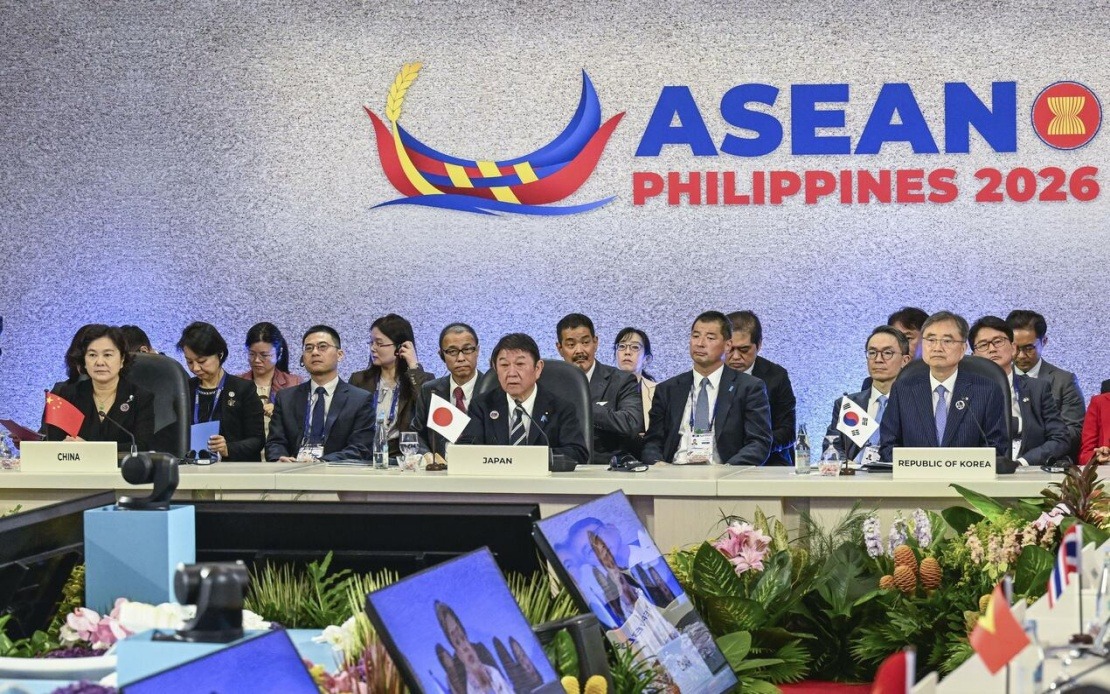
Japan has signalled its intention to deepen regional partnerships on critical infrastructure and digital security, pledging concrete cooperation with ASEAN member states, China and South Korea during high-level ministerial discussions held in Manila. Japanese Foreign Minister Toshimitsu Motegi used the gathering to outline Tokyo's strategic priorities, focusing particularly on fortifying energy networks across Southeast Asia and addressing the rising threat of internet-based financial fraud that has become an increasingly pressing concern throughout the region.
The meeting brought together foreign ministers from the ten ASEAN nations alongside representatives from Japan, South Korea and China—a configuration known as the ASEAN-plus-three grouping. While South Korea's Foreign Minister Cho Hyun attended in person, China's representation came through Vice Foreign Minister Hua Chunying, stepping in for Foreign Minister Wang Yi. The diplomatic gathering underscored the enduring relevance of this multilateral framework, which has served as a crucial platform for regional dialogue and practical cooperation for over two decades.
Motegi emphasised the substantial economic weight that the ASEAN-plus-three bloc now carries on the world stage, noting that their combined Gross Domestic Product exceeds one quarter of global economic output. This economic heft translates into considerable influence over regional and global trajectories, making the grouping's collective decisions on matters ranging from trade to security increasingly consequential. For Southeast Asian nations, this recognition of ASEAN's centrality in regional affairs carries symbolic importance, affirming the bloc's leadership role in shaping the region's future direction.
Japan's diplomatic messaging prioritised alignment with ASEAN's own strategic vision, particularly the ASEAN Outlook on the Indo-Pacific initiative. Motegi reaffirmed Tokyo's support for ASEAN unity and centrality while drawing parallels between Japan's longstanding free and open Indo-Pacific concept and AOIP's foundational principles. This convergence of visions reflects a broader Japanese strategy to position itself as a reliable partner that respects ASEAN's agenda-setting authority rather than seeking to impose external frameworks. The emphasis on coordinating through the ASEAN-plus-three mechanism signals Japan's preference for working within established multilateral structures rather than pursuing bilateral arrangements.
Energy security emerged as a paramount concern among the participating nations, with ministers highlighting the vulnerability of regional supply chains in light of geopolitical tensions in West Asia. The Middle East remains a critical source of energy imports for many Southeast Asian economies, and disruptions there reverberate quickly across the region. Japan, dependent on imported energy for its industrial base, shares a vested interest with ASEAN in ensuring stable and diversified energy supplies. The ministerial discussions centred on strengthening the resilience of energy networks—a challenge that requires coordinated investment in infrastructure, technology transfer and strategic reserves.
The cybercrime agenda reflects a shared vulnerability among the ASEAN-plus-three nations, as online scams have escalated dramatically in recent years, costing individuals and businesses billions of dollars across the region. Criminal networks operating from multiple countries have become increasingly sophisticated, exploiting digital payment systems and social engineering tactics. Japan's push for greater cooperation recognises that addressing this transnational threat requires intelligence-sharing, harmonised regulatory approaches and capacity-building support for less-resourced law enforcement agencies. For Malaysia and other ASEAN economies grappling with rising cybercrime losses, Japanese collaboration could prove valuable in developing detection and prevention systems.
The ASEAN-plus-three framework itself carries historical significance as a product of the 1997 Asian financial crisis, when regional leaders recognised the need for structured dialogue beyond formal ASEAN mechanisms. Nearly three decades later, the grouping continues to serve as an incubator for practical cooperation on issues that transcend individual national boundaries. Energy security, cybercrime prevention and economic resilience naturally fall within this cooperative remit, as no single nation can effectively address these challenges in isolation.
Motegi's subsequent bilateral meeting with newly appointed British Foreign Secretary Ed Miliband demonstrated Japan's broader engagement strategy, signalling Tokyo's intention to strengthen partnerships with Western allies on global security matters. The reference to Prime Minister Andy Burnham's administration, however, appears to contain an inaccuracy regarding UK political leadership at the time. Regardless, the meeting illustrated Japan's balancing act—maintaining robust ties within the Asian region while simultaneously deepening partnerships with traditional Western allies. This dual engagement approach has become central to Japan's geopolitical strategy, particularly as tensions in the Indo-Pacific intensify.
For Malaysia and the broader ASEAN region, Japan's reaffirmed commitment to energy cooperation and cybersecurity collaboration holds concrete implications. Japanese expertise in renewable energy technology and cybersecurity infrastructure could accelerate Southeast Asia's energy transition while strengthening digital defences. The ASEAN-plus-three framework provides a structured channel through which these benefits can be distributed relatively equitably across member states. Additionally, Japan's explicit support for ASEAN centrality and the AOIP reinforces the bloc's positioning as the driver of regional diplomatic agendas, a principle that Malaysia and other ASEAN nations have consistently championed.
The gathering also reflected the complex regional dynamics whereby countries maintain cooperative relationships even as geopolitical tensions simmer beneath the surface. Japan's willingness to work closely with China on regional issues through the ASEAN-plus-three mechanism suggests that despite bilateral tensions, Tokyo recognises the necessity of structured dialogue and practical cooperation. Similarly, ASEAN's continued engagement with both Japan and China demonstrates the bloc's commitment to maintaining balanced relationships and avoiding forced alignment, a cornerstone of ASEAN's diplomatic tradition.
Looking forward, the energy and cybercrime initiatives outlined at the Manila meeting will likely spawn working groups and technical committees tasked with developing concrete implementation mechanisms. These structures will determine whether ministerial-level pledges translate into tangible improvements in regional energy resilience and digital security. The success of such initiatives ultimately depends on sustained political commitment, adequate funding and genuine knowledge-sharing among participating nations. For Southeast Asian economies navigating complex global challenges, the ASEAN-plus-three framework offers a valuable multilateral space where regional interests can be advanced through coordinated action.

