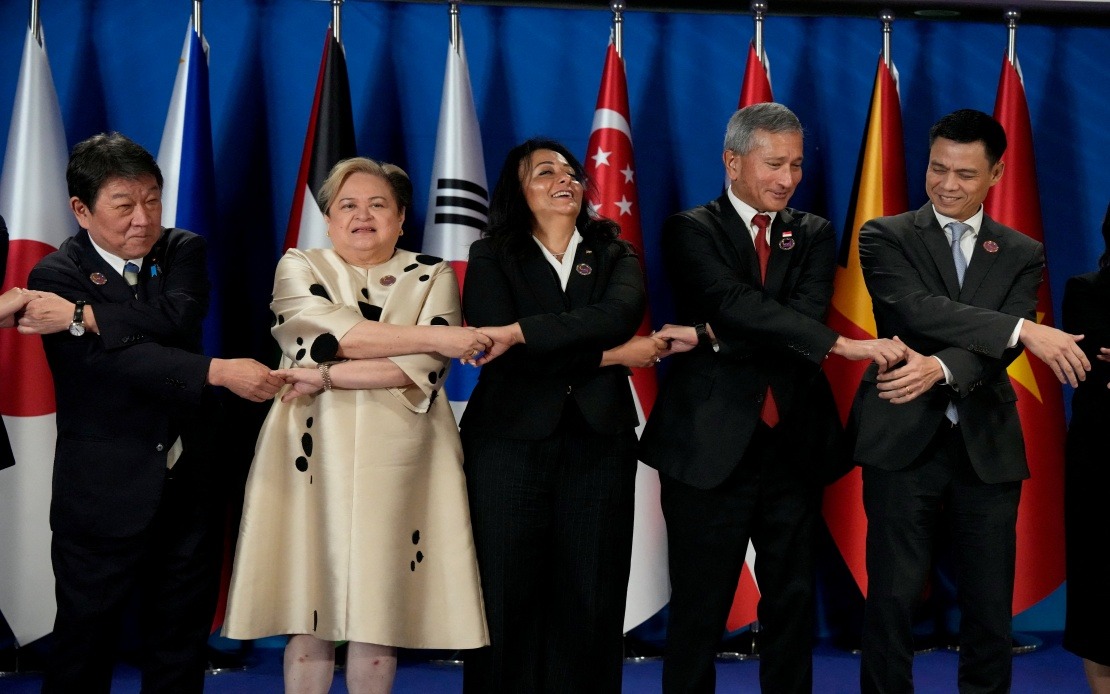
Four major Asia-Pacific democracies have reaffirmed their commitment to ASEAN partnership while grappling with shared concerns over technological disruption, economic instability, and escalating regional tensions. During Post-Ministerial Conferences held in Manila on Wednesday, foreign ministers from Japan, South Korea, Australia and New Zealand each underscored the importance of maintaining multilateral cooperation as the regional order faces unprecedented pressure from competing strategic interests and rapid global change.
Japanese Foreign Minister Toshimitsu Motegi positioned his country as a steadfast supporter of ASEAN's institutional role, emphasising Japan's readiness to expand engagement in domains where both sides possess complementary strengths and shared aspirations. His remarks specifically flagged three priority areas: the digital economy, artificial intelligence capabilities, and the green energy transition. By aligning these future-oriented initiatives with ASEAN's development agenda, Japan seeks to deepen integration while addressing the urgent challenge of climate change that affects the entire region.
South Korea's Foreign Minister Cho Hyun articulated a more cautious assessment of the contemporary strategic environment, identifying three destabilising forces reshaping Asia-Pacific dynamics. Global supply chain disruptions—a legacy of the pandemic and geopolitical fragmentation—continue to threaten economic growth and business confidence. Simultaneously, mounting volatility in West Asia, from maritime tensions to proxy conflicts, reverberates through regional calculations. Technological change, while offering enormous potential for prosperity, simultaneously generates anxiety about labour displacement and security vulnerabilities. Cho framed ASEAN solidarity as the essential counterweight to this turbulence, arguing that collective coordination expands strategic autonomy for all member states.
Seoul has begun translating this rhetorical commitment into concrete cooperation mechanisms. Two initiatives deserve particular attention: an artificial intelligence companionship programme, which suggests innovation in social applications of AI technology, and a cultural and creative industries initiative designed to tap the region's enormous soft power potential. These ventures reflect South Korea's own strengths in technology and entertainment sectors while offering tangible benefits to ASEAN partners seeking to nurture high-value creative economies.
New Zealand's Foreign Minister Winston Peters delivered a similarly comprehensive diagnosis of regional challenges, cataloguing renewed great-power competition, erosion of multilateral governance frameworks, AI governance uncertainties, and climate impacts as defining concerns for the coming years. His emphasis on partnership as a foundational strategy suggests Wellington views regional stability as directly connected to New Zealand's own security and prosperity. By investing in ASEAN relationships, Wellington hedges against a future of unilateral great-power dominance or institutional collapse in Southeast Asia.
Australian Foreign Minister Penny Wong offered perhaps the most geopolitically explicit assessment, describing the past year as materially reshaping strategic calculations. She identified escalation risks and miscalculation hazards as immediate threats, warning that unfolding consequences of Middle Eastern upheaval, regional tensions, and global economic shocks continue reverberating through critical infrastructure sectors. Her reference to impacts on food and energy security, fertiliser supplies, and manufacturing inputs underscores how interconnected modern economies remain—and how vulnerable they are to distant disruptions.
Canberra's response strategy combines rhetorical backing for ASEAN centrality with material support for specific resilience-building projects. The Australian government has committed to backing ASEAN-led infrastructure initiatives, most notably the ASEAN Power Grid and the Digital Economy Framework Agreement. These projects possess concrete significance: the power grid would diversify energy sourcing and reduce individual member vulnerabilities to supply shocks, while a digital framework would harmonise commercial regulation and foster cross-border digital services trade. Both initiatives directly serve Malaysia's own economic interests.
Wong's characterisation of ASEAN's role illuminates why these external powers invest such diplomatic energy in Southeast Asia. She argued that ASEAN constitutes the region's geopolitical centre—the institution that mediates between competing powers, establishes regional norms, and fosters coordinated responses to shared challenges. Without a functional, authoritative ASEAN architecture, the region risks fragmentation into competing spheres of influence or bilateral power hierarchies favourable to the largest players. From the Australian perspective, a strong ASEAN preserves strategic space for middle powers and smaller nations while maintaining open, rules-based approaches to regional governance.
For Malaysian policymakers and business leaders, these ministerial positions carry significant implications. The emphasis on digital transformation and AI development aligns with Malaysia's own aspirations to upgrade technological capacity and compete in high-value sectors. The supply chain resilience discussion reflects Malaysia's vulnerability as a trade-dependent economy—disruptions anywhere in global networks impose immediate costs. The security concerns articulated by all four nations, while expressed diplomatically, reflect anxiety about power projection and political coercion in the region.
Furthermore, the ministerial statements reveal a shared analytical framework among major democracies regarding Asia-Pacific futures. All four nations privileged multilateral, rule-based cooperation over bilateral dominance. All identified technological change as simultaneously opportunity and risk. All emphasised ASEAN's central institutional role while pledging continued partnership. This consensus, though not explicitly directed against any specific actor, implicitly counters a vision of regional order defined by hierarchical great-power management.
The convergence of external support for ASEAN centrality creates both opportunities and pressures for Southeast Asian nations. External backing strengthens ASEAN's bargaining position in interactions with larger powers, but acceptance of partnership commitments may constrain strategic autonomy. Malaysia must navigate these dynamics carefully, extracting maximum benefit from great-power competition for ASEAN favour while preserving genuine institutional independence and flexibility in responding to regional developments.
Looking forward, the success of these cooperative initiatives depends on translating high-level political commitments into functioning institutional mechanisms. The power grid and digital framework require sustained technical cooperation, regulatory harmonisation, and investment coordination across disparate national systems. Similarly, AI governance initiatives require agreement on technical standards, ethical frameworks, and commercial rules despite differing national approaches to technology regulation. ASEAN member states will need to balance external partnership with internal cohesion to convert these opportunities into tangible prosperity gains.

