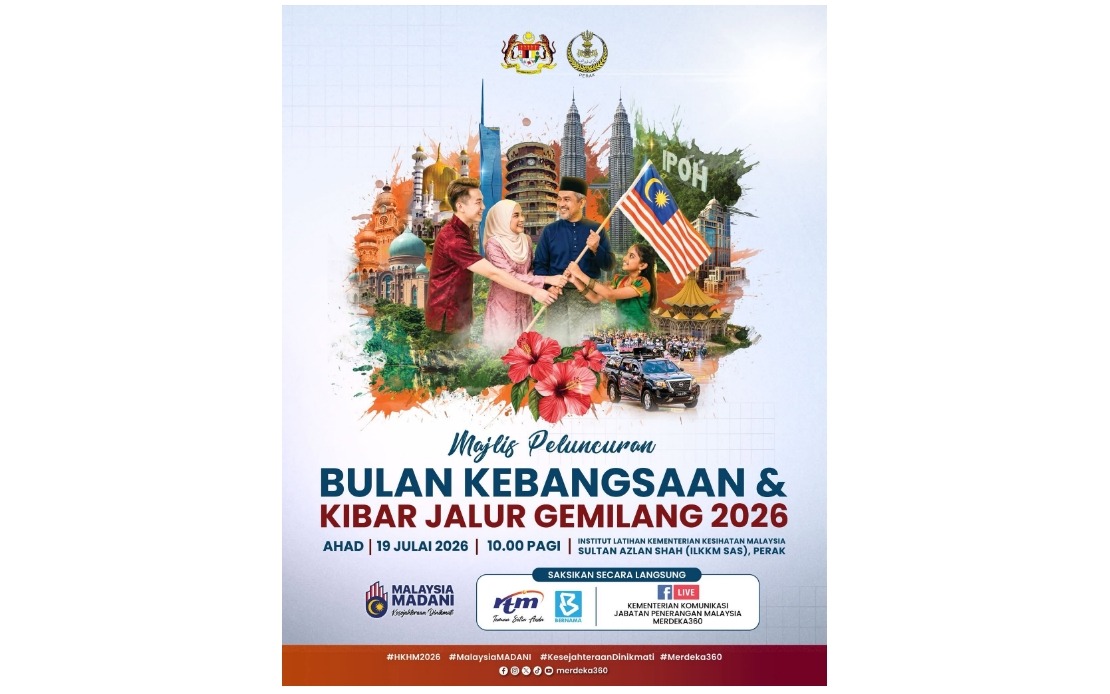
The official launch of Malaysia's 2026 National Month and Fly the Jalur Gemilang campaign will take place on July 19 at the Institut Latihan Kementerian Kesihatan Malaysia Sultan Azlan Shah in Perak, signalling the formal beginning of this year's nationwide patriotic celebrations. The ceremony, commencing at 10 am, represents a pivotal moment in the government's effort to mobilise national spirit across the country ahead of the main National Day and Malaysia Day observances scheduled for August and September respectively.
The launch event will receive extensive media coverage, being broadcast live across Radio Televisyen Malaysia and BERNAMA TV, while simultaneously streaming on Facebook Live through the Merdeka360 platform and official channels of the Ministry of Communications and Department of Information Malaysia. This multi-platform approach reflects the government's recognition that reaching Malaysians requires engagement across both traditional broadcast media and digital platforms where younger audiences increasingly consume information. The broad dissemination strategy underscores the importance placed on the campaign's visibility and accessibility across diverse demographic groups throughout the nation.
Central to the 2026 celebrations is the theme "Malaysia MADANI: Kesejahteraan Dinikmati," which encapsulates the government's vision of ensuring prosperity is experienced equitably across Malaysian society. The Malaysia MADANI logo, which debuted in previous celebrations, has been retained as the official emblem for continuity and recognition among the public. This thematic framework builds upon principles of justice, humanity and public welfare, positioning national prosperity not as an abstract concept but as tangible benefits that should reach all citizens without discrimination or exclusion.
The Malaysia MADANI concept itself deserves deeper examination for Malaysian readers, as it represents a deliberate policy direction distinct from previous national frameworks. Grounded in Islamic principles while remaining inclusive of Malaysia's multicultural character, the MADANI approach signals the government's commitment to balancing spiritual values with practical governance focused on citizen welfare. For Southeast Asian observers, this articulation of a nation-building philosophy demonstrates how Malaysia continues to negotiate its identity as a Muslim-majority democracy with significant religious and ethnic diversity.
Communications Minister Datuk Seri Fahmi Fadzil previously indicated that the primary National Day celebration on August 31 will unfold at Dataran Putrajaya, though organisers have deliberately chosen to scale back the grandeur in favour of a more subdued yet culturally vibrant programme. This conscious decision to move away from increasingly elaborate state ceremonies reflects broader discussions about balancing national pride with fiscal responsibility—a concern resonating across the region as governments reassess spending priorities. Meanwhile, Malaysia Day on September 16 will shift celebrations to Sarawak, a significant move that acknowledges the constitutional importance of East Malaysian states in the federation and distributes celebratory focus beyond the peninsular heartland.
To sustain momentum throughout the National Month period, the government has scheduled seven supporting programmes and activities designed to engage Malaysians across different interests and regions. These initiatives include Kembara Bahasa HKHM, a language-focused programme reflecting the centrality of Bahasa Malaysia to national identity; Quran Hour, acknowledging Islam's role in Malaysian life; Ambang Merdeka and Merdeka Countdown, which build anticipation through countdown activities; RIUH Merdeka, an entertainment and cultural showcase; and the National Statesmen Commemoration Ceremony, honouring historical figures instrumental in Malaysia's independence journey. This diverse programming strategy recognises that patriotism manifests through multiple channels—cultural, religious, linguistic, and historical—rather than through singular, top-down messaging.
For Malaysian readers particularly, the Merdeka360 platform serves as a centralised repository for campaign materials, offering downloadable official logos, patriotic songs, and promotional resources designed to facilitate grassroots participation. This distribution model represents a relatively democratic approach to national campaigning, enabling schools, community organisations, businesses and individuals to access authentic materials and incorporate them into localised celebrations. The emphasis on making resources freely available online acknowledges both the digital divide and the importance of equitable access to official campaign materials across urban and rural communities.
The strategic timing of the July 19 launch provides sufficient lead time for schools and organisations to plan participation in supporting programmes before the peak celebration periods in August and September. Malaysian secondary schools, in particular, typically incorporate National Month activities into their calendars, and the advance notice allows administrators and student bodies to coordinate transportation, permissions, and thematic preparations. The spread of celebrations across multiple months also prevents fatigue associated with compressed celebration windows, potentially sustaining public interest and participation at higher levels.
From a regional perspective, Malaysia's approach to National Month celebrations, with their emphasis on inclusive prosperity and multicultural participation, contrasts with nationalist movements in some neighbouring countries that emphasise ethnic or religious majority dominance. The explicit framing of the Malaysia MADANI theme as benefiting all Malaysians reflects ongoing efforts to navigate the complex relationship between Islamic governance principles and constitutional pluralism—a balancing act that carries implications for Malaysia's stability and its standing within Southeast Asia's diverse political landscape.
The choice of a health ministry training facility in Perak as the launch venue carries subtle significance beyond mere logistical convenience. Perak holds historical importance in Malaysia's independence struggle and maintains cultural resonance as a state with substantial rural populations, indigenous communities, and varying levels of economic development. Holding the launch away from Kuala Lumpur's government precinct signals an intentional effort to decentralise the campaign's opening and signal that national pride and prosperity encompasses the entire geographic and demographic spectrum of Malaysia, not merely the federal capital's urban elite.
As Malaysia approaches its 2026 National Day and Malaysia Day celebrations, the Jalur Gemilang campaign represents the government's attempt to refresh patriotic messaging for contemporary audiences while honouring historical narratives of independence and nation-building. The multi-platform launch and subsequent supporting programmes will test whether traditional nationalism frameworks can resonate with increasingly diverse, digitally-connected, and pragmatically-minded Malaysians who evaluate national identity through lenses of economic security, social inclusion, and good governance alongside historical pride.

