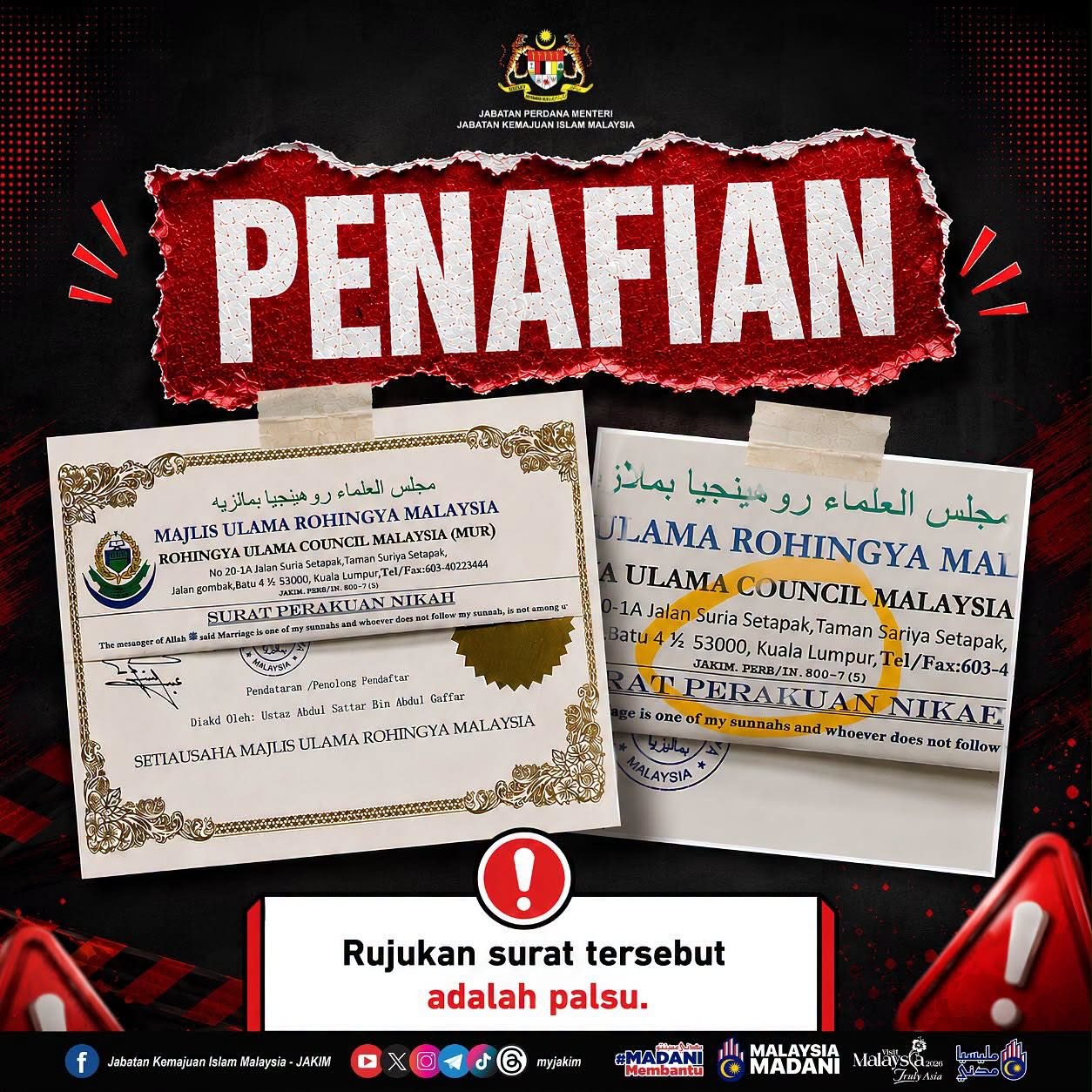
Malaysia's Department of Islamic Development (JAKIM) has moved swiftly to discredit a forged letter that recently spread across social media platforms, warning citizens against accepting documents without proper verification from official Islamic authorities. The department's statement, released through its official Facebook channel, represents a growing concern about the circulation of counterfeit religious certificates that could mislead Malaysians on important matters such as marriage recognition and certification.
The fraudulent document in question purportedly originated from the Malaysia Rohingya Ulama Council and carried the reference number "JAKIM.PERH/LN.800-7(5)", which appeared designed to lend credibility by mimicking authentic JAKIM documentation formats. Upon investigation, the department confirmed that neither this reference number nor the document itself holds any official standing within Malaysia's Islamic regulatory framework. The sophistication of the forgery—complete with what appeared to be legitimate bureaucratic numbering—highlights how such scams exploit the trust citizens place in official institutions.
JAKIM's statement explicitly clarified that the department, along with all state-level Islamic religious councils and departments operating throughout Malaysia, has never authorised the Malaysia Rohingya Ulama Council or any similar organisation to manage, validate, or certify marriage-related matters on their behalf. This distinction is crucial because marriage certificates and declarations carry significant legal weight in Malaysia, affecting inheritance rights, spousal benefits, and family law proceedings. The absence of proper authentication could render such documents useless in court or administrative proceedings, potentially creating serious complications for unsuspecting individuals who might rely upon them.
The timing of this viral circulation raises questions about the perpetrators' intentions. Marriage-related fraud represents a particularly insidious form of document forgery because it affects deeply personal life decisions and family structures. The Malaysia Rohingya Ulama Council's mention in this context is noteworthy, as the organisation operates within Malaysia's diverse religious and ethnic landscape, and any fraudulent use of its name could damage its credibility and community relations. Whether the forgery was deliberately attributed to this council or whether opportunistic scammers simply chose a recognisable Islamic-sounding name remains unclear.
Minister in the Prime Minister's Department (Religious Affairs) Dr Zulkifli Hasan indicated that a formal investigation would commence following the collection of complete details surrounding the fraudulent letter's origins and circulation. This institutional response signals that authorities are treating the matter seriously, as document forgery—particularly documents relating to Islamic affairs and marriage—falls within the purview of multiple government bodies. The investigation phase will likely attempt to trace the letter's creation and distribution networks, potentially identifying whether this represents an isolated incident or part of a broader pattern of religious document fraud.
The public advisory issued by JAKIM represents an important educational moment for Malaysian citizens navigating an increasingly complex digital landscape. The department has specifically encouraged individuals who encounter questionable religious documents to contact either JAKIM directly or their respective state Islamic religious authorities before accepting any certificate's legitimacy. This direct engagement strategy acknowledges that ordinary Malaysians may struggle to distinguish authentic documents from sophisticated forgeries, particularly when such documents employ official-looking formatting and reference numbers.
The broader context of this incident reflects growing vulnerabilities in Malaysia's document verification systems in the digital age. While JAKIM and state Islamic authorities maintain physical records and databases of legitimately issued certificates, the viral nature of social media allows forged documents to spread far faster than official corrections can reach affected populations. A single share, retweet, or forward can expose thousands to fraudulent information within hours, creating a credibility lag where false documents circulate widely before authorities can issue denials.
For Malaysian readers, particularly those from the Rohingya or broader Muslim communities, this incident carries specific implications. Marriage documentation forms the foundation of family law recognition in Malaysia, affecting matters from spousal inheritance rights to child custody and property division. Individuals relying upon forged marriage certificates could face severe legal consequences when such documents are presented to government agencies or courts. The vulnerability of recent migrant communities to such scams is particularly acute, as language barriers and unfamiliarity with Malaysian bureaucratic processes may make them more susceptible to accepting fraudulent documentation as legitimate.
The incident also underscores the importance of direct institutional channels in verifying official documents. While JAKIM's Facebook announcement reaches tech-savvy Malaysians, the department's broader communication strategy should ensure that vulnerable populations—including elderly citizens, rural communities, and non-digital-native groups—receive clear guidance on verification procedures. Establishing simple, accessible verification hotlines or in-person consultation services could prevent vulnerable individuals from becoming victims of document fraud.
Looking forward, this case suggests that Malaysian Islamic authorities may need to strengthen document security protocols and digital verification systems to stay ahead of increasingly sophisticated forgery operations. QR codes, blockchain verification, or other technological solutions employed in other countries could potentially be adapted to Malaysian contexts. The investment in such systems would pay dividends not only in preventing fraud but also in streamlining legitimate document verification processes, reducing the administrative burden on both applicants and government departments.
The viral spread of this particular forged letter also raises questions about social media platform accountability in Malaysia. While the platforms themselves typically operate under international policies, greater cooperation with local authorities in identifying and removing fraudulent documents could help stem the spread of such materials before they reach vulnerable populations. Community education campaigns emphasising the risks of trusting unverified documents circulating online could serve as an important complementary strategy alongside official denials and investigations.
Ultimately, this incident serves as a stark reminder that document fraud remains a persistent threat within Malaysia's administrative and legal systems, particularly in areas involving religious matters where trust and community standing carry significant weight. The response from JAKIM and the Minister's office demonstrates institutional awareness of the problem, but sustained vigilance, public education, and possibly enhanced security measures will be necessary to protect Malaysian citizens from such schemes in the future.

