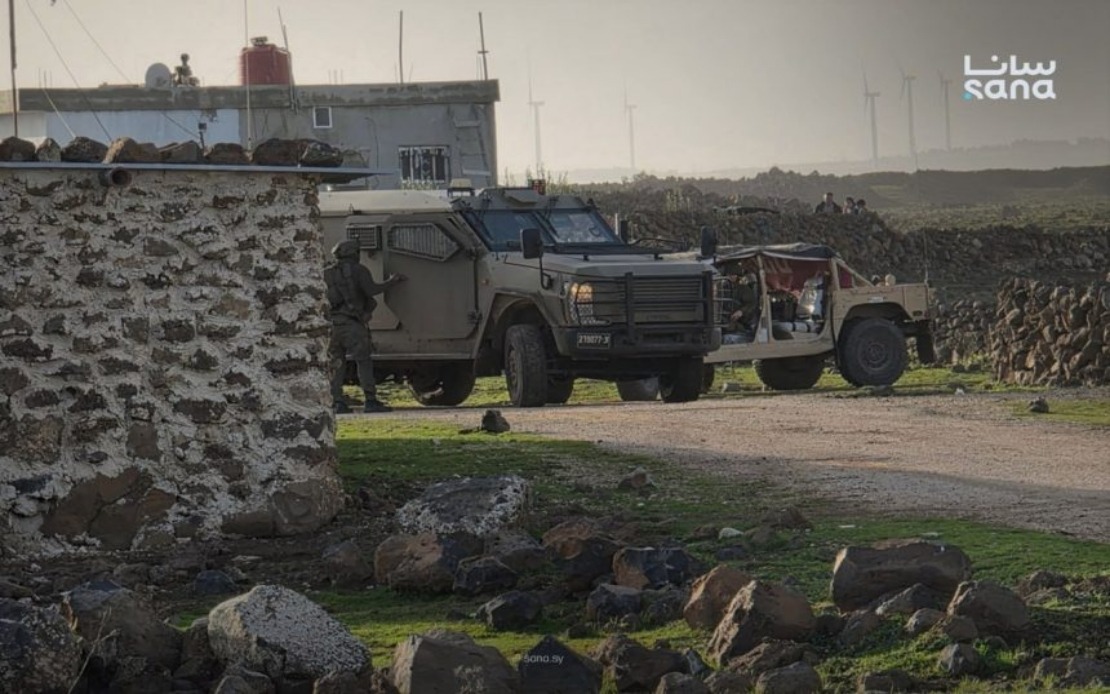
Israeli military forces have once again breached Syrian territory, with six military vehicles entering the southwestern Quneitra province on Saturday according to reports from the Syrian Arab News Agency. The incursion, documented by Turkish news sources citing SANA, saw the vehicles advance toward the Kudna Dam in Quneitra's central countryside while unmanned aerial systems operated overhead. The operation underscores the deteriorating security situation in southern Syria, where the traditional boundaries that once governed Israeli-Syrian military interactions have effectively dissolved.
The geopolitical landscape shifted dramatically following Bashar al-Assad's regime collapse in December 2024, an event that fundamentally altered regional power dynamics and security arrangements. Israel's response was swift and consequential: the country formally nullified the 1974 disengagement agreement that had maintained a fragile ceasefire in the Golan Heights region for fifty years. This decision effectively ended Israeli commitments to the buffer zone arrangements that had previously constrained military movements and provided a degree of predictability to cross-border relations.
Southern Syria has become a theatre of escalating Israeli activity over recent months, with the pattern extending far beyond isolated incidents. Repeated incursions have become routine, complemented by airstrikes targeting what Israel identifies as strategic locations and military assets. The operations have evolved in scope and intensity, incorporating ground-based raids accompanied by systematic searches of populated areas, detention of individuals identified as security threats, and the establishment of Israeli military checkpoints that function as de facto occupation infrastructure in contested zones.
The drone reconnaissance element observed during Saturday's incursion reflects Israel's reliance on intelligence gathering technologies to map terrain, monitor military movements, and identify targets within Syrian territory. This combination of ground vehicle penetration and aerial surveillance suggests a coordinated operation rather than a spontaneous border crossing. The targeting of the Kudna Dam indicates Israeli interest in infrastructure that holds both strategic and symbolic significance—dams control water resources essential to civilian populations and can be leveraged as tactical assets in regional negotiations.
For Malaysian and Southeast Asian observers, this escalation carries implications extending beyond bilateral Israeli-Syrian concerns. The breakdown of Cold War-era agreements that once stabilized volatile regions demonstrates how regime change can precipitate broader security vacuums and encourage revisionist powers to reshape territorial arrangements. The incident illustrates vulnerabilities in international frameworks designed to prevent conflict—when central governments collapse or lose legitimacy, the diplomatic scaffolding surrounding them becomes irrelevant.
The Syrian government's inability or unwillingness to contest these incursions reflects the profound state weakness that has followed years of civil conflict and now political transition. Without functional armed forces capable of mounting credible resistance, Syria's sovereignty exists increasingly as a nominal concept rather than an operative reality. This vulnerability invites not only Israeli activity but potentially complications from other regional powers seeking to advance their interests in a power vacuum.
The pattern of Israeli behaviour suggests a deliberate strategy to establish facts on the ground while international attention remains fragmented and the new Syrian administration consolidates power. By incrementally expanding military presence and control over frontier zones, Israel effectively redraws de facto boundaries without formal annexation. This approach mirrors historical territorial acquisitions accomplished through gradual encroachment rather than dramatic conquest.
Regional stability concerns extend to Lebanon, Iraq, and other neighbours who must contend with a transformed security environment in which previously respected ceasefire arrangements no longer provide protection. The demonstration that longstanding agreements can be unilaterally abandoned raises questions about the durability of other international frameworks governing military conduct in the Middle East and beyond.
The international community's response to these violations remains muted, reflecting broader geopolitical divisions and the complexity of Syrian politics following Assad's fall. Major powers hesitate to antagonize Israel while simultaneously navigating relationships with whoever emerges as Syria's effective governing authority. This diplomatic paralysis leaves little recourse for the Syrian state beyond formal protests, amplifying its marginalization in deciding its own territorial fate.
For Southeast Asian nations monitoring these developments, the incident underscores how quickly established security orders can unravel when domestic political structures collapse. It serves as a cautionary tale about the fragility of arrangements dependent on strong central authority and the importance of maintaining institutional capacity even amid political upheaval. The Quneitra incursion will likely prove one of many such crossings, each normalization advancing de facto Israeli control over territory without conventional military conquest.

