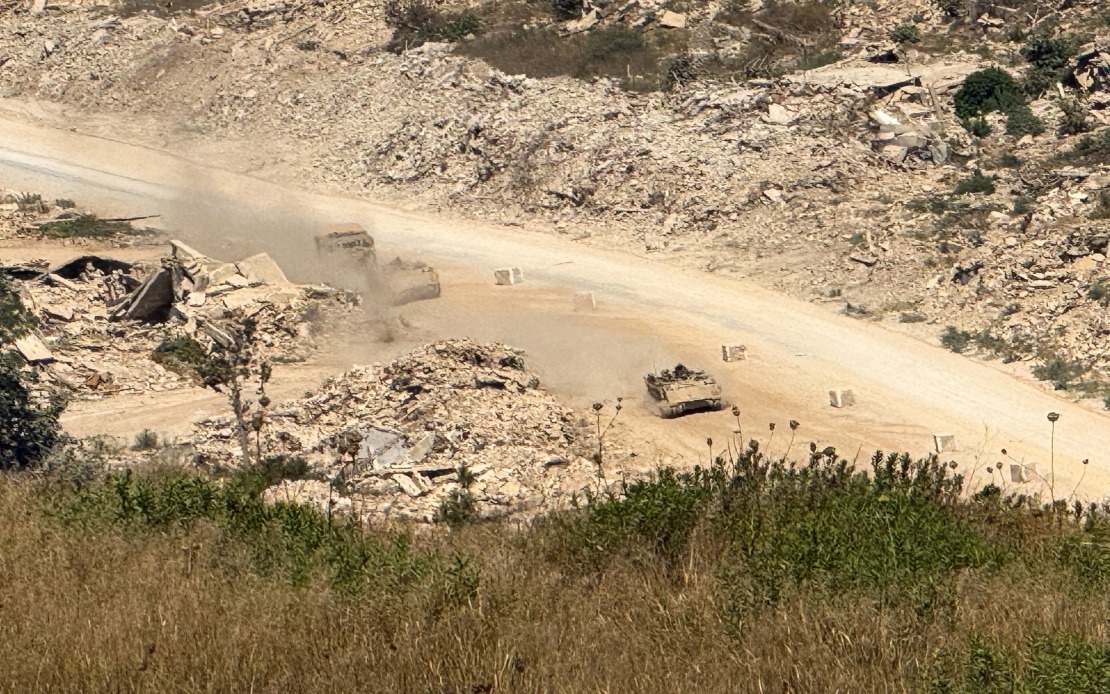
The Israeli military has resumed substantial military operations across southern Lebanon, implementing coordinated artillery bombardments, ground penetrations, and destruction of civilian infrastructure in what Lebanese authorities characterise as systematic ceasefire violations. The escalation occurred on Monday and included machine gun fire directed at populated areas, multiple explosive detonations, and the deliberate burning of residential structures in several towns, signalling a hardening of Israel's military posture even as diplomatic channels remain ostensibly active.
According to Lebanon's National News Agency, Israeli forces concentrated their operations across multiple locations in the southern region. Machine gun fire targeted Wadi al-Salouqi in Nabatieh governorate, while the town of Mansouri experienced overnight artillery shelling accompanied by two separate explosions. The pattern of attacks extended to Kfar Tebnit, where Israeli forces detonated explosives, and to the outskirts of Nabatieh al-Fawqa, which came under sustained intermittent artillery fire. These operations reflect a deliberate targeting strategy rather than sporadic military engagement.
The destruction of civilian property has emerged as a notable feature of the current military campaign. Israeli forces reportedly burned multiple houses in the town of Khiam while operations continued throughout the settlement, while also advancing into the western outskirts of Mays al-Jabal with accompanying artillery fire directed at residential targets. Concurrently, Israeli military drones conducted low-altitude reconnaissance flights over the Zahrani area, suggesting ongoing surveillance and tactical planning for future operations. Notably, Lebanese authorities reported no immediate casualties or property damage assessments, though the pattern of destruction indicates substantial civilian impact over time.
The timing of these operations proves particularly significant given their proximity to diplomatic negotiations. Just three days prior, the seventh round of Lebanese-Israeli talks concluded in Rome under United States sponsorship. These discussions focused on implementing a framework agreement originally established on June 26, addressing key issues including border demarcation, the status of detainees, and territorial arrangements. Lebanese President Joseph Aoun had characterised the Rome negotiations as producing positive momentum, specifically highlighting progress on border definition and prisoner exchange matters during a Cabinet session on Friday.
The framework agreement itself envisions a calibrated process of Israeli withdrawal from occupied Lebanese territory through designated pilot zones, coupled with Lebanese army deployment and the disarmament of non-state armed groups, particularly Hezbollah. This structure theoretically permits both sides to demonstrate compliance and build confidence through phased implementation. However, the continuation of Israeli military operations simultaneously with negotiations suggests that Israel may be maintaining maximum territorial control and military advantage during the diplomatic process, potentially complicating implementation of any eventual agreement.
The broader context of this conflict reveals entrenched positions and escalating humanitarian consequences. Israel's military campaign in Lebanon commenced on March 2 and has produced staggering human costs according to Lebanese official figures: 4,335 deaths, 12,277 wounded, and displacement exceeding one million people. These figures represent a civilian catastrophe of significant proportions, with entire communities fractured and displaced from their ancestral lands. The scale of displacement rivals some of the largest contemporary humanitarian crises globally.
Israeli military occupation extends across multiple dimensions of the Middle Eastern geography, reflecting decades-long strategic positioning. Israel maintains control over portions of southern Lebanese territory dating back several decades, with additional areas seized during the 2023-2024 military campaign. Current operations have pushed Israeli military presence more than ten kilometres into Lebanese territory, representing a substantial territorial advance during this specific campaign cycle. This geographical expansion under military pressure complicates any eventual withdrawal arrangement and potentially strengthens Israel's negotiating position by securing additional terrain as de facto bargaining chips.
The occupation extends beyond Lebanon into Palestinian and Syrian territories, where Israel similarly maintains military control and refuses withdrawal. Israel's consistent rejection of United Nations resolutions calling for Palestinian statehood and territorial sovereignty reflects a strategic approach prioritising security dominance and territorial retention over political settlement frameworks. This broader posture towards regional disputes suggests that negotiations over Lebanon may face similar structural obstacles, with Israel potentially viewing continued military operations as compatible with diplomatic processes rather than contradictory to them.
For Malaysian observers and policymakers, these developments carry particular significance given Malaysia's historical support for Palestinian rights and its engagement with regional stability mechanisms. The pattern of simultaneous military escalation and diplomatic negotiation demonstrates how powerful states may utilise military pressure to strengthen negotiating positions while nominally pursuing peaceful resolution. Malaysia has consistently advocated for international law compliance and peaceful dispute resolution through forums like the United Nations and the Non-Aligned Movement, positions that gain renewed relevance when observing such contradictions between stated diplomatic objectives and ground-level military conduct.
The humanitarian dimension deserves particular emphasis for Southeast Asian nations that prioritise civilian protection norms. The displacement of over one million Lebanese civilians represents not merely a statistical measure but reflects systematic uprooting of communities, disruption of livelihoods, destruction of social infrastructure, and psychological trauma across entire populations. This scale of civilian impact exceeds typical conflict scenarios and approaches patterns associated with population displacement campaigns. The burning of residential structures specifically indicates deliberate targeting of civilian infrastructure rather than military-focused operations, raising serious questions about adherence to international humanitarian law principles.
The diplomatic framework being negotiated in Rome may ultimately prove fragile if undermined by simultaneous military operations that expand Israeli territorial control and destroy Lebanese civilian infrastructure. Confidence-building measures typically require demonstrated restraint and good faith commitment to negotiated outcomes. Military escalation during active negotiations typically signals to the other party that military advantage remains a primary objective, potentially justifying reciprocal escalation or hardening of positions. Lebanon's government faces the challenge of advancing negotiations while its civilians endure continued military operations, creating domestic political pressure and questioning the efficacy of diplomatic engagement.
Future developments will likely depend upon whether the United States can broker genuine commitments to military restraint while negotiations proceed, and whether Lebanese political actors can maintain unity around negotiation objectives despite the ongoing humanitarian costs. The involvement of Hezbollah as a party to the conflict adds complexity, as disarmament provisions require managing relationships between state and non-state actors in contested security arrangements. International observers, including Malaysia and fellow ASEAN members, will monitor whether this negotiation process produces meaningful military disengagement or becomes another example of diplomatic failure amid continued regional instability.

