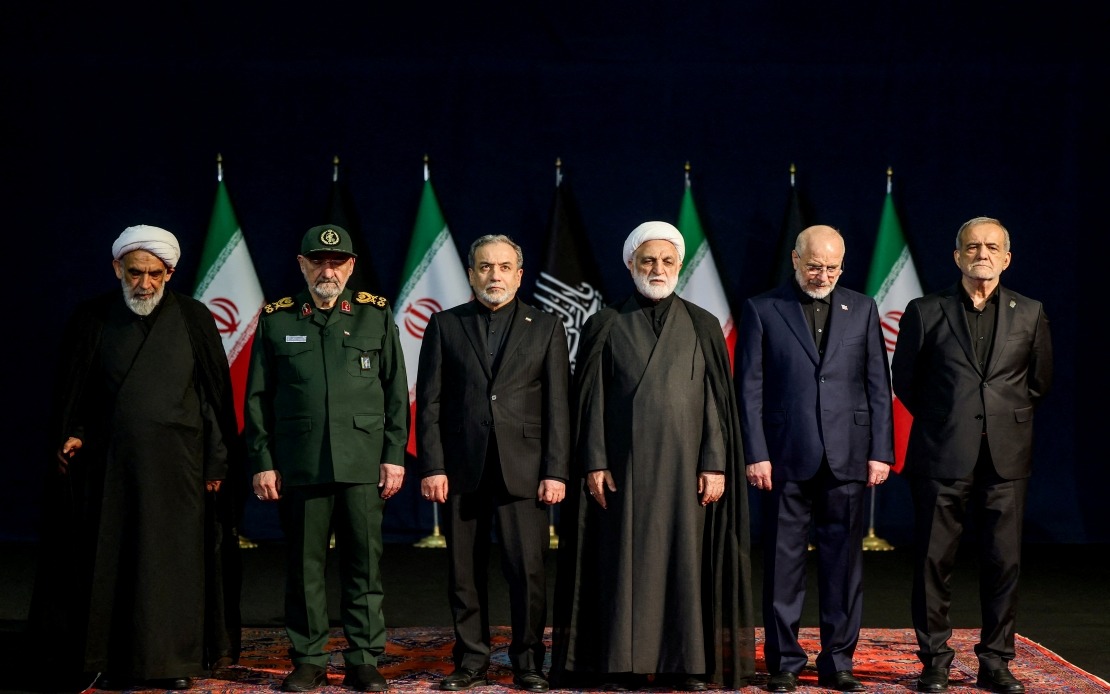
Iran held a major state funeral ceremony on Friday for Ayatollah Ali Khamenei, the country's Supreme Leader who died in a military strike in February. The tribute gathering at Imam Khomeini's Mosalla prayer hall in central Tehran drew the nation's most senior figures alongside an impressive roster of international dignitaries, underscoring both the symbolic importance of the moment and Iran's continued diplomatic engagement despite regional tensions.
The scale and composition of attendees reflected the geopolitical significance of Iran's leadership transition. Iran's current President Masoud Pezeshkian, Parliament Speaker Mohammad Baqer Qalibaf, and Judiciary Chief Gholamhossein Mohseni-Ejei were all present, alongside Sadeq Amoli Larijani, who chairs the Expediency Discernment Council—a powerful body that arbitrates disputes between Iran's legislative and executive branches. Their unified appearance signalled institutional continuity during a period when Iran's power structure could have fractured along factional lines.
The international guest list offered telling glimpses into Iran's diplomatic priorities and regional alignments. Pakistan's Prime Minister Shehbaz Sharif and Chief of Army Staff Field Marshal Syed Asim Munir attended, reflecting the deep security and strategic ties between Islamabad and Tehran despite both countries' complex regional roles. Armenian Prime Minister Nikol Pashinyan and Georgian President Mikheil Kavelashvili represented the Caucasus, a zone of continuing instability where both countries maintain delicate relationships with regional powers. Their presence suggested Iran's efforts to maintain influence in a strategically contested area.
The Middle Eastern representation was particularly substantial. Iraqi President Nizar Amedi and the President of Iraq's Kurdistan Region Nechirvan Barzani both attended, highlighting Iraq's significance as a neighbour where Iran wields considerable influence through proxy militias and political networks. Tajik President Emomali Rahmon's attendance underscored Iran's connections across Central Asia, a region increasingly pivotal to global geopolitics as great powers compete for influence.
Notably, delegations from China and Russia participated in the ceremony, though the source material does not specify their precise composition or rank. This attendance carries substantial weight given the broader strategic context. Both nations have deepened ties with Iran in recent years, with Russia particularly reliant on Iranian support for its war in Ukraine and both countries collaborating within the Shanghai Cooperation Organisation and other multilateral frameworks. Their representation, regardless of seniority, affirmed the continuing alignment between Tehran and these two powers against Western pressure.
The scale of the gathering stands in contrast to Iran's international isolation on some issues. Despite decades of Western sanctions and diplomatic tensions, Iran demonstrated its capacity to convene a genuinely international ceremony. This reflects both the country's own diplomatic efforts and the reality that many nations maintain pragmatic relationships with Tehran regardless of ideological differences with the United States or Israel.
Ayatollah Khamenei's death in February during a US and Israeli strike represented one of the most dramatic moments in recent Iranian history. Yet the transition to his son, Mojtaba Khamenei, who was selected as the new Supreme Leader in March, proceeded without the internal chaos or violence some international observers had feared. The Friday ceremony allowed Iran's leadership to publicly consolidate this transition while demonstrating that the state remained stable and commanding respect on the world stage.
Funeral proceedings were scheduled to continue through July 9, extending across multiple locations that hold deep significance in Shia Islam and Iranian national identity. Processions would move through Tehran, Qom—home to major seminaries and a centre of religious authority—and Mashhad, which houses the shrine of Imam Reza, one of Islam's most sacred sites. Additional rites were planned in Iraq, acknowledging the spiritual connections between the two predominantly Shia nations and Iran's deep influence there.
The Iranian authorities imposed public closures and airspace restrictions in Tehran and Mashhad on key dates, with July 4 declared a national day of mourning. These measures reflected the magnitude of the event within Iranian society and the government's determination to manage both the ceremonial proceedings and public expressions of grief or dissent. For Malaysian observers, such administrative precautions illustrate how state funerals in countries with Iran's security challenges require careful coordination across multiple agencies.
The attendance of religious scholars, tribal leaders, and clerics alongside political figures demonstrated that Khamenei's death carried weight across Iran's fragmented society. These constituencies represent different power bases and ideological emphases within the Iranian system, and their unified participation suggested that the supreme leadership transition, while momentous, had not fractured the consensus required to maintain state stability.
For Southeast Asia and Malaysia specifically, Iran's succession matters because it affects the broader Middle Eastern equilibrium that influences global energy markets, regional security, and the strategic partnerships that shape Asia-Pacific geopolitics. A stable transition in Tehran, particularly one demonstrating institutional resilience, reduces the risk of regional miscalculation that could affect Malaysian interests. The rapid and apparently smooth elevation of Mojtaba Khamenei, validated through the international ceremony, suggests that Iran's new leadership intends to continue existing foreign policy trajectories rather than pivot radically, providing a degree of predictability in an otherwise turbulent region.

