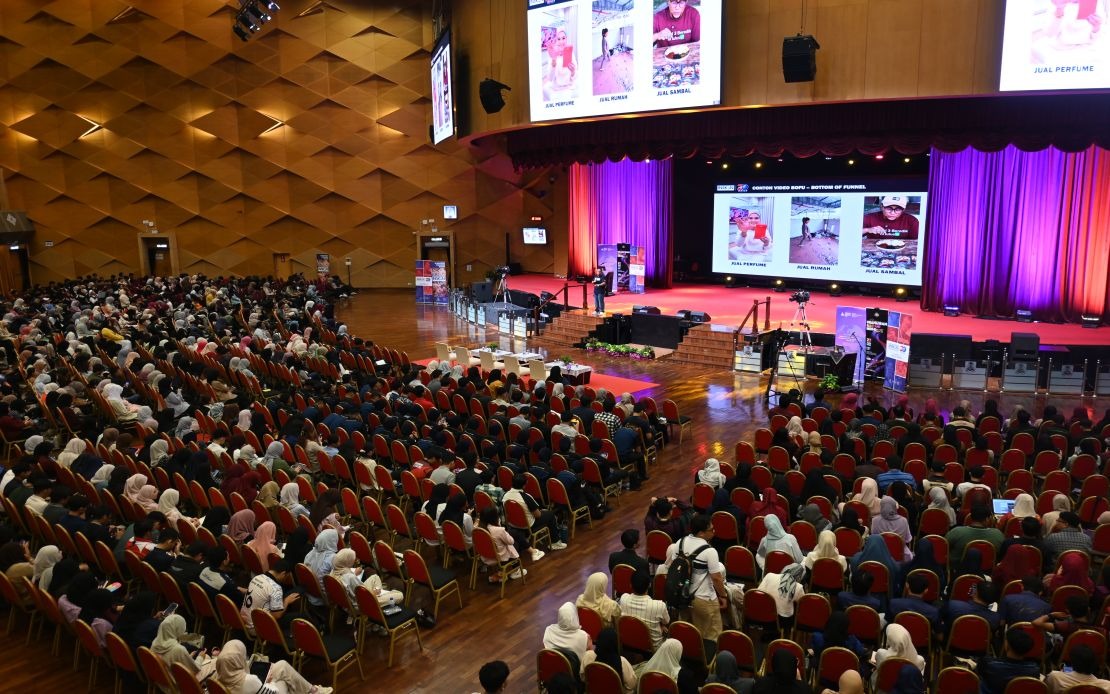
Nearly 7,000 university students and online participants converged at Dewan Agung Tuanku Canselor, UiTM Shah Alam, on June 23 for the Usahawan MADANI Mega (SUM MEGA) 2026 entrepreneurship seminar, marking a watershed moment in Malaysia's efforts to cultivate the next generation of business founders. The event, which drew 6,877 attendees both in-person and via virtual channels, has earned recognition from the Malaysia Book of Records as the nation's largest student-focused entrepreneurship seminar, underscoring the remarkable appetite among young Malaysians to explore self-employment and venture creation as a tangible career trajectory.
Organised by the National Entrepreneurship Institute (INSKEN) in partnership with the Malaysian Academy of SME and Entrepreneurship Development (MASMED) and Universiti Teknologi MARA (UiTM), the seminar served as a comprehensive knowledge hub connecting students across the country through facilitated learning sessions, skills enhancement workshops, and carefully structured networking opportunities. The scale of participation signals a fundamental shift in how Malaysia's youth perceive entrepreneurship—no longer a marginal pursuit, but a mainstream pathway worthy of serious consideration and institutional backing.
Datuk Mohamad Alamin, deputy minister for Entrepreneur and Cooperatives Development, framed the gathering as evidence of entrepreneurship's deepening resonance with young Malaysians seeking alternatives to traditional employment. In his remarks, he emphasised that entrepreneurship transcends the concept of mere job selection; rather, it functions as a cornerstone of national economic resilience and competitiveness in an increasingly complex global marketplace. The deputy minister's presence highlighted the government's recognition that cultivating entrepreneurial mindsets among university cohorts directly translates into broader economic dynamism and sectoral innovation.
Through the Ministry of Entrepreneur and Cooperatives Development (KUSKOP), the MADANI administration has committed to nurturing a multifaceted entrepreneurial ecosystem that addresses critical barriers young founders encounter. This comprehensive approach encompasses four interdependent pillars: targeted capacity-building programmes to equip aspiring entrepreneurs with practical skills; improved financing mechanisms that lower capital acquisition barriers; enhanced market access initiatives connecting startups with buyers and distribution networks; digitalisation support enabling businesses to harness technology for competitive advantage; and ongoing business development advisory services. By addressing these systemic bottlenecks, the government aims to remove friction points that historically impeded the transition from entrepreneurial intent to sustainable business operation.
The seminar itself employed a structured pedagogical framework called the MOFA approach, which distils business success into four actionable domains: marketing, operations, finance, and business administration. Participants engaged in practical sharing sessions where experienced entrepreneurs and business practitioners unpacked real-world challenges and solutions within each dimension. This compartmentalised methodology allows emerging business founders to systematically strengthen their competencies across the value chain, thereby enhancing their enterprises' resilience against market shocks and competitive pressures. Such direct mentoring and peer-learning exchanges generate insights that classroom instruction alone cannot convey.
Datuk Mustaffa Kamil Ayub, Board of Trustees chairman for INSKEN and a UiTM board member, interpreted the seminar's exceptional turnout as validation that entrepreneurial culture is taking root among Malaysians, particularly the younger demographic who will shape the economy over the coming decades. His intervention reframed entrepreneurship as fundamentally a cultural and psychological orientation rather than merely a career classification. This framing matters considerably because it positions entrepreneurial behaviour as a competitive mindset applicable across sectors and organisational contexts—whether founders establish independent ventures or drive innovation within larger institutional frameworks. By cultivating such a mindset at the university level, Malaysia can produce talent that generates disproportionate economic value regardless of employment structure.
INSKEN's portfolio of entrepreneurship development programmes extends well beyond single-event activations. The institute runs the INSKEN Masterclass series offering deep-dive technical training, BANGKIT, a structured acceleration pathway for early-stage founders, and PROTÉGÉ, a mentorship initiative pairing emerging entrepreneurs with experienced business leaders. These complementary programmes create a developmental continuum that captures interested participants at various maturity stages and shepherds them toward higher levels of business sophistication and market readiness. Such ecosystem thinking—where initiatives interconnect and reinforce one another—represents a maturation in how government and educational institutions approach entrepreneurship development.
SUM MEGA 2026 functions simultaneously as a marketplace of ideas and a coalition-building exercise. The seminar has catalysed collaboration among diverse ecosystem participants: government agencies setting policy and providing subsidies; universities supplying talent and institutional credibility; industry practitioners sharing operational expertise; financial institutions offering capital and risk management solutions; entrepreneur development agencies delivering specialised support; and the broader business community providing mentorship and market opportunities. This multi-stakeholder architecture reflects recognition that sustainable entrepreneurial ecosystems require coordinated action across institutional boundaries rather than isolated initiatives.
The seminar's timing and scope align directly with Malaysia's National Entrepreneurship Policy 2030, which positions entrepreneurship as central to achieving middle-income country aspirations and developing a resilient, diversified economy. The policy acknowledges that reliance on foreign direct investment and commodity exports leaves Malaysia vulnerable to external shocks; entrepreneurship-driven innovation and job creation represent the alternative pathway. By mobilising 6,877 students around entrepreneurial ideals and practical skill-building, initiatives like SUM MEGA 2026 operationalise this strategic vision at grassroots level where actual founder activity originates.
For Malaysian entrepreneurs and the broader ecosystem, the seminar's scale and structure offer valuable lessons about knowledge dissemination and community mobilisation. The hybrid physical-digital format expanded geographic reach beyond Shah Alam, enabling participation from students across peninsular Malaysia, Sabah, and Sarawak—a logistical achievement that mirrors how future entrepreneurship support must function in an increasingly distributed, digitally-enabled economy. Universities nationwide now possess proof-of-concept that large-scale, synchronous engagement around entrepreneurship development is operationally feasible and generates measurable demand.
Looking forward, the challenge lies in converting this initial spark of interest into sustained venture creation and business longevity. Seminar attendance represents initial exposure; the harder task involves ensuring that motivated participants transition to actual founder activity, secure appropriate financing, navigate regulatory frameworks, and sustain operations through the critical first three to five years when failure rates remain elevated. INSKEN's portfolio of follow-on programmes, coupled with improving access to financing through schemes administered by KUSKOP, may substantially improve conversion rates from seminar attendance to active entrepreneurship.
The Malaysia Book of Records acknowledgement carries symbolic weight beyond mere statistical recognition. It signals that entrepreneurship capacity-building has achieved sufficient institutional priority and resource commitment to generate record-breaking participation. For prospective founders, such validation reinforces that entrepreneurship enjoys legitimacy and support within Malaysia's economic establishment. For policymakers, it demonstrates measurable return on investment in entrepreneurship development infrastructure. As Malaysia navigates post-pandemic economic recovery and intensifying regional competition, transforming student interest into a cohort of resilient, innovative founders may prove as strategically important as any traditional industrial policy.