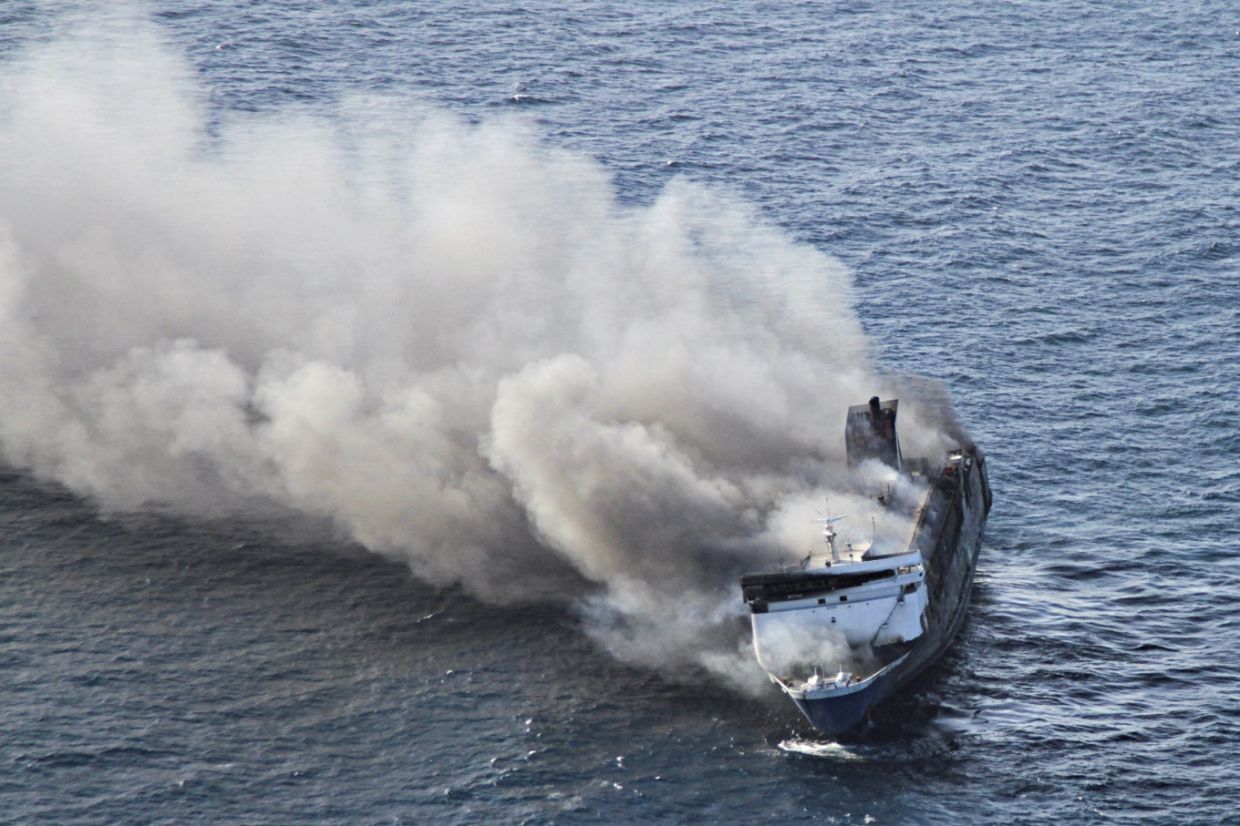
A catastrophic fire aboard the KMP Mutiara Sentosa II has thrust Indonesia's maritime safety framework into the spotlight once again, exposing what regulators and industry figures warn may be systemic weaknesses in how the country oversees its busy shipping corridors. The passenger vessel, operating between Surabaya in East Java and Makassar in South Sulawesi, caught fire around 6am on Sunday, August 2, killing at least five of the 236 passengers and 39 crew members aboard, with two others still unaccounted for.
The tragedy has revived long-standing questions about regulatory compliance and emergency preparedness across Indonesia's maritime sector, a critical transportation artery for the archipelago's economy and passenger movement. The vessel, a 160-meter-long roll-on/roll-off passenger ferry primarily carrying logistics truck drivers, was engulfed by flames in waters off Madura, forcing panicked evacuees to resort to jumping overboard with only life jackets as protection. According to Udin Karo Karo, chairman of the Makassar–Surabaya Truck Drivers Association, the crew's response fell drastically short of maritime safety standards, with evacuation procedures appearing entirely absent and approximately 40 percent of drivers managing their own rescue without official guidance.
The operational failures documented by eyewitnesses paint a troubling picture of safety culture aboard the vessel. Udin reported that lifeboats and inflatable rescue rafts were not deployed during the emergency, forcing passengers into the sea despite regulations mandating proper evacuation protocols. He subsequently called for port authorities and the country's maritime regulators to launch a thorough probe into the ship's operational readiness and adherence to safety requirements, while demanding that company officials be held accountable and that victim compensation be provided swiftly. Such criticisms reflect broader frustrations among industry stakeholders who have observed repeated failures in enforcement and implementation of maritime regulations across Indonesia's shipping operations.
What makes this incident particularly alarming to safety experts is the historical pattern at the operating company. The KMP Mutiara Sentosa II is operated by PT Atosim Lampung Pelayaran (ALP), the same entity responsible for the KMP Mutiara Sentosa I, which caught fire near Madura on May 19, 2017, killing five people in an eerily similar tragedy. That repetition of incidents involving vessels from the same operator within a span of five years suggests that fundamental lessons from the earlier accident were never properly internalized or enforced. Edi Priyanto, deputy chairman of the East Java Occupational Safety and Health Council, emphasized that the recurrence indicates systemic failures extending beyond technical or mechanical causes into the company's safety management culture, organizational learning capacity, and risk assessment frameworks.
Edi's analysis highlights a critical gap between the existence of maritime safety regulations and their genuine implementation. He stressed that investigations into such disasters cannot be confined to identifying the immediate cause of the fire but must examine why flames spread so rapidly, whether emergency response systems functioned as designed, and whether crew training adequately prepared personnel for crisis situations. This deeper investigation approach recognizes that maritime safety depends on multiple interconnected factors including proper vessel maintenance, crew competency, effective safety management systems, and—fundamentally—an organizational commitment to safety that transcends compliance checkboxes. The absence of such comprehensive frameworks appears evident in the chaotic evacuation aboard the KMP Mutiara Sentosa II.
The incident comes during a period of heightened concern within Indonesia's maritime domain. Merely one month before the ferry fire, another passenger vessel sank near Selayar, an island off South Sulawesi, carrying more than 70 passengers. That disaster claimed at least four lives, with 14 others missing when authorities concluded their search efforts. The clustering of such major maritime incidents within such a compressed timeframe has prompted officials to view them not as isolated misfortunes but as indicators of systemic vulnerabilities requiring urgent intervention at the policy and enforcement levels.
Transportation Minister Dudy Purwagandhi acknowledged the gravity of the situation while indicating that comprehensive action depends on findings from the National Transportation Safety Committee (KNKT). He confirmed that the government would undertake a full evaluation of PT ALP once the KNKT completes its accident investigation, noting that the company's involvement in at least two significant maritime accidents warrants serious scrutiny regarding its safety practices and operational standards. However, Dudy's cautious framing—emphasizing the need to first establish the accident's cause—drew criticism from those who argue that too much time is consumed by investigative processes while operators continue conducting business under questionable safety conditions.
Abdul Hadi, a House of Representatives member serving on Commission V, which oversees transportation and infrastructure, characterized the ferry fire as a watershed warning about the state of Indonesia's entire maritime safety apparatus. He rejected the notion that successive accidents should be treated as unrelated events, framing them instead as symptomatic of deeper regulatory dysfunction. Abdul specifically criticized the ritualistic nature of safety inspections and certification processes, which he contended have been reduced to administrative formalities disconnected from genuine safety verification. He warned that seaworthiness certificates, inspections, and safety procedures must represent authentic assessments of vessel safety rather than bureaucratic performances that place passenger lives at risk through negligence or supervisory weakness.
The regulatory failures exposed by this incident carry particular significance for Malaysia and Southeast Asian nations that share interconnected maritime networks and passenger flows. Indonesia's maritime sector handles enormous volumes of inter-island and regional traffic; lapses in safety oversight there create ripple effects across the region's shipping ecosystems. Malaysian ports, particularly those in Peninsular Malaysia and East Malaysia, receive regular traffic from Indonesian operators, meaning that substandard safety practices by Indonesian companies directly affect the safety profile of regional maritime commerce. Furthermore, many Malaysian logistics operators and passengers travel on Indonesian ferries for inter-regional commerce and transportation, making Indonesia's safety record a matter of immediate concern for Malaysian stakeholders.
The path forward requires Indonesia to move beyond investigating individual accidents toward implementing systemic reforms in maritime oversight. This includes strengthening the independence and resources of regulatory bodies responsible for vessel certification and safety audits, establishing meaningful consequences for operators with repeated safety violations, and creating transparent mechanisms for reporting and addressing safety deficiencies. International best practices from other maritime nations demonstrate that genuine safety improvements emerge when regulatory agencies possess adequate funding, trained personnel, and political backing to enforce standards consistently. Indonesia's maritime sector remains vital to the nation's economy and regional connectivity, but that importance underscores rather than diminishes the necessity for rigorous, non-negotiable safety standards that protect the thousands of passengers daily depending on these services.
The tragedy aboard the KMP Mutiara Sentosa II represents not merely a discrete accident requiring investigation but a systemic indictment of how maritime safety oversight has been conducted and enforced in Indonesia. The convergence of inadequate crew response, questionable vessel readiness, repeated incidents involving the same operator, and visible gaps in regulatory enforcement suggests that Indonesia's maritime sector faces challenges that require comprehensive rather than piecemeal remediation. Until regulatory bodies demonstrate capacity and commitment to enforcing standards with genuine rigor, and until operators understand that violations will result in serious consequences, Indonesia's waterways will remain significantly more hazardous than they should be. For Malaysian observers and operators engaged with Indonesian maritime routes, this incident serves as a reminder of the critical importance of maintaining independent safety oversight within one's own regulatory frameworks rather than relying on neighboring jurisdictions' capacity and commitment.

