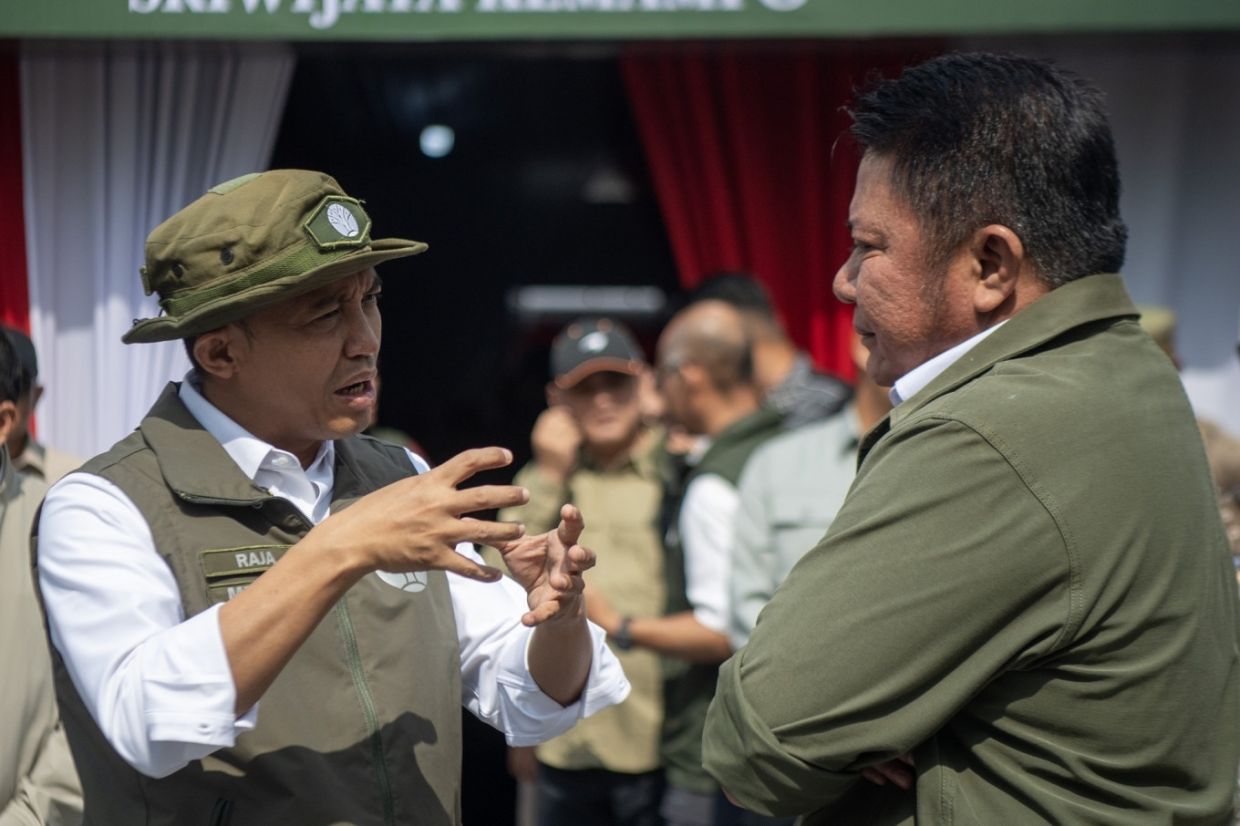
Indonesia's Corruption Eradication Commission (KPK) has resumed investigations into allegations that Forestry Minister Raja Juli Antoni may not have fully returned bribes allegedly tendered by Suhardiman Amby, the regent of Kuantan Singingi in Riau province. The reopened probe centres on suspected gaps between the amount of illicit funds the minister initially claimed to have received and what he later reported returning to authorities, according to a statement from KPK spokesperson Budi Prasetyo released on Thursday, August 6.
The alleged bribery incident originated from a meeting held on June 2 between representatives of the Forestry Ministry and the Kuantan Singingi administration. During this encounter, Suhardiman purportedly handed Raja Juli an envelope filled with Singaporean currency valued at S$14,000—equivalent to approximately US$10,919. The regent's actions have been interpreted by investigators as an attempt to secure official cooperation on forestry matters. Beyond the minister, several other Forestry Ministry personnel allegedly received kickbacks totalling S$12,500 from various officials within the Kuantan Singingi administration.
Raja Juli initially reported the incident to the KPK on July 3, maintaining that he had rejected the offered payment and subsequently returned the envelope to Kuantan Singingi Police headquarters on June 12, a full ten days after the June 2 meeting. In his account, the minister emphasised that he possessed no legal authority to accept such a gift. However, investigators remain focused on verifying whether the amounts disclosed by Raja Juli align with the actual sums transferred by Suhardiman, a discrepancy that has prolonged the investigation and raised questions about the completeness of his cooperation.
The underlying context involves forest policy rather than simple personal enrichment. Kuantan Singingi's administration had submitted requests to the Forestry Ministry seeking the reclassification of more than 1,800 hectares of limited production forest, or HPT, designated under Indonesian law for controlled timber harvesting and limited industrial development. KPK investigators are examining whether these reclassification proposals formed the explicit or implicit basis for the alleged kickback scheme. Such linkage would substantially strengthen corruption charges and suggest a pattern of attempting to influence ministerial decision-making through financial inducement.
Indonesian anti-corruption law establishes strict protocols governing the receipt and reporting of improper gifts by public officials. Any gifts received in connection with a public position must be reported directly to the KPK within thirty days of acceptance to avoid criminal liability. Failure to comply with this requirement can trigger prosecution. Officials convicted of accepting illicit gifts face sentences of up to twenty years imprisonment alongside fines reaching Rp 1 billion, approximately US$55,867—penalties severe enough to deter casual transgressions but insufficient to eliminate opportunistic corruption in practice.
The investigation has expanded beyond the single June 2 encounter. Budi disclosed that Raja Juli and Suhardiman had met on at least three separate occasions spanning April, May, and June, though investigators have not yet determined whether these meetings shared common objectives or addressed distinct matters. The frequency of contact between a senior minister and a provincial regent merits scrutiny, particularly when coupled with allegations of financial wrongdoing, as it suggests potential cultivation of a relationship designed to facilitate unofficial influence.
Suhardiman, himself a member of President Prabowo Subianto's Gerindra Party, was arrested and designated a suspect in late June on primary charges relating to kickbacks allegedly offered to Zulkarnain, the regency secretary, in exchange for his appointment to office. The KPK subsequently broadened its investigation to encompass the separate stream of alleged payments directed toward the Forestry Ministry concerning forest conversion permits. This expansion transformed what initially appeared as localised misconduct into a potentially wider corruption scheme implicating both provincial and national officials.
The scandal has intensified scrutiny of Raja Juli's ministerial conduct and his political standing. Beyond his role as Forestry Minister, he serves as secretary-general of the Indonesian Solidarity Party (PSI), a parliamentary faction already navigating competitive relationships within Indonesia's fractious political ecosystem. Members of the House of Representatives' Commission IV, which oversees forestry and resource management planning, summoned him for questioning. Notably, he declined to appear at a scheduled meeting on July 14, with Commission IV deputy chair Alex Indra Lukman of the Indonesian Democratic Party of Struggle (PDI-P) attributing his absence to an umrah pilgrimage. The unexplained absence fuelled public and parliamentary scepticism regarding his transparency and willingness to engage with oversight mechanisms.
The Forestry Ministry has issued statements reaffirming its institutional commitment to supporting the KPK investigation and pledging full cooperation should investigators request additional documentation or evidence. Officials emphasised that the ministry has not approved any forest reclassification requests from Kuantan Singingi to date, with the most recent three proposals either formally rejected or remaining under verification. This defensive posture reflects institutional awareness that public confidence in the ministry's decision-making processes depends on demonstrable adherence to rule of law and transparent procedures insulated from external pressure or financial inducement.
The case raises broader implications for forest governance across Indonesia and Southeast Asia. Limited production forests represent strategically important resources in regions pursuing economic development, creating inherent tensions between conservation objectives and commercial interests. When officials entrusted with allocating access to these resources become vulnerable to corruption, the resulting distortions can undermine sustainable forest management principles and entrench exploitative extraction patterns. Indonesia's forest sector already faces international scrutiny regarding deforestation rates and environmental stewardship; instances of high-level ministerial corruption reinforce perceptions that political considerations may override environmental protection in resource allocation decisions.
For Malaysian observers, this case illuminates governance challenges within a regional peer state and illustrates how corruption networks can extend across multiple institutional levels—from local regents through national ministers to administrative staff. Malaysia's own anti-corruption framework, managed by the Malaysian Anti-Corruption Commission (MACC), operates within comparable legal constraints and faces similar challenges in prosecuting high-profile officials. The Indonesian case underscores that institutional mechanisms for detecting and investigating corruption remain essential but insufficient without complementary political will to hold senior officials accountable regardless of party affiliation or governmental position. The investigation's outcome will signal whether the KPK can effectively pursue ministers allied with the current presidential administration.

