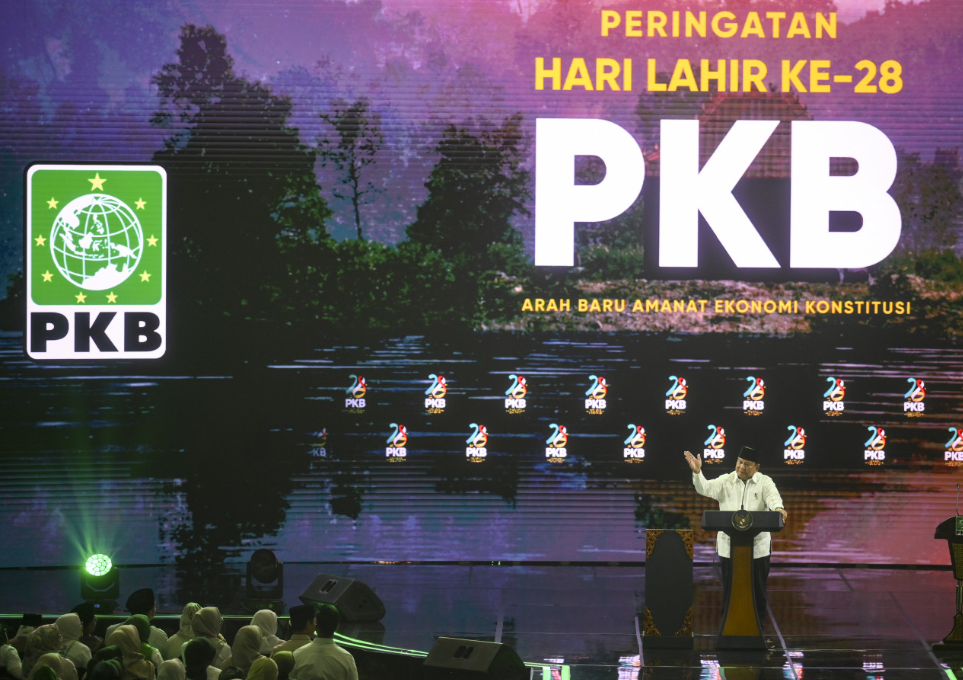
President Prabowo Subianto faces mounting pressure from the Indonesian media establishment after deploying a historically loaded insult against journalists, sparking a coordinated rebuke from six major press unions across the archipelago. The Alliance of Independent Journalists, the Journalists Association of Indigenous Peoples of the Archipelago (AJMAN), the Alternative Media Coalition (KOMA), the Society of Indonesian Environmental Journalists (SIEJ), the Indonesian Photojournalist Association (PFI), and the Archipelago Media Development Society (PPMN) have all issued formal demands for an apology, characterising the presidential comment as fundamentally incompatible with democratic governance.
During remarks at the National Awakening Party (PKB) anniversary celebration on Thursday evening, Prabowo invoked the term londo ireng whilst defending his administration against external pressures. He suggested that elements within Indonesian society retained allegiances to foreign powers, drawing a parallel to colonial-era collaborators. Prabowo specifically identified journalists, reporters, analysts, and non-governmental organisations as contemporary examples of this perceived disloyalty, implying that critical voices operating within these sectors might be serving interests other than the nation's.
The phrase londo ireng carries profound historical weight in Indonesian consciousness. Originating in the Javanese language, the term literally translates to "black Dutchman" and carries multiple layers of meaning shaped by colonial experience. Initially, it referred to West African mercenaries recruited into the Royal Netherlands East Indies Military (KNIL) following the catastrophic 1825-1830 Diponegoro War. The linguistic frame subsequently expanded to encompass indigenous Indonesians accused of collaborating with Dutch colonial authorities during the independence struggle—a designation that, even generations later, remains stigmatising within Indonesian political discourse.
For AJI chairwoman Nany Afrida, the presidential deployment of this terminology represents more than mere rhetorical excess. She characterised the remark as condescending, belittling, and corrosive to the legitimacy of professional journalism. Beyond the immediate sting of the insult, the categorisation carries insinuations of foreign complicity that strike at the core of journalistic identity in a post-colonial nation. Afrida emphasised that such accusations lack factual foundation and represent behaviour wholly unbecoming of a sitting president, particularly one committed to upholding Indonesia's democratic framework.
The unions grounded their objection within Indonesia's existing legal architecture governing press freedom. Law No. 40/1999 on Press establishes foundational protections for journalistic practice and expression. By invoking londo ireng—a term intrinsically bound to colonial collaboration and national betrayal—Prabowo arguably violated the spirit of legislation designed to protect rather than undermine press operations. The unions argue that the president's remarks directly contradict statutory obligations to foster an environment where journalism can flourish without suspicion or hostility.
Nany stressed that journalists operate under rigorous professional constraints, bound by the Journalists' Code of Ethics and legal requirements that govern their conduct. Rather than serving unaccountable foreign masters as the presidential statement implied, practitioners in the field work to deliver factual information to the public whilst subjecting themselves to established ethical frameworks. The accusation thus misrepresents the actual functioning of professional journalism, which the unions maintain serves primarily to illuminate governmental action and demand accountability from those wielding state power.
This confrontation reflects deeper anxieties about press freedom under the Prabowo administration. Nany noted that the president has previously demonstrated antagonism toward journalists, including incidents where he ordered members of the press to vacate rooms during public addresses. Such patterns suggest a presidential posture fundamentally at odds with democratic norms, wherein a free and independent press functions as an essential check on executive authority. The unions interpret the londo ireng remarks as emblematic of a broader unwillingness to tolerate critical scrutiny.
The timing of the dispute carries additional significance given Indonesia's regional role as a Southeast Asian democracy. For neighbouring nations monitoring institutional resilience and press freedom protections, how the Prabowo administration responds to this challenge will signal whether Indonesia remains committed to democratic principles or is experiencing institutional backsliding. Malaysian observers, in particular, may find the Indonesian case instructive given ongoing discussions in Malaysia regarding optimal balances between state authority and media independence.
The unions have advanced comprehensive demands extending beyond a simple apology. They seek formal guarantees that the government will cease stigmatising journalists, media organisations, civil society observers, and advocacy groups through rhetoric or policy. The demands include explicit commitments to journalist safety, assurances against intimidation or violence targeting practitioners, and avoidance of criminal charges deployed against media for critical reporting. These provisions effectively outline the unions' vision of baseline democratic conduct.
Nany articulated the fundamental democratic principle underlying the unions' position: in functioning democracies, criticism of governmental action represents normal and necessary practice rather than evidence of disloyalty. Journalists exercising critical scrutiny perform essential democratic labour, pushing authorities toward improved governance outcomes and greater public accountability. Hostility toward this function, whether rhetorical or institutional, corrodes the mechanisms through which democratic societies maintain equilibrium between state power and public oversight.
Prabowo's family background adds contextual complexity to the controversy. His maternal great-grandfather, Captain Benjamin Thomas Sigar, served as a KNIL officer involved in apprehending Prince Diponegoro during the colonial period—precisely the historical moment that generated the londo ireng terminology. From his paternal lineage, Prabowo lost relatives in anti-Japanese resistance during the final stages of colonial rule. This genealogical positioning within independence struggle narratives complicates interpretation of his invocation of londo ireng, potentially suggesting deep historical sensibilities shaping his worldview even as critics argue such sensibilities should not extend to delegitimising contemporary journalists.
The press unions' unified response demonstrates institutional cohesion within Indonesia's media sector and willingness to mobilise collective action in defence of professional interests. By orchestrating a coordinated demand involving six separate organisations, the unions signal that concerns about press freedom transcend factional divisions and represent broadly shared commitment to democratic principles. Their insistence that government must guarantee press safety and refrain from criminalising critical reporting establishes clear parameters for what constitutes acceptable state-media relations under democracy.
Looking forward, the dispute hinges on whether Prabowo will acknowledge union concerns and modify his rhetorical approach toward journalists, or whether he will maintain defensive postures that further entrench divisions between the executive and media sectors. The resolution will substantially shape the character of his presidency and signal to both domestic constituencies and international observers whether his administration prioritises democratic consolidation or concentrates primarily on executive prerogatives.

