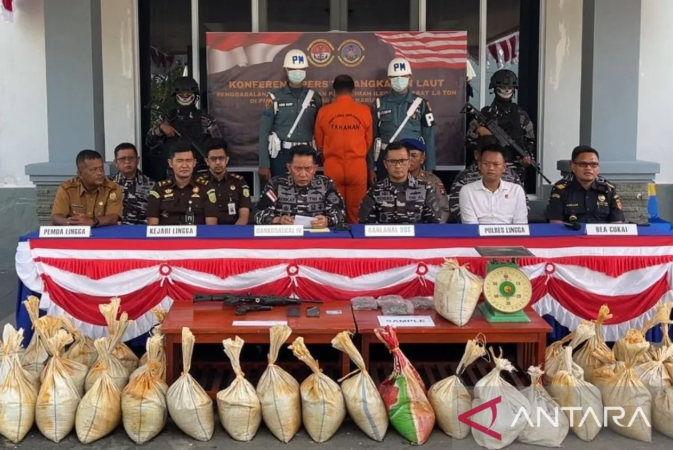
Indonesia's naval forces have successfully disrupted what officials believe was a systematic attempt to smuggle substantial quantities of illegally mined tin sand into Malaysia, uncovering a haul worth Rp76.04 billion (US$79,300) across multiple locations in the Bangka Belitung Islands region. The discovery marks a significant enforcement action against mineral trafficking in an area long plagued by unauthorised mining operations and cross-border resource flows. Vice Admiral Denih Hendrata, who leads the Indonesian Fleet Command, disclosed details of the operation during a public briefing in Tanjungpandan on Wednesday, describing how the initial detection of contraband at a jetty sparked a much broader investigation into what appears to be an organised smuggling network.
The operation unfolded across several weeks during August, beginning with a routine checkpoint inspection that yielded unexpected results. Naval personnel stationed at a jetty in East Belitung detected a truck laden with approximately eight tonnes of tin sand on August 2, immediately signalling the existence of potential illegal trafficking activity. Rather than treating this as an isolated incident, Indonesian authorities recognised the discovery as a possible window into a larger operation and shifted into investigative mode. This strategic decision to probe deeper rather than closing the case after the initial seizure proved instrumental in dismantling what appears to be a more extensive smuggling infrastructure.
Subsequent raids authorised following the initial interception revealed the true scale of the operation. On August 3, enforcement teams located roughly 50 tonnes of tin sand stashed in Lenggang village, representing a dramatic increase in the quantity already in state custody. The following day, August 4, investigators recovered an additional 10 tonnes carefully packaged in 200 individual sacks, suggesting a degree of sophistication in the operation's logistics and concealment methods. A final five-tonne seizure on August 8 brought the total recovered quantity to 75.7 tonnes, though officials have not ruled out the possibility that additional contraband may yet be uncovered as the investigation deepens. Hendrata emphasised during his statement that the operation remained active and expanding, with teams following investigative leads rather than simply cataloguing what had already been seized.
The geographical focus of these raids—the Bangka Belitung Islands located off Sumatra's eastern coast—reflects the region's historical significance as a tin production zone and its vulnerability to illegal mining operations. These islands have long been associated with both legitimate tin extraction and unauthorised small-scale mining that operates outside regulatory frameworks. The archipelago's coastal geography and proximity to maritime shipping routes create ideal conditions for smuggling networks to operate, as contraband can be moved by sea with relative ease compared to land-based trafficking. Malaysia's proximity to the region makes it a natural destination for illegally mined minerals, as the material can be processed or reexported through Malaysian ports and facilities that handle tin products.
At the time of Hendrata's briefing, investigators had not publicly identified any suspects connected to the smuggling operation, though the admiral indicated that five distinct locations were now under investigative scrutiny. This suggests that the network extended beyond the immediate areas where tin sand was seized, encompassing sites involved in extraction, processing, storage, or coordination of the smuggling effort. The complexity of operations spanning multiple locations indicates this was not merely opportunistic small-scale theft but rather an organised enterprise with established supply chains and distribution mechanisms.
To determine the quality and precise composition of the confiscated material, laboratory analysis was underway, with officials expecting chemical and mineral testing to provide additional insights into the origin and processing methods used. This technical investigation serves dual purposes: confirming the value of the seizure for official records and potentially identifying fingerprints of specific mining sites or processing facilities that could help trace the operation's source. Understanding the mineral content profile of seized tin sand can reveal whether material came from multiple sources or a single operation, and whether it had undergone any preliminary processing before interception.
The investigation's potential international dimensions underscore the transnational nature of mineral smuggling in Southeast Asia. Hendrata acknowledged that substantive progress in identifying recipients and dismantling the complete network would require cooperation between Indonesian and Malaysian authorities. Such interstate collaboration remains essential in maritime regions where smuggling operations routinely exploit jurisdictional boundaries and the relative difficulty of coordinated enforcement across national waters. The identification of Malaysian recipients represents a critical next phase that could reveal the extent of demand for illegally sourced tin on the Malaysian side and potentially expose downstream processing or trading networks.
This seizure arrives amid broader concerns about resource trafficking across Southeast Asia and the environmental and economic consequences of unregulated mining. Illegal tin extraction devastates local ecosystems, depletes national mineral reserves without proper compensation to governments, and fuels criminal networks that profit from weak enforcement. For Malaysia, which maintains significant tin processing and trading infrastructure, the supply of smuggled material can distort legitimate market prices and undercut producers operating within legal and regulatory frameworks. The success of this particular operation demonstrates Indonesian authorities' capacity to respond when smuggling activity is detected, though questions remain about how much illegal material successfully crosses borders undetected.
The Rp76.04 billion valuation assigned to the seized tin sand reflects current market prices for the commodity, though the actual economic damage extends beyond this single haul. If this operation had proceeded undetected, it would have represented revenue lost to Indonesia's legitimate mineral sector while enriching criminal networks. The broader implications for Indonesian resource governance are significant, particularly as the government seeks to strengthen oversight of mining activities and demonstrate commitment to preventing illegal extraction and export. Maritime enforcement capabilities, while improving, remain under strain given the vast coastlines and numerous islands that require monitoring across the Indonesian archipelago.

