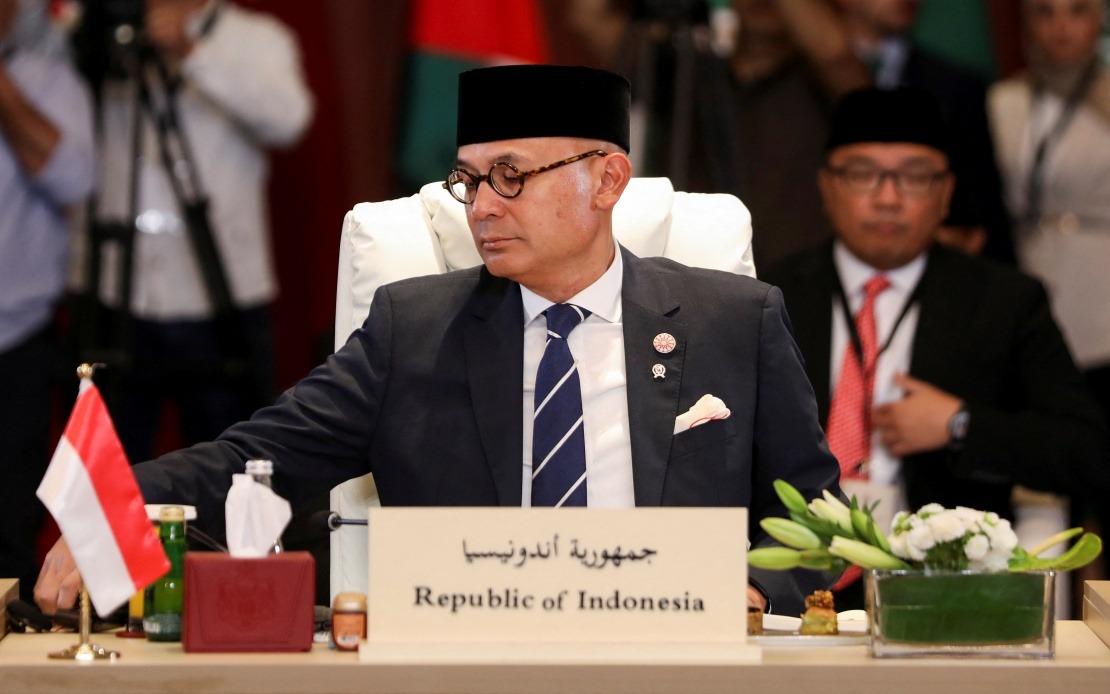
Indonesia has stepped up diplomatic pressure on the international community to forge a unified front in support of Palestine, moving beyond what Jakarta views as ineffective piecemeal responses to the long-standing territorial dispute. Speaking at the Ministerial Meeting on Jerusalem in Amman, Jordan, on Wednesday, Deputy Foreign Minister Arrmanatha Nasir—representing Foreign Minister Sugiono—articulated a vision of coordinated global action grounded in international law and collective resolve.
The timing of Indonesia's initiative reflects a regional concern that the Palestinian cause has become fragmented across competing diplomatic channels and varied national interests. Nasir's central argument centered on a diagnosis of division as Israel's primary strategic advantage. By highlighting how fragmented international responses have historically been exploited by Israel, Indonesia positioned itself as a voice for structural reform in how the global community addresses the conflict. This framing carries implications for Southeast Asian countries, many of which have significant Muslim populations and long-standing solidarity with Palestinian aspirations, yet often struggle to translate that sentiment into coordinated foreign policy action.
Indonesia's proposal outlined five interconnected pillars designed to strengthen international engagement with the Palestinian question. The first calls for developing a unified global strategy based on common principles rather than isolated bilateral positions. The second emphasizes strict adherence to international legal frameworks and respect for International Court of Justice rulings, a position that implicitly critiques what Indonesia sees as selective enforcement of international law. The third prong focuses on expanding the number of nations formally recognizing Palestinian statehood, a practical measure that would enhance Palestine's diplomatic standing and leverage in negotiations.
The remaining components of Indonesia's framework target specific dimensions of the conflict. Protecting the Al Aqsa Mosque and its broader compound—a site of extraordinary religious and political significance—has become increasingly contentious following periods of heightened Israeli security operations in the area. Indonesia's emphasis on this site reflects both its religious importance to Muslims worldwide and its function as a flashpoint in Jerusalem's volatile political geography. Similarly, the proposal to support Gaza's reconstruction addresses the humanitarian dimension of the conflict, recognizing that prolonged infrastructure damage perpetuates civilian suffering and undermines prospects for stability.
Indonesia also prioritized Palestinian national unity, acknowledging that internal Palestinian divisions have historically weakened the collective negotiating position and created openings for external actors to pursue divide-and-conquer strategies. The final measure calls for sustained backing of the United Nations Relief and Works Agency for Palestine Refugees in the Near East, which provides essential services to millions of Palestinians across the region. By anchoring its proposal in UN structures, Indonesia sought to legitimize its approach within established international institutions rather than positioning it as a challenger to the global order.
The broader geopolitical context that motivated Indonesia's intervention deserves careful attention. Nasir explicitly identified several destabilizing trends in West Asia that have accelerated in recent years: the expansion of Israeli settlements in the West Bank, which the international community largely views as violations of international law; Israeli military operations that have extended beyond Gaza into Syria and Lebanon; and intensifying tensions between the United States and Iran. This constellation of conflicts has created what Indonesia views as a critical juncture requiring decisive action before further escalation makes resolution more difficult.
The choice of Amman as the venue for this ministerial gathering carried symbolic weight. Jordan's role as custodian of certain Muslim holy sites in Jerusalem, and its complex relationship as both a neighbor to Israel and a constitutional monarchy with significant Palestinian refugee populations, made it an appropriate location for addressing these issues. The attendee list—bringing together foreign ministers and senior officials from Malaysia, Algeria, Saudi Arabia, Iraq, Egypt, Türkiye, Tunisia, Somalia, Pakistan, Morocco, Palestine, and Qatar, alongside the League of Arab States—represented substantial diplomatic firepower and reflected the issue's resonance across the Muslim world and the Arab sphere.
Indonesia's reaffirmation of support for Jordanian custodianship over Jerusalem's holy sites, including Al Haram Al Sharif, positioned Jakarta as supportive of existing arrangements while advocating for their stronger international protection. This nuanced stance reflects Indonesia's broader diplomatic approach: supporting Palestinian independence and condemning Israeli actions while respecting established regional institutional frameworks and treaties. Such positioning allows Indonesia to maintain influence across multiple stakeholder groups without appearing to endorse either extreme Israeli positions or positions that some Western capitals might characterize as maximalist.
The ministerial meeting's joint statement, which the assembled nations adopted, reinforced several core themes consistent with Indonesia's agenda. The rejection of unilateral moves to relocate diplomatic missions to Jerusalem underscored international concern about actions that could alter the city's status quo or prejudice final-status negotiations. The call for coordinated media campaigns to publicize Israeli actions and their consequences marked an interesting strategic choice—acknowledging that information warfare and narrative competition form integral dimensions of modern conflicts. For Malaysian readers particularly, such media coordination efforts could influence how regional populations perceive the conflict and support particular policy positions.
The Palestinian issue holds distinct salience within Indonesian foreign policy architecture. As the world's largest Muslim-majority democracy and a leader within the Non-Aligned Movement, Indonesia's statements on Palestinian matters carry weight across the developing world and particularly throughout the Islamic world. Jakarta's emphasis on building coalitions rather than issuing unilateral condemnations reflects a sophisticated understanding that sustainable international pressure requires broad-based consensus and institutional legitimacy. Indonesia's approach stands in contrast to more confrontational diplomatic styles, instead seeking to create positive incentives for international cooperation around shared principles of international law and human rights.
For Southeast Asian nations, Indonesia's initiative presents both opportunities and complications. Malaysia, which shares Indonesia's Islamic identity and Palestinian solidarity, must consider whether to amplify Indonesia's coalition-building efforts or maintain independent policy positions. Other ASEAN members with less pronounced positions on Middle Eastern affairs may face pressure to adopt clearer stances. The broader implication concerns whether Southeast Asian states can translate rhetorical support for Palestinian causes into coordinated diplomatic action that produces tangible results, or whether they will continue articulating support through symbolic gestures while lacking mechanisms for collective enforcement.
Looking forward, Indonesia's proposal essentially challenges the international community to graduate from rhetorical solidarity to institutional coordination. Whether countries will sacrifice independent positions and domestic political constituencies to join such a broad coalition remains uncertain. However, by framing the issue in terms of international law, institutional respect, and coordinated strategy rather than religious or ideological solidarity alone, Indonesia has created intellectual space for diverse actors to participate. The effectiveness of this diplomatic initiative will depend on whether the assembled nations can translate their joint statement into sustained, coordinated action addressing the concrete measures Indonesia has outlined.

