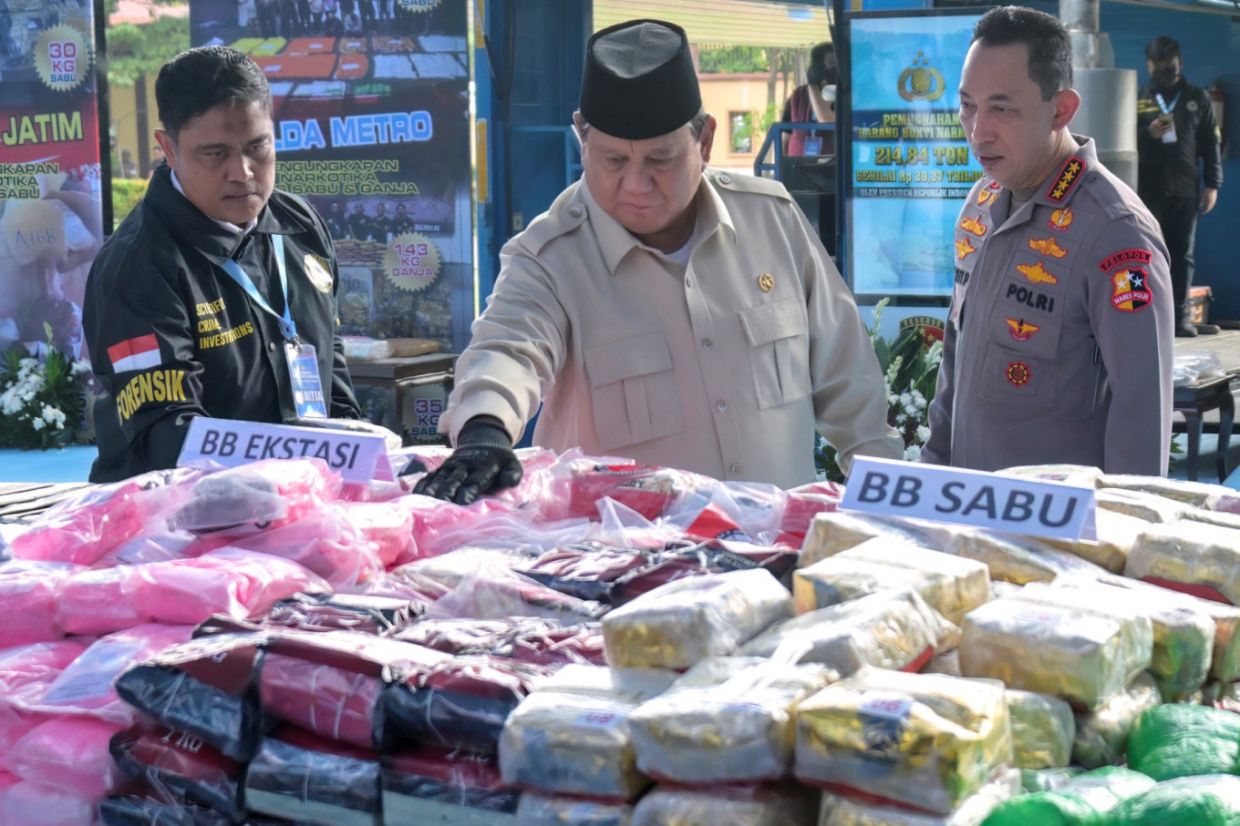
Indonesia's war on narcotics has claimed another significant victory with the interception of a merchant vessel carrying 2.6 tonnes of liquid methamphetamine—one of the nation's most substantial drug hauls in recent memory. The National Narcotics Agency orchestrated a joint operation with customs authorities to stop the MV Rain Maker, which was operating under an assumed identity, in waters near Bengkalis in Riau province late Monday. The seizure underscores the ongoing struggle faced by Southeast Asian nations against transnational drug trafficking networks that exploit maritime routes and flag irregularities to move contraband across borders.
Intelligence reports had flagged the vessel as a potential threat weeks earlier. Operatives learned that a ship departing from Sarawak, Malaysia, and traversing the Andaman Sea appeared destined for Indonesian ports with a suspicious cargo manifest. This tip enabled authorities to position themselves strategically along critical shipping lanes, leading to the successful interdiction. The agency's investment in intelligence gathering and inter-agency coordination proved instrumental in detecting what would have been a devastating influx of narcotics into local markets.
The contraband itself revealed careful concealment methods favoured by trafficking syndicates. Officials discovered the methamphetamine—in its liquid form, a particularly potent variant—concealed within eight water barrels and a water tank, a tactic designed to evade routine inspections and exploit the mundane appearance of standard maritime supplies. The liquid formulation compounds the severity of the seizure, as this preparation method facilitates easier transport and can yield higher purity levels compared to crystalline alternatives. Such sophistication in smuggling techniques reflects the organisational capacity and resources of international drug cartels operating throughout the region.
Beyond the primary narcotics seizure, customs officials made a secondary discovery that broadens the scope of the operation's significance. Sniffer dogs detected more than 1.5 million illegal cigarettes stashed aboard the same vessel, suggesting the trafficking network may have been diversifying its contraband portfolio across multiple illicit commodities. This pattern of multi-product smuggling demonstrates how criminal organisations exploit single voyages to maximise profits and distribute risk across different black markets.
Ten crew members, all identified as Myanmar nationals, faced arrest in connection with the seizure. Their detention raises questions about recruitment patterns within transnational smuggling networks and the vulnerability of seafarers from economically disadvantaged regions who may accept hazardous employment on vessels engaged in illicit trade. The involvement of Myanmar personnel aligns with established trafficking patterns, as the country has long served as both a source of precursor chemicals and a transit point for methamphetamine destined for markets across Southeast Asia and beyond.
This latest bust follows a similar interception just ten days prior, when Indonesian authorities seized 1.3 tonnes of ketamine from another vessel operating in Riau Island waters. That August 8 operation resulted in the arrest of eight crew members—seven from Myanmar and one from Taiwan—emphasising the serial nature of trafficking attempts through these strategic waterways. The concentration of drug seizures within a ten-day window in the same geographic region suggests either intensified smuggling activity or more effective enforcement deployment, possibly prompted by advance intelligence regarding a coordinated trafficking campaign.
The maritime corridor linking Sarawak through the Andaman Sea to Riau and beyond to Batam represents one of Southeast Asia's most trafficked drug routes. The geography combines weak enforcement capacity in certain stretches, the plausible deniability provided by legitimate commercial shipping volumes, and convenient proximity to major production facilities. For Malaysian and Singaporean readers, these intercepts underscore the regional nature of the drug crisis—contraband originating from or transiting Malaysian territory ultimately destined for Indonesian markets creates shared security challenges and necessitates continued cross-border cooperation.
Indonesia's legal framework surrounding narcotics offences ranks among the world's harshest, enshrining capital punishment for trafficking activities. However, the country has maintained an informal execution moratorium for several years, creating a gap between statutory penalties and actual enforcement. This inconsistency may paradoxically reduce deterrent effects while also providing international observers with reassurance regarding due process protections. For trafficking syndicates calculating risk-reward calculations, the distinction between theoretical execution and actual imprisonment becomes a factor in operational planning.
The 2.6-tonne seizure arrived just months after Indonesia announced what authorities described as the nation's largest-ever drug bust—a two-tonne crystal methamphetamine haul recovered from a fishing vessel bound for Batam Island from the Andaman Sea. That operation, conducted in 2023, set a benchmark against which subsequent seizures are measured. The current bust, while marginally smaller in weight, carries comparable significance given the liquid formulation's higher concentration and potency, potentially representing a larger number of individual doses.
These successive interceptions reveal both the sophistication of regional smuggling networks and the growing capacity of Indonesian law enforcement agencies to detect and disable trafficking operations. The integration of intelligence analysis, canine detection units, and inter-agency coordination demonstrates institutional learning and resource allocation improvements. Yet the relentless frequency of attempted smuggling suggests supply remains robust and demand within Indonesia continues driving criminal investment in new trafficking schemes.
For Malaysia, Singapore, and other Southeast Asian nations, Indonesia's drug enforcement challenges carry immediate implications. As the region's largest economy and a key transit point for regional narcotics flows, Indonesia's successes and failures directly affect the broader drug trade's structural economics. More effective enforcement in Indonesian ports increases costs and risks for traffickers, potentially redirecting contraband toward alternative routes through Malaysian or Thai waters. Conversely, sustained trafficking through Indonesian channels may reflect spillover effects from increased enforcement elsewhere.
The arrests and seizures also highlight the porous nature of maritime borders and the inadequacy of current enforcement infrastructure relative to trafficking sophistication. Vessels operating under false names, crew nationality mismatches, and concealment technologies that exploit standard maritime equipment demonstrate how determined criminal networks stay ahead of conventional detection methods. Addressing these challenges requires sustained investment in surveillance technology, intelligence sharing protocols, and training for maritime enforcement personnel across the region.

