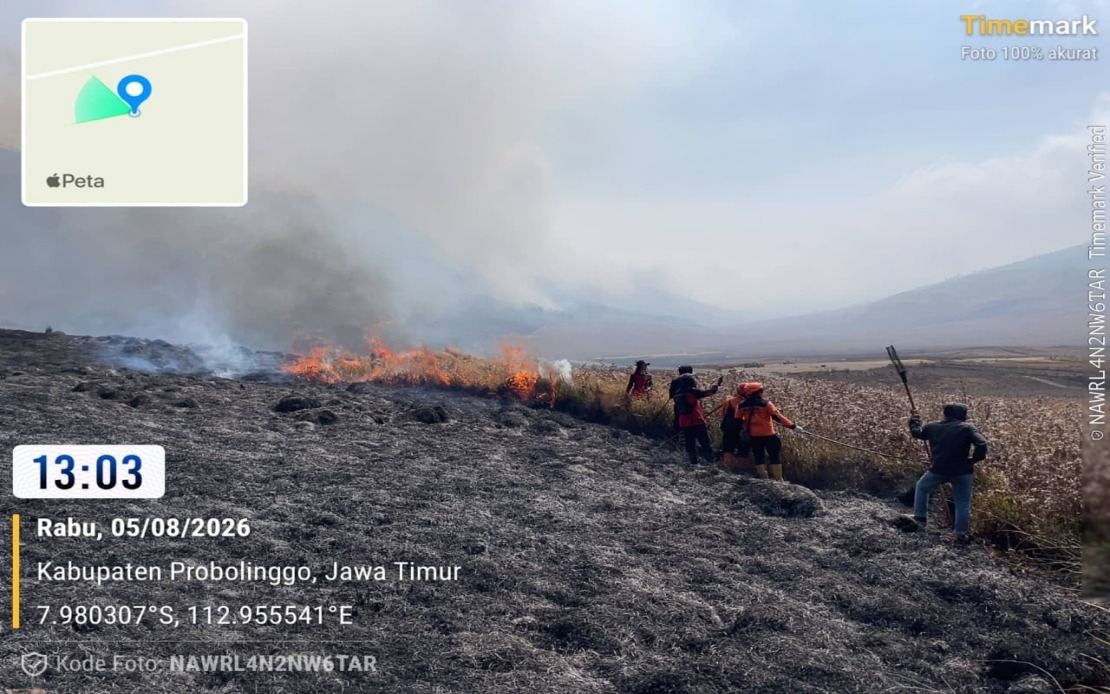
Indonesia's National Disaster Management Agency (BNPB) has launched an intensive aerial and ground campaign to contain a spreading wildfire at Mount Bromo in East Java, which has already scorched around 60 hectares of forest and vegetation across Probolinggo and Malang regencies. The escalation to helicopter deployment marks a critical intensification in efforts to manage what has become a substantial natural disaster threatening one of Indonesia's most iconic volcanic landscapes and a major regional tourism destination.
The blaze ignited on Monday and has since expanded dramatically, consuming approximately 10 hectares within Probolinggo Regency while devastatingly affecting the Bromo Tengger Semeru National Park in Malang Regency, where the majority of damage—roughly 50 hectares—has occurred. According to Abdul Muhari, head of BNPB's Disaster Data, Information and Communication Centre, ground crews achieved significant progress by Wednesday afternoon in controlling the fire's spread, yet the battle remained unfinished as dangerous hotspots persisted in precipitous terrain inaccessible to conventional firefighting teams.
The decision to deploy two water-bombing helicopters reflects the operational challenge posed by Mount Bromo's steep volcanic slopes, which present severe obstacles to ground-based firefighting personnel. These aerial assets provide critical capability for reaching and dousing flames in locations where terrain makes conventional approach impossible or extraordinarily hazardous. The helicopters represent a considerable commitment of resources, underscoring both the severity of the situation and the determination of authorities to prevent further expansion of the fire zone.
Beyond aerial operations, Indonesian disaster management officials are preparing to implement a Weather Modification Operation, contingent on atmospheric conditions, as an additional tool to suppress the remaining hotspots. This approach demonstrates the multifaceted nature of modern disaster response in Indonesia, combining traditional ground-based suppression with advanced aerial techniques and weather-dependent technological interventions. The integration of such diverse methods reflects institutional learning from previous wildfire experiences across the archipelago.
The Bromo Tengger Semeru National Park Authority has imposed a temporary closure of affected tourist zones to prioritize firefighting operations and safeguard visitor safety. This decision carries significant economic implications for regional tourism operators, guides, and hospitality businesses dependent on visitor traffic to one of East Java's premier attractions. The closure underscores how environmental disasters create cascading impacts extending far beyond immediate environmental damage into local livelihoods and economic activity.
Preliminary investigation suggests the fire originated from a campfire inadequately extinguished by hikers, though authorities are conducting a formal investigation to confirm the actual cause. If validated, this finding would emphasize recurring problems with visitor awareness regarding fire safety protocols in protected natural areas across Southeast Asia. Mount Bromo's popularity among both domestic and international trekkers creates inherent fire risks that demand continuous education and enforcement initiatives.
The incident reflects broader vulnerabilities affecting Indonesia's forest and wildland areas. Climate conditions, vegetation density, accessibility challenges, and human activity converge to create environments where fires can expand rapidly once ignited. The response mechanisms activated by BNPB and regional authorities demonstrate institutional preparedness, yet also highlight the resource constraints and operational difficulties inherent in managing large-scale wildfire incidents in challenging topography.
For Malaysia and other Southeast Asian nations, the Mount Bromo situation offers instructive lessons regarding wildfire management protocols, resource allocation, and coordination between national and regional disaster agencies. Cross-border fire incidents and transboundary smoke pollution have historically affected Malaysia, making monitoring and learning from Indonesian firefighting operations strategically relevant for regional environmental security.
The continuing operations at Mount Bromo underscore that emergency response teams remain engaged in managing residual hotspots even as major fire progression has been arrested. This phase proves equally critical, as inadequately suppressed embers can reignite into secondary fires, particularly given volatile wind conditions and combustible vegetation typical of volcanic forest ecosystems. Sustained vigilance and resource commitment will determine whether the current containment stabilizes into successful permanent suppression.

