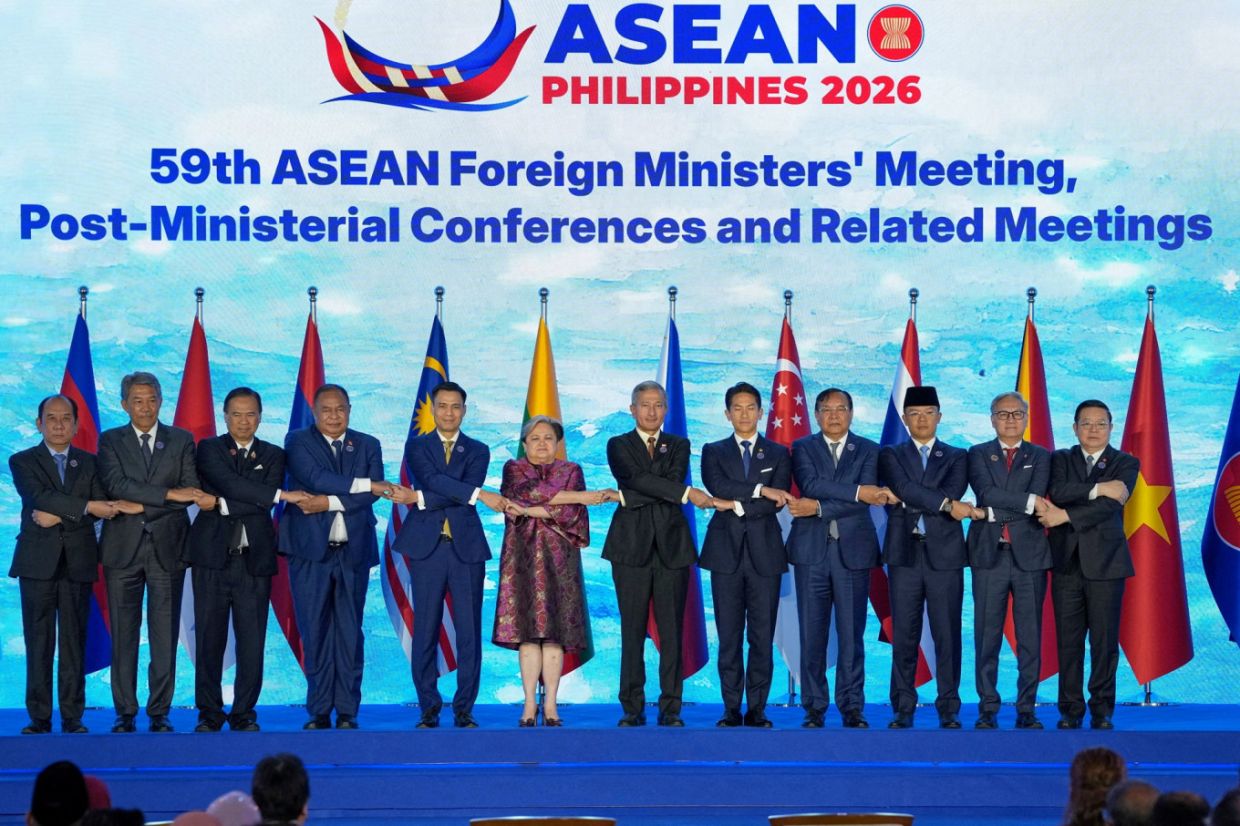
The Association of Southeast Asian Nations faces mounting pressure to prove its worth through substantive achievements rather than diplomatic platitudes, Indonesia warned on Tuesday in Manila, as top regional diplomats convened to chart a course through treacherous geopolitical waters. Indonesian Foreign Minister Sugiono delivered a pointed challenge to his counterparts from the 10 other member states, framing the bloc's ability to transform commitments into measurable progress as fundamental to its survival as a credible regional voice. His remarks underscored growing anxiety that Asean risks becoming increasingly marginalised in an era of intensifying great power competition and cascading regional crises that demand swift, unified responses.
Sugiono's intervention at the 59th Asean Foreign Ministers Meeting reflected deep institutional frustration. Recent international upheavals, from the Middle East conflict to maritime disputes in Southeast Asia, have exposed gaps between Asean's ambitious rhetoric and its actual capacity to influence outcomes. The Foreign Minister articulated this tension directly, asking fellow diplomats: "Can Asean deliver on its promises?" This seemingly straightforward question carries profound implications for an organisation that derives its legitimacy from its commitment to consensus-based decision-making and the peaceful resolution of regional disputes. The subtext was unmistakable—member states must move beyond statements of concern and produce tangible policy results that matter to their citizens and demonstrate relevance to their strategic partners.
The most pressing manifestation of this challenge lies in the prolonged negotiation over a Code of Conduct for the South China Sea, a dispute resolution framework that has languished for nearly a quarter-century. Sugiono emphasised that after 24 years of waiting, the region's peoples deserved rules-based governance rather than arrangements dictated by military or economic power. This formulation reveals a subtle but significant anxiety: that without a binding code, smaller Southeast Asian states risk being subordinated to the preferences of stronger nations, particularly China. The urgency reflects genuine concern that delays undermine Asean's leverage in Beijing, especially as member states increasingly depend on Chinese energy alternatives following disruptions caused by Middle East instability. Philippines data illustrating a doubling of solar panel imports from China in just five months exemplifies how economic dependencies are reshaping negotiating dynamics in real time.
The Middle East crisis has injected new complications into Asean's already fragile internal consensus. Joint statements expressing concern about economic impacts, the welfare of nationals, and supply chain disruptions mask deeper divisions over how aggressively the bloc should address the crisis or what positions it should adopt toward the conflict's principal actors. The energy vulnerability exposed by Middle Eastern turmoil particularly affects developing Southeast Asian economies dependent on stable energy imports, yet the bloc has struggled to coordinate substantive mitigation strategies beyond expressions of solidarity. This gap between acknowledged problems and coordinated solutions exemplifies the structural weaknesses that Sugiono implicitly criticised—Asean tends toward diplomatic statements rather than binding commitments with enforcement mechanisms.
Myanmar represents another arena where Asean's credibility has been tested and found wanting. The Five-Point Consensus, adopted as a roadmap toward resolving the country's military-led crisis, has produced minimal tangible progress despite years of implementation efforts. Divisions among member states persist, with some nations prioritising engagement with the military government while others maintain principled opposition. Philippine Foreign Secretary Theresa P. Lazaro's acknowledgment that ministers agreed to review how the Five-Point Consensus's progress is measured suggests the original framework has proven inadequate. Proposed reforms to Asean's annual special envoy mechanism—to be finalised by November's leaders' meeting—indicate recognition that procedural adjustments alone cannot overcome the fundamental lack of political will among member states to enforce meaningful consequences for non-compliance.
The timing of Indonesia's challenge carries particular significance. The May Asean Summit approved the admission of Timor-Leste as the bloc's 11th member, a step touted as demonstrating Asean's dynamism and relevance. Yet Sugiono's framing suggested that institutional expansion without substantive capability is merely performative. Expanding membership while failing to resolve core disputes or enforce agreed-upon positions risks diluting Asean's already-stretched consensus mechanisms further. The question implicitly posed was whether adding another voice to a chamber struggling to achieve unity represents progress or merely multiplication of complexity.
The underlying tension driving Indonesia's remarks reflects a sophisticated understanding of how regional dynamics have shifted. Asean's entire strategic architecture rests on the premise that smaller states can collectively constrain larger powers through institutional rules and consensus. Yet that premise weakens when economic realities—Chinese solar panels, Middle Eastern oil disruptions—force individual members toward bilateral accommodations that contradict collective positions. Indonesia's call for tangible results rather than mere promises acknowledges this erosion and demands a response that goes beyond incremental diplomacy.
Wednesday's scheduled meetings with external partners—the United States, China, Russia, and others—will test whether Asean can present a unified voice on critical questions of security, economics, and geopolitics. Historically, dialogue partners have sought to exploit divisions within Asean, offering bilateral inducements that undermine collective positions. The bloc's ability to maintain cohesion while negotiating with powers possessing vastly greater resources and military capabilities depends on demonstrating that Asean membership offers concrete benefits unavailable through bilateral arrangements. This calculation infuses Sugiono's challenge with urgency: without tangible deliverables, member states will increasingly pursue individual strategies that fragment the bloc.
Indonesia's diplomatic intervention also reflects its own strategic positioning. As the region's largest economy and population centre, Indonesia has long positioned itself as Asean's de facto leader, responsible for articulating collective interests and pushing the bloc toward greater coherence. By demanding that Asean deliver on its promises, Sugiono signals that Indonesia will not tolerate indefinite delays on matters affecting regional stability. The implicit warning extends to both Asean members—some of whom may resist binding agreements that constrain their autonomy—and external partners, particularly China, whose cooperation is essential for resolving the South China Sea dispute.
The chartered pathway forward appears incremental rather than transformative. November's leaders' meeting will review Myanmar policy procedures. The South China Sea code negotiation continues without a firm deadline. The Middle East's economic impact will be managed through national and regional mitigation efforts. Yet Sugiono's insistence on measurable outcomes suggests that Indonesian patience for diplomatic shadowboxing is wearing thin. For Malaysian readers and Southeast Asian observers generally, this tension between Asean's institutional rhetoric and actual capacity to produce binding, enforceable agreements directly affects regional security and prosperity. As great powers increasingly determine outcomes in Asia through military and economic coercion, Asean's relevance depends on proving that collective action can deliver results that individual states cannot achieve alone.

