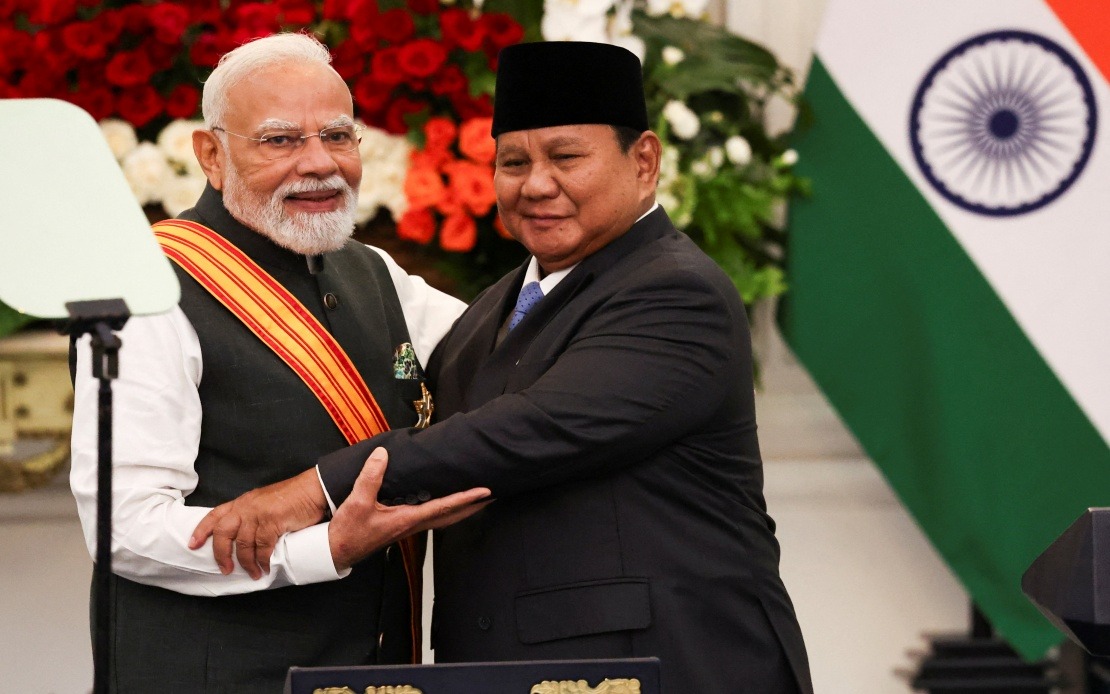
Indonesia has bestowed its most prestigious state honour upon Indian Prime Minister Narendra Modi, marking a significant diplomatic recognition during his ongoing state visit to the Southeast Asian nation. The accolade, presented by President Prabowo Subianto at the Merdeka Palace in Jakarta, underscores the deepening relationship between two of Asia's largest democracies as they navigate an increasingly complex geopolitical landscape.
President Subianto justified the award by highlighting Modi's instrumental role in elevating Indonesia-India relations to the status of a Comprehensive Strategic Partnership. The distinction reflects not merely ceremonial goodwill but rather acknowledges concrete contributions Modi has made to bilateral cooperation across multiple sectors and domains. Subianto emphasised that the recognition encompassed Modi's persistent endeavours to cultivate collaborative frameworks that benefit both nations, extending beyond traditional diplomatic channels into substantive development initiatives.
The Indonesian president specifically referenced Modi's backing for developmental programmes and infrastructure projects that have materially assisted Indonesia's national growth trajectory. This framing positions the bilateral relationship within a practical context rather than purely ideological terms, suggesting that both governments view cooperation as mutually advantageous and rooted in tangible outcomes. For Malaysian observers, this approach mirrors the pragmatic engagement model increasingly favoured across Southeast Asia, where countries prioritise demonstrable benefits alongside partnership declarations.
Historically, Indonesia has rarely conferred this highest honour on foreign leaders, which makes the award to Modi particularly noteworthy. President Subianto drew a parallel with Jawaharlal Nehru, India's founding Prime Minister, who received identical recognition decades ago. That comparison carries symbolic weight, positioning Modi within a continuum of Indian leadership that has fundamentally shaped Indonesia's trajectory as a nation. Nehru's pioneering role in establishing the Non-Aligned Movement—a concept deeply embedded in Indonesian foreign policy—provides historical context for understanding why Indonesia values India's contributions to regional stability and sovereignty.
Modi's visit represents a reciprocal gesture, following President Subianto's earlier visit to New Delhi this year. Such exchanges signal an intention by both governments to sustain momentum in their strategic partnership rather than allowing bilateral relations to drift or become episodic. For the broader Southeast Asian region, India's elevated engagement with Indonesia carries implications for the balance of power in the Indo-Pacific, particularly as regional nations calibrate their relationships with larger powers amid shifting strategic alignments.
The timing of this visit and honour acquisition occurs against a backdrop of Indonesia's expanding international profile. Subianto noted Indonesia's bid for permanent membership within BRICS, the influential bloc comprising Brazil, Russia, India, China, and South Africa. He acknowledged India's backing for this ambition, a gesture suggesting that bilateral cooperation extends into multilateral forums where Indonesia seeks enhanced representation. India's support carries strategic significance given New Delhi's own positioning within BRICS as a counterbalance to Beijing's dominance within the organisation.
President Subianto characterised Modi's visit as a watershed moment in bilateral relations, language suggesting that both governments perceive this engagement as catalytic rather than routine. He framed the visit as reflecting mutual commitment to advancing their Comprehensive Strategic Partnership through pragmatic, reciprocal cooperation that delivers tangible benefits. This rhetorical emphasis on concrete outcomes rather than aspirational partnership declarations reflects modern diplomatic practice, where domestic constituencies increasingly demand evidence that international engagement translates into domestic advantage.
The cultural and historical dimensions of Indonesia-India relations provided another pillar of Subianto's remarks. He emphasised the civilisational links connecting the two nations, rooted in centuries of shared history, religious exchange, and cultural flow. These deeper connections, he suggested, transcend contemporary political frameworks and provide enduring foundation for cooperation. For Malaysia, observing this emphasis on historical ties offers perspective on how larger nations in the region construct narratives of partnership—narratives that often emphasise civilisational affinity alongside contemporary strategic interest.
The bilateral meeting at Merdeka Palace, livestreamed to the Indonesian public, underscores both nations' desire to signal their partnership's significance to domestic audiences. Open diplomacy of this sort serves multiple functions: it validates executive decisions to invest diplomatic capital in the relationship, it demonstrates tangible international recognition and engagement, and it frames bilateral cooperation within narratives of national achievement. The public dimension of the honour presentation amplifies its domestic political value for both leaders.
Indonesia's willingness to accord Modi its highest honour reflects a calculated assessment that India represents an essential counterweight within regional geopolitics. As China expands its influence throughout Southeast Asia through Belt and Road investments and strategic positioning, Indonesia and other regional powers increasingly view India as a vital partner capable of providing alternative partnership models and investment opportunities. Modi's award recognition implicitly endorses India as a preferred partner in Indonesia's effort to maintain strategic autonomy amid great power competition.
The strengthening of Indonesia-India ties carries indirect significance for Malaysia and other ASEAN members navigating regional dynamics. Indonesia, as ASEAN's largest economy and most influential member, shapes the organisation's strategic posture. Enhanced Indonesia-India cooperation, particularly through structured Comprehensive Strategic Partnership frameworks, influences how ASEAN collectively engages with major powers. Malaysia observers should monitor whether this deepening bilateral relationship translates into broader ASEAN coordination mechanisms with India or whether it remains concentrated in bilateral channels.
Looking forward, the substantive outcomes and follow-up mechanisms from Modi's visit will determine whether the honour represents symbolic recognition or catalysts genuine strategic realignment. Both governments will face pressure to demonstrate that their elevated partnership commitment translates into measurable progress on shared initiatives, whether in infrastructure development, defence cooperation, or multilateral coordination. The success of these follow-through efforts will signal to other regional players whether Indonesia-India partnership constitutes a stable feature of the strategic landscape or remains dependent on individual leaders' initiatives and favourable circumstances.

