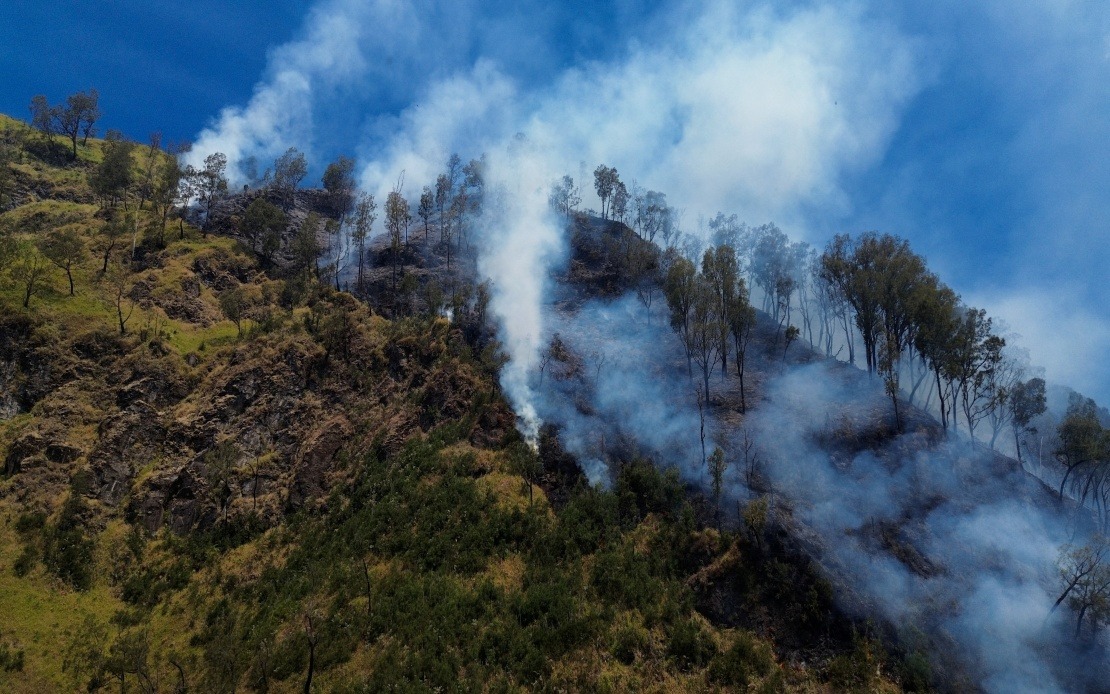
Indonesia's Bromo Tengger Semeru National Park authority has imposed an immediate closure of Mount Bromo to all visitors, halting tourism operations indefinitely as wildfires continue to ravage the volcanic caldera region in East Java. The decision, implemented at 10pm on Saturday, represents a significant blow to one of Southeast Asia's most popular tourist destinations during what would typically be peak holiday season in the region.
The comprehensive closure affects all five main entry points to the protected area: Cemorolawang in Probolinggo Regency, Wonokitri in Pasuruan Regency, and the combined access routes through Jemplang and Coban Trisula in Malang Regency, as well as Senduro in Lumajang Regency. Park officials characterised the move as essential both for enabling firefighting operations to proceed without obstruction and for safeguarding tourist lives in an increasingly volatile environment.
According to Abdul Muhari, head of Indonesia's National Disaster Management Agency (BNPB) Disaster Data, Information, and Communication Centre, the uncontrolled fire has been burning continuously since Monday and has already consumed approximately 176.20 hectares across the Probolinggo and Malang regions. Active hotspots remained visible late Saturday evening, with smoke still billowing from affected areas even as firefighting teams worked through challenging conditions and moderate wind patterns that could accelerate the fire's spread.
The scale of deployment underscores the severity of the situation. Two dedicated water-bombing helicopters, each equipped with 1,000-litre capacity tanks, have been mobilised to support ground firefighting efforts. This deployment represents a significant commitment of resources and suggests that conventional ground-based firefighting alone was proving insufficient to contain the advancing flames.
For international and domestic tourists who had already purchased online tickets for visits during the closure period, park authorities have arranged alternative arrangements. Visitors facing disrupted holiday plans can either reschedule their trips for a future date once the fire is extinguished and the park reopens, or process refund requests through the same online ticketing system. However, given the unpredictability of large-scale forest fires in tropical climates, reopening timelines remain uncertain.
The Mount Bromo crisis was not an isolated incident during this period. A separate forest fire simultaneously raged across the Sembalun Resort area within Mount Rinjani National Park, located in East Lombok Regency in neighbouring Nusa Tenggara Barat province. That blaze, which ignited around 8pm on Friday, consumed roughly 30 hectares before firefighters successfully brought it under control early Saturday morning at approximately 1.30am. The proximity of these two major incidents across separate volcanic peaks in East Java and the Lesser Sunda Islands suggests broader environmental or meteorological factors may be at play.
Investigations into the origins of both fires are currently underway, though preliminary findings have yet to be released. Authorities have not disclosed whether the causes were human-induced, such as abandoned campfires or deliberate arson, or whether natural phenomena such as spontaneous combustion in dry vegetation played a role. The absence of clear causal explanations adds uncertainty to public messaging about prevention strategies.
For Malaysia and broader Southeast Asia, the Mount Bromo closure carries implications beyond the immediate inconvenience to tourism operators. The event illustrates the region's vulnerability to seasonal fire hazards, particularly as climate patterns shift and vegetation becomes increasingly susceptible to rapid ignition. Malaysian travellers who routinely visit East Java—whether for religious pilgrimages to Mount Bromo's sunrise vantage points or adventure tourism—may need to revise travel plans and reconsider timing for upcoming trips.
The incident also highlights interdependencies within Southeast Asian tourism networks. Tour operators based in Malaysia, Thailand, and Singapore that market East Java packages to regional clientele face substantial disruptions to their business operations and reputational challenges if they cannot swiftly communicate alternative itineraries or compensation to affected customers. The closure demonstrates how environmental crises in one nation can ripple through the interconnected tourism economies of the entire region.
Longer-term, the fires at both Mount Bromo and Mount Rinjani warrant regional dialogue on wildfire management protocols, vegetation monitoring systems, and emergency response coordination across provincial and international boundaries. Indonesia's management of these incidents—including the decision to prioritise safety over short-term economic revenue—sets precedent for how comparable crises might be handled elsewhere in Southeast Asia where tourism and environmental protection compete for priority.
Until further notice, Mount Bromo remains inaccessible to the general public. Authorities have not announced provisional reopening dates, leaving both casual tourists and operators unable to plan with certainty. The situation underscores the volatility of natural environments and the precarious balance between tourism development and ecosystem preservation in one of the world's most biodiverse and geologically active regions.

