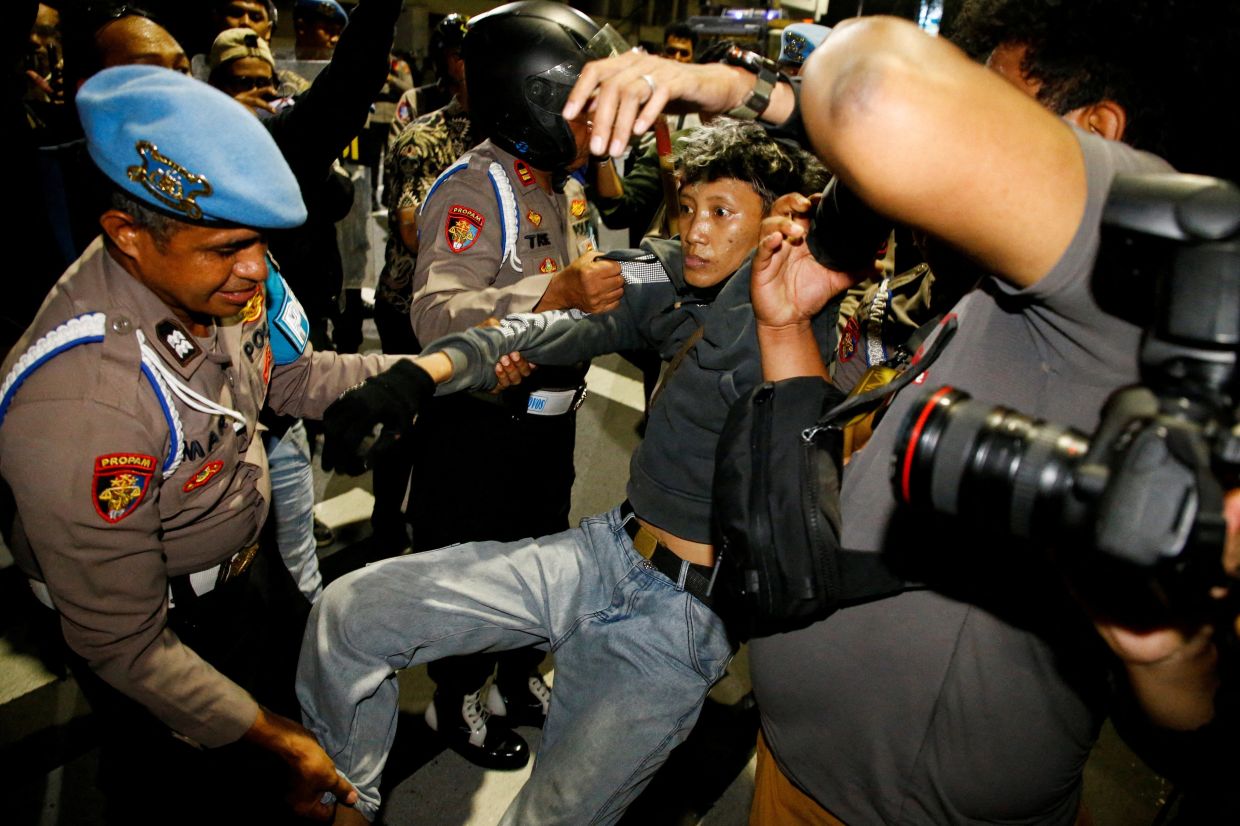
Indonesian law enforcement has moved to prosecute four individuals following an anti-government demonstration in Surabaya, the nation's second-largest city, marking a significant escalation in authorities' response to recent civil unrest that has swept across multiple urban centres. According to Surabaya police chief Luthfie Sulistiawan, the charges relate specifically to property destruction and assault against officers during Friday's gathering, which saw approximately 100 protesters assemble near a government building to voice grievances over two contentious policy decisions.
The demonstration in Surabaya was triggered by the government's decision to increase prices of non-subsidised petrol by roughly 30 per cent, a measure authorities justified as necessary to ease mounting fiscal pressures as geopolitical tensions in the Middle East continue to disrupt global energy markets and supply chains. The pricing adjustment has proven particularly unpopular given Indonesia's status as South-East Asia's largest economy where fuel subsidies remain deeply entrenched in public expectations and household budgets. This paradox—that an oil-producing nation must import substantial quantities of petroleum—underscores the structural vulnerabilities in Indonesia's energy economy and the difficult trade-offs policymakers face when attempting fiscal consolidation.
Beyond fuel pricing, protesters also directed their anger at the government's ambitious free school meals programme, an initiative designed ostensibly to combat childhood malnutrition across the archipelago. However, the scheme has become engulfed in controversy following widespread food poisoning incidents that affected tens of thousands of participants after the programme's rollout. Allegations of corruption have further tarnished the initiative, with critics arguing that poor implementation and insufficient oversight have transformed what should be a straightforward welfare intervention into a public health liability and a suspected vector for embezzlement and mismanagement.
Police accounts indicate that some demonstrators engaged in destructive conduct during Friday's assembly, with participants reportedly throwing firecrackers and hurling rocks toward officers deployed to manage the gathering. In response, Surabaya police determined that forceful dispersal measures were warranted, resulting in the arrest of 24 individuals at the scene. However, demonstrating either restraint or a pragmatic assessment that charges were insufficiently supported, authorities released the vast majority of those detained without pursuing formal charges. The decision to prosecute only four individuals suggests that police identified a specific subset of participants deemed culpable for the most serious violations of public order.
Beyond the four facing criminal charges, six additional detainees remain under investigation following the discovery of controlled substances in their systems during the initial processing phase. This ancillary drug-related investigation adds another dimension to the enforcement action and illustrates how public order incidents can become entry points for broader law enforcement activities. The outcome of these investigations remains unclear, though the development suggests authorities may employ multiple regulatory mechanisms to manage dissent.
The Surabaya incident reflects a broader pattern of increasingly organized and geographically dispersed resistance to the government's economic policies. In Jakarta, the capital, thousands of students have mobilised to express opposition to both the fuel price increases and the free meals scheme, indicating that youth constituencies view these policies as detrimental to national interests. Student activism has historically served as an early warning indicator of wider public discontent in Indonesia, and the scale and coordination of current demonstrations suggest genuine, substantive grievances rather than isolated complaints.
The free school meals programme presents a particularly complex political challenge for Jakarta's policymakers. Conceived as a flagship social welfare initiative with multi-billion-dollar annual commitments, the scheme was intended to address documented malnutrition among school-age children and to create visible evidence of government responsiveness to poverty reduction. Yet the programme has foundered due to inadequate institutional capacity, apparent corruption within supply chains, and catastrophic food safety failures that have generated public health crises rather than improvements. The partial suspension of the programme indicates that authorities have recognised the urgency of addressing these implementation failures, though critics contend that half-measures will prove insufficient to restore public confidence.
The fuel price adjustment, meanwhile, represents a more classic dilemma confronting developing economies dependent on energy subsidies. As global oil prices fluctuate and fiscal deficits mount, governments eventually must choose between unsustainable subsidy regimes and politically costly price liberalisation. Indonesia's substantial oil import requirements—despite domestic production capacity—reflect both declining domestic reserves and rising domestic consumption, a structural reality that constrains policy flexibility. By moving to reduce subsidies incrementally, the government signals its commitment to fiscal discipline, yet simultaneously provokes immediate public hardship that fuels legitimate grievances among lower-income households and small business operators reliant on energy-intensive activities.
For Malaysia and other Southeast Asian observers, the Surabaya events illuminate the political economy challenges confronting the region's larger economies as they navigate the intersection of fiscal sustainability, energy security, and social welfare provision. Indonesia's experience demonstrates that even well-intentioned social programmes can backfire catastrophically when implementation capacity proves inadequate, a cautionary lesson as the region's governments contemplate expanded welfare commitments. Additionally, the willingness of Indonesian authorities to deploy police enforcement against demonstrators, while relatively restrained in this instance, reflects the narrow margins within which governments operate when pursuing necessary but unpopular economic adjustments.

