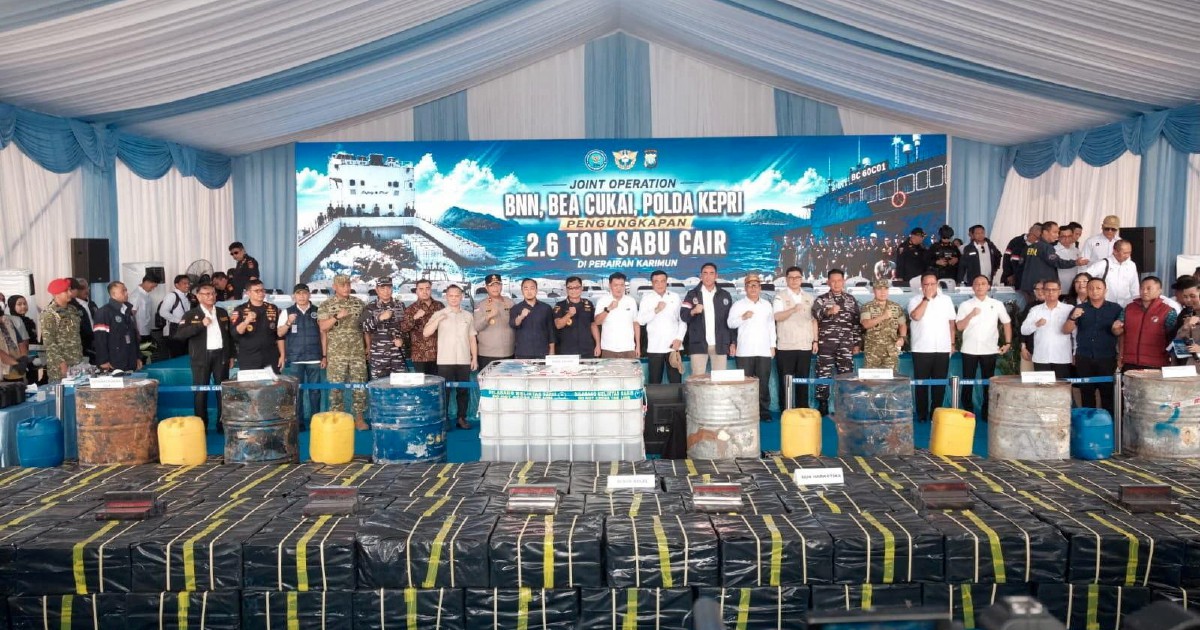
Indonesian authorities have secured a major victory against drug trafficking with the arrest of ten Myanmar nationals following the discovery of an enormous cache of liquid methamphetamine aboard a commercial vessel, officials announced during a press briefing in Jakarta on Friday. The seizure, involving approximately 2.6 metric tonnes of the synthetic drug, underscores the persistent vulnerability of regional maritime routes to exploitation by international narcotics syndicates seeking to move contraband across Southeast Asian waters.
The vessel in question sailed under a Tanzanian flag, a registration pattern increasingly common among smugglers attempting to obfuscate the true origins and ownership of ships engaged in illicit activities. This practice of flag convenience—where vessels register in jurisdictions with minimal oversight—has become a hallmark of transnational crime networks operating throughout the Indian Ocean and Southeast Asian maritime zones. The choice of such a flag suggests the operation involved coordination between multiple criminal entities spanning different continents and operating outside conventional law enforcement oversight.
The arrest of the ten Myanmar nationals points to the entrenched role that individuals from Myanmar play within regional drug production and distribution networks. Over the past decade, Myanmar's border regions, particularly areas under limited government control, have evolved into major manufacturing hubs for synthetic drugs destined for consumption throughout Asia and beyond. The nation's geographic position, coupled with porous borders and limited state capacity in remote regions, has created conditions allowing criminal enterprises to operate with relative impunity, transforming certain areas into de facto narcotics production zones.
Liquid methamphetamine represents a particularly concerning form of the drug due to its concentrated potency and transportability. Unlike crystalline forms, the liquid variant allows traffickers to conceal massive quantities within relatively compact shipments, dramatically increasing the volume that can be moved during a single operation. A 2.6 metric tonne seizure of liquid form translates to an extraordinarily large street-level quantity once diluted for consumer distribution, potentially representing hundreds of millions of dollars in black market value and enough product to supply addiction networks across multiple countries for extended periods.
Indonesia's enforcement success reflects intensified maritime interdiction efforts by regional authorities responding to years of escalating synthetic drug flows. The archipelago's vast sea lanes, connecting numerous islands across thousands of kilometres, create natural chokepoints for interdiction operations when law enforcement agencies deploy resources strategically. However, the sheer volume of maritime traffic passing through Indonesian waters daily means that even sophisticated detection systems capture only a fraction of actual trafficking attempts, indicating the true scale of contraband movement likely far exceeds publicly disclosed seizures.
The implications for Malaysia and other Southeast Asian nations remain significant, as liquid methamphetamine trafficking networks often target multiple markets simultaneously. Shipments destined for Indonesian consumption typically originate from the same sources and transit identical maritime corridors as consignments bound for Malaysian, Thai, or Philippine markets. The Myanmar nationals arrested may have connections to broader criminal organisations with operations spanning the entire region, suggesting that disrupting this particular network could yield intelligence beneficial to law enforcement agencies throughout ASEAN member states conducting parallel investigations.
Myanmar's role as a production epicentre cannot be divorced from the country's complex political situation and the associated breakdown of state authority in certain territories. Areas nominally under the control of armed organisations outside the central government's reach have become de facto sanctuaries for drug manufacturing facilities, which operate openly in some instances. International attempts to address the problem through diplomatic channels have yielded limited results, as enforcement capacity remains weak and political instability continues diverting governmental resources away from narcotics control toward internal security concerns.
The Tanzanian flag registration employed by the smuggling vessel illustrates how African jurisdictions, themselves struggling with capacity constraints and corruption, become unwitting accomplices in Asian drug trafficking. International maritime regulations permit vessels to register in nations entirely removed from their operational patterns, creating legal ambiguities that traffickers exploit systematically. Addressing this vulnerability would require unprecedented international coordination among shipping registries, port authorities, and law enforcement agencies—cooperation that remains elusive despite years of policy discussions at multilateral forums.
Indonesia's continued commitment to aggressive maritime interdiction comes amid broader regional concerns about synthetic drug proliferation. The country hosts extensive domestic demand for methamphetamine and serves simultaneously as a transit hub for products destined for Australia, New Zealand, and other distant markets. Each significant seizure represents not merely the removal of contraband but potentially the disruption of supply chains affecting multiple consumer markets across a geographic radius spanning thousands of kilometres.
The investigation into this shipment may yet yield additional arrests and uncover connections to other smuggling operations currently active within regional waters. Indonesian authorities have become increasingly sophisticated in following the financial and logistical threads extending from individual arrests to broader criminal enterprise structures. Intelligence derived from interrogating the arrested Myanmar nationals could provide valuable leads for coordinated enforcement efforts involving multiple ASEAN nations, particularly if the network maintained distribution infrastructure spanning Thailand, Malaysia, or the Philippines.

