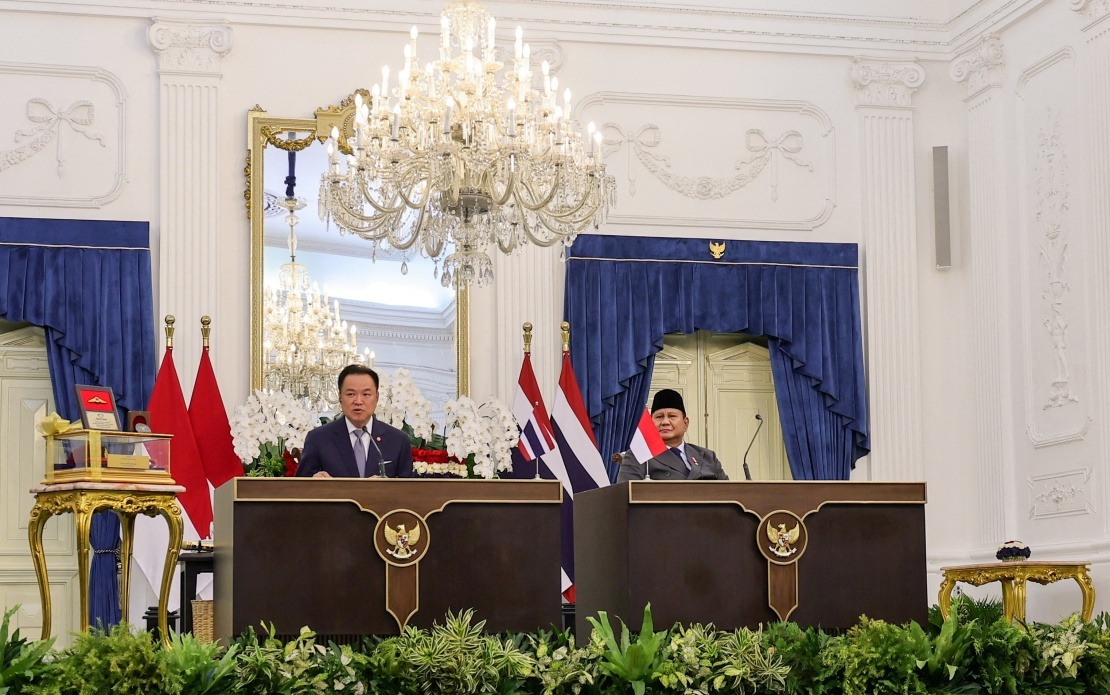
Indonesian President Prabowo Subianto and Thai Prime Minister Anutin Charnvirakul have jointly committed to sustaining ASEAN-led peace efforts in Myanmar, signalling the bloc's determination to implement its Five-Point Consensus through dialogue and humanitarian channels. The commitment emerged from their second Leaders' Consultation at Jakarta's Merdeka Palace, underscoring the strategic importance both nations place on regional stability as the bloc navigates Myanmar's ongoing political turbulence.
The Five-Point Consensus, adopted by ASEAN in 2021 following Myanmar's military coup, remains the organisation's cornerstone policy for resolving the crisis. By reaffirming support for inclusive dialogue and expanded humanitarian access, Indonesia and Thailand are signalling their intention to work within ASEAN's institutional framework rather than pursue unilateral interventions. For Malaysia and other Southeast Asian nations watching regional developments, this approach reflects a careful balance between respecting Myanmar's sovereignty and preventing the humanitarian catastrophe from destabilising the broader region through refugee flows and economic disruption.
Prabowo emphasised that maintaining ASEAN unity and centrality remains fundamental to achieving lasting peace and stability across the bloc. This statement carries particular weight given the increasing international pressure on ASEAN to take a firmer stance on Myanmar, with Western nations and some regional actors questioning whether the consensus approach has yielded tangible results. Indonesia's position as ASEAN's largest economy and most influential voice lends credibility to efforts to keep the bloc cohesive, though critics argue the Five-Point Consensus has struggled to translate diplomatic commitments into on-the-ground improvements in Myanmar's humanitarian situation.
Beyond Myanmar's immediate crisis, Indonesia and Thailand are deepening their bilateral security architecture to address the region's most pressing transnational challenges. The two nations have agreed to significantly enhance intelligence sharing, joint investigations, financial tracking, and law enforcement coordination specifically targeting online scam syndicates that have become increasingly sophisticated across Southeast Asia. This expansion reflects growing recognition that organised cybercrime networks operating from multiple jurisdictions require coordinated cross-border responses that legacy security arrangements were not designed to handle.
The scale of the online scam problem affecting the region cannot be overstated. Thailand's facilitation of the repatriation of nearly 1,000 Indonesian victims of scam operations demonstrates the humanitarian toll these networks inflict, often involving coerced labour, psychological trauma, and significant financial devastation for individual families. By establishing closer cooperation between Indonesian and Thai law enforcement, the two nations are attempting to disrupt criminal supply chains that recruit, traffic, and exploit vulnerable workers from multiple Southeast Asian countries, particularly those from economically disadvantaged backgrounds seeking overseas employment opportunities.
A significant institutional innovation emerging from the bilateral talks is the proposed Transnational Referral Mechanism, designed to streamline identification, protection, and repatriation of victims across borders. Such mechanisms are crucial because victims of transnational crimes often face legal ambiguity, lack documentation, or encounter bureaucratic obstacles that prevent their return home. By creating a standardised referral process, Indonesia and Thailand are attempting to establish best practices that could eventually be adopted more broadly across ASEAN, potentially improving outcomes for victims of human trafficking, labour exploitation, and other cross-border crimes.
Thailand's proposal to expand defence industry collaboration signals a deepening military partnership with Indonesia. The proposal to supply 36 amphibious wheeled armoured vehicles represents not merely a transaction but a confidence-building measure demonstrating Thailand's commitment to supporting Indonesia's military modernisation objectives. For regional observers, such defence procurement partnerships often carry strategic significance beyond their immediate military application, potentially signalling alignment on regional security perspectives and creating deeper institutional ties between defence establishments.
Anutin's visit to Jakarta marks his first official trip to Indonesia since assuming Thailand's premiership in September 2025, and notably represents the first visit by a Thai prime minister to Indonesia in 15 years. This timeline underscores how bilateral high-level engagement had atrophied despite the two nations' shared membership in ASEAN and their geographic proximity. The resumption of such visits at the prime ministerial level suggests both governments view deepening bilateral cooperation as essential to addressing emerging regional challenges that require coordination beyond formal ASEAN mechanisms.
The emphasis on maritime security cooperation reflects Indonesia and Thailand's shared interests in protecting critical sea lanes and preventing illegal activities in shared waters. Indonesia's position as the world's largest maritime nation and Thailand's role as a major shipping hub make their cooperation on maritime security vital for regional trade flows and security. Combined efforts to enhance maritime awareness and coordinate patrols represent practical applications of the broader security partnership being forged.
Wildlife trafficking emerged as another focus area in the bilateral discussions, with Thailand explicitly mentioning its readiness to strengthen ASEAN-wide efforts against transnational wildlife trafficking networks. Southeast Asia has become a critical hub for illegal wildlife trade, with organised criminal networks exploiting weak enforcement, corruption, and porous borders to traffic endangered species destined primarily for Asian markets. Indonesian and Thai cooperation on this front has implications for biodiversity conservation across the region and demonstrates how security cooperation increasingly encompasses environmental protection concerns.
The proposal for enhanced capacity building in law enforcement reflects realistic assessment that addressing transnational crime requires not merely operational coordination but systematic improvement in detection, investigation, and prosecution capabilities. By committing to joint training initiatives and knowledge sharing, Indonesia and Thailand acknowledge that many Southeast Asian law enforcement agencies face resource constraints and skill gaps that hamper their ability to investigate sophisticated transnational crimes. Such capacity building, when coordinated through bilateral channels, can eventually raise standards across the region.
For Malaysian policymakers and observers, the Indonesia-Thailand partnership expansion carries implications for ASEAN-wide security cooperation frameworks. Malaysia itself faces significant challenges with online scams, human trafficking, and drug trafficking, suggesting potential value in extending the bilateral intelligence-sharing and operational coordination models being developed by Indonesia and Thailand into broader ASEAN mechanisms. The success or failure of their Transnational Referral Mechanism will likely influence whether similar institutional innovations gain traction across the bloc.
The timing of this bilateral deepening, occurring against a backdrop of global geopolitical uncertainty and complex regional dynamics, underscores how Southeast Asian nations are attempting to strengthen intra-regional partnerships as insurance against external pressures. By emphasising ASEAN unity and centrality while simultaneously deepening bilateral security cooperation, Indonesia and Thailand are pursuing a dual-track strategy that combines bloc-level institutional frameworks with targeted bilateral partnerships on shared priority areas. This approach acknowledges ASEAN's limitations while attempting to preserve the organisation's role as the primary forum for regional diplomacy.

