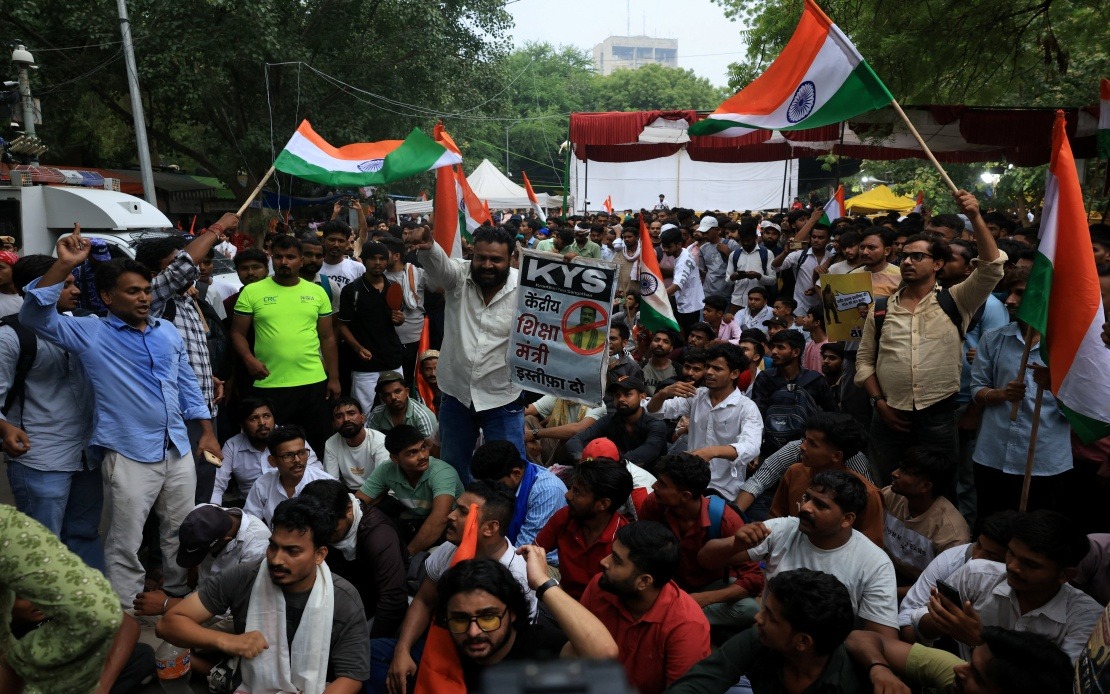
Thousands of demonstrators gathered in New Delhi on Monday to demand comprehensive reform of India's educational framework, in a dramatic show of youth activism that forced police to deploy containment measures outside the nation's legislative headquarters. The movement, organised by an emerging grassroots coalition claiming substantial digital presence, reflects growing discontent among younger Indians over the structure and quality of their academic institutions. The "Sansad Chalo" march represented an escalation in pressure on policymakers to address long-standing grievances within the education sector, even as Prime Minister Narendra Modi convened parliament for its Monsoon Session.
The timing of the demonstration proved particularly significant, coinciding with the commencement of parliamentary proceedings that would shape India's legislative agenda for the coming weeks. As protesters mobilised toward the parliament complex, security personnel established barricades to prevent direct access to the legislative building, setting up a tense standoff between demonstrators exercising their right to petition the government and authorities tasked with maintaining order. Local media accounts documented the deployment of crowd-control protocols typical of large-scale public assemblies in the Indian capital, where security officials frequently manage competing demands between public expression and institutional security.
The movement spearheading these demonstrations represents a notable shift in Indian youth activism, leveraging contemporary digital networks to mobilise support beyond traditional protest mechanisms. By claiming millions of online adherents, the organisers have tapped into widespread frustration among students and young professionals regarding educational accessibility, curriculum relevance, and employment preparedness. This digital-first strategy mirrors similar movements globally, where younger generations utilise social media platforms to circumvent conventional gatekeepers and build constituencies rapidly.
Educational reform in India has emerged as a critical policy debate, with stakeholders questioning whether the current system adequately prepares students for evolving labour market demands and developing competencies necessary in a technology-driven economy. The protesters' call for systemic overhaul likely encompasses concerns spanning pedagogical methods, examination systems, institutional funding, and the perceived disconnect between academic training and professional requirements. Such grievances resonate particularly among students navigating challenging employment landscapes despite educational credentials.
Prime Minister Modi's departure from the parliament complex during the demonstrations underscores the operational challenges posed by large-scale public gatherings near sensitive government installations. Security protocols require the protection of senior officials while simultaneously respecting citizens' constitutional rights to peaceful assembly and protest. The presence of the Prime Minister within the parliamentary precincts during such demonstrations necessitates heightened security measures and contingency planning.
The Monsoon Session itself carries substantial significance within India's legislative calendar, typically addressing matters requiring monsoon-specific considerations and enabling comprehensive debate on pending legislation. The commencement of this session now occurs against a backdrop of public pressure on educational policy, potentially influencing parliamentary discourse and prioritisation of reforms. Legislators may face renewed pressure to accelerate consideration of education-related proposals, particularly those addressing youth concerns articulated through such organised demonstrations.
Security arrangements across New Delhi reflected the broader implications of the protest, with enhanced measures implemented in key governmental areas and transportation corridors. Such precautions, while necessary for institutional security, also represent the visible assertion of state authority in response to public dissent. The scaling of security protocols across multiple locations demonstrates how substantial demonstrations ripple through urban governance and resource allocation.
For regional observers including those in Southeast Asia, India's youth mobilisation around education represents a noteworthy pattern within South Asia's democratic landscape. The ability of emerging movements to organise large-scale protests using digital platforms, coupled with willingness to challenge established institutions, reflects broader demographic shifts across the Indian subcontinent. Youth populations increasingly expect responsive governance and institutional adaptation to contemporary challenges.
The academic system reform debate extends beyond immediate institutional concerns to encompass questions of social mobility, economic competitiveness, and equitable resource distribution. Educational structures inherited from previous eras increasingly face challenges from rapidly evolving technological and professional landscapes, compelling policymakers to consider fundamental restructuring. The protesters' demands likely reflect recognition among younger Indians that incremental adjustments prove insufficient to address systemic shortcomings.
Parliament's response to such pressure will prove instructive for understanding India's policy flexibility and responsiveness to public demands. Whether legislative bodies prioritise education reform amid competing budgetary and political considerations will substantially influence both immediate outcomes and the trajectory of future youth activism. The government's engagement with these concerns may determine whether institutional channels successfully absorb public grievances or whether alternative forms of pressure continue escalating.

