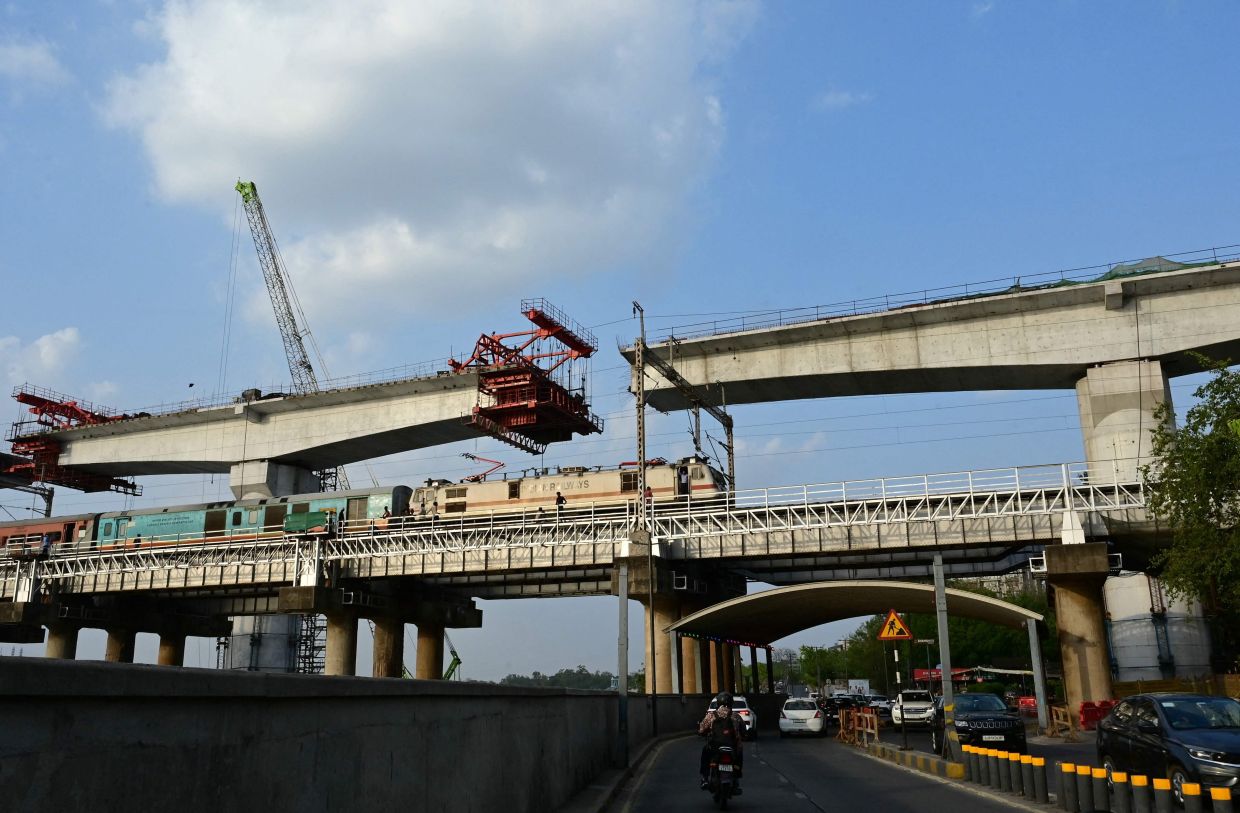
India is finally progressing with its long-anticipated first bullet train line, with railway officials confirming that the inaugural operational section will be ready by 2027, roughly nine years after construction commenced. The milestone represents a significant step forward for one of South Asia's most ambitious infrastructure projects, even as it falls well short of the original 2023 completion target set when Prime Minister Narendra Modi and then-Japanese Premier Shinzo Abe jointly launched the initiative in 2017.
The initial segment will connect the cities of Surat and Vapi, two industrial and commercial hubs separated by approximately 100 kilometres along India's western coast. Surat, renowned globally as a centre for diamond cutting and processing, and Vapi, an established manufacturing and chemical industry hub in Gujarat, will serve as the testbed for Japan's proven Shinkansen technology. Dharmendra Tewari, additional director general of Indian Railways, stated that considerable progress has already been made across the entire 508-kilometre Mumbai-Ahmedabad High Speed Rail Corridor, with the first section ready to commence passenger operations by 2027.
The project embodies India's broader railway modernisation agenda, which the government views as foundational to developing a nationwide electrified high-speed rail network. Officials believe the technical expertise, engineering capabilities and operational knowledge acquired through constructing and operating this initial line will provide the blueprint for subsequent high-speed corridors throughout the country. This learning process proves critical for a nation transitioning from managing one of the world's largest rail networks inherited from colonial times to establishing cutting-edge 21st-century transport infrastructure.
India's railway system has undergone remarkable transformation over recent decades. Operating one of the globe's most extensive networks spanning approximately 85,000 kilometres, Indian Railways transported 7.41 billion passengers and 1.67 billion tonnes of freight annually, with roughly 80 percent of all lines now capable of speeds exceeding 110 kilometres per hour. The domestically developed Vande Bharat trains, which can achieve speeds of 180 kilometres per hour, have become a source of national pride, carrying nearly 40 million passengers last year. Yet the bullet train, designed to operate at 320 kilometres per hour with a maximum capability of 350 kilometres per hour, represents an entirely different technological threshold.
When the complete 508-kilometre corridor opens by end of 2028, the journey between Mumbai and Ahmedabad will be compressed from the current six hours via rail or four to five hours by air into just under two hours. This dramatic reduction in travel time will fundamentally reshape connectivity between India's financial capital, a metropolis of 22 million inhabitants, and Ahmedabad, the principal city in Modi's home state of Gujarat. The timing aligns conveniently with Ahmedabad's hosting of the 2030 Commonwealth Games, an event the government views as a stepping stone toward India's broader aspirations to host the 2036 Olympic Games.
The project has navigated substantial obstacles since its inception. Originally budgeted at approximately 17 billion US dollars with 81 percent financing through the Japan International Cooperation Agency via Tokyo, cost overruns and escalating land acquisition expenses threaten to inflate the final price significantly. The engineering challenges are formidable, including a 21-kilometre tunnel through mountainous terrain and India's first undersea rail tunnel, infrastructure feats that have contributed to delays but underscore the project's technical sophistication.
Beyond the immediate Mumbai-Ahmedabad corridor, India's government has articulated far more expansive ambitions. Seven proposed high-speed rail corridors totalling 4,000 kilometres are being evaluated as potential future routes, which the administration describes as "growth connectors" capable of integrating major cities and facilitating seamless movement of people across state boundaries. One significant proposal would link New Delhi to Varanasi, Modi's own parliamentary constituency and one of Hinduism's holiest sites, and extend through to Siliguri, the strategic northeastern gateway connecting India's isolated eastern states with the remainder of the nation.
A second network envisioned in government planning documents would create a north-south axis running from Ahmedabad through Mumbai, then extending southeastward through the major technology and manufacturing hubs of Pune, Hyderabad and Chennai. This proposed network would establish unprecedented connectivity across India's economic heartland, potentially triggering substantial economic integration and trade flows between regions currently separated by significant travel times. However, these ambitious proposals remain largely plans on paper, lacking timelines, funding allocations or formal approval mechanisms.
The bullet train project carries profound significance within India's political and economic landscape. Modi, first elected in 2014 on a platform promising transformative infrastructure development, has made the high-speed rail network a personal priority and symbol of India's modernisation ambitions. The project's delayed progression has occasionally drawn criticism from opposition quarters, yet the government's persistence and incremental progress suggest deep institutional commitment to realising this vision. Japanese Premier Sanae Takaichi, Abe's successor, is scheduled to visit India this week, providing an opportune moment for both nations to reaffirm their partnership on this landmark infrastructure initiative.
For Southeast Asian nations and the broader region, India's evolving transport infrastructure holds relevance beyond mere bilateral India-Japan cooperation. As the Indian economy expands and becomes increasingly integrated with regional trade networks, improved domestic connectivity translates into enhanced capacity for international commerce and movement. The technologies, operational methodologies and institutional lessons India develops through implementing high-speed rail could potentially inform transport planning discussions across South and Southeast Asia, particularly among nations considering similar modernisation trajectories.
The 2027 opening of the Surat-Vapi section represents a crucial validation point for India's high-speed rail ambitions. A successful, punctual and commercially viable operation of this initial segment would substantially strengthen the case for prioritising the broader corridor network and subsequent phases of expansion. Conversely, any significant operational challenges or further delays would complicate political momentum for subsequent projects. This first section therefore carries disproportionate importance as both a practical milestone and a symbolic endorsement of India's capacity to execute world-class infrastructure projects on challenging timelines.

