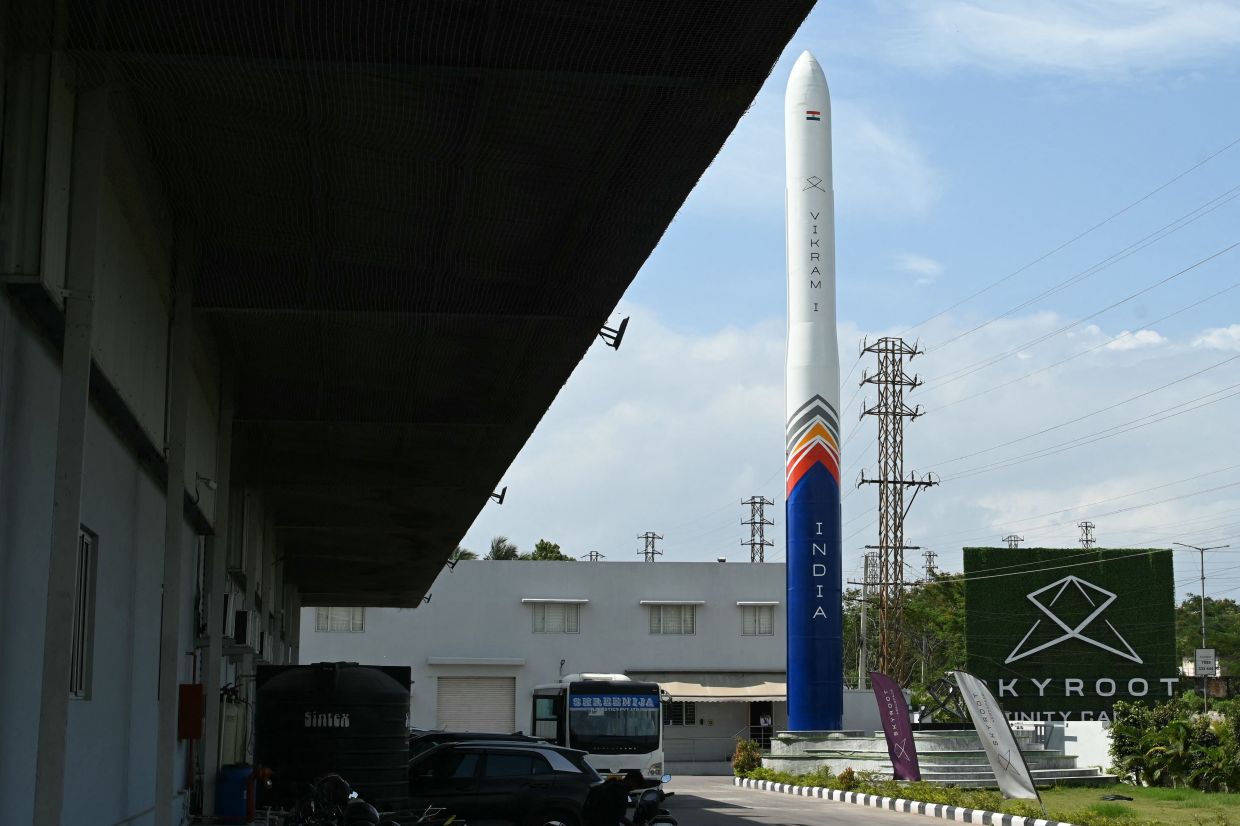
India's space programme has matured from a government monopoly into a thriving ecosystem where private enterprise and state ambition increasingly converge. Within days, Skyroot Aerospace will launch Vikram-1, the nation's first privately developed orbital-class rocket, from Sriharikota between July 12 and August 4. This milestone reflects the transformation of Indian spaceflight since the sector opened to private investment in 2020, attracting more than 400 startups to a market now valued at $8.4 billion and projected to reach $44 billion by 2033.
New Delhi's space achievements have firmly positioned India among global spacefaring nations. The Indian Space Research Organisation (ISRO) sent a spacecraft to Mars in 2014, becoming the first Asian nation to achieve orbit around the Red Planet. More recently, India's Chandrayaan lunar programme has marked successive milestones: an orbital mission in 2008, a failed landing attempt in 2019, and crucially, a successful 2023 rover deployment that made India the fourth country to land an unmanned craft on the Moon, following Russia, the United States, and China. Looking ahead, ISRO plans a fourth Chandrayaan mission in 2027 designed to return Moon samples to Earth, while a Venus orbit mission is scheduled for 2028.
Beyond planets and moons, India is pursuing parallel ambitions in space science and Earth observation. The ongoing Aditya solar mission is studying the Sun's outer layers and monitoring space weather patterns that affect satellites and communications systems. On the terrestrial front, ISRO technology is contributing to India's Matsya submarine project, which Science Minister Jitendra Singh says will carry researchers six kilometres underwater by 2027 to locate rare earth and critical minerals on the ocean floor. This convergence of space and deep-sea exploration underscores New Delhi's broader strategy to leverage advanced technology for resource security.
India has built a reputation for cost-efficient space missions that deliver results without the enormous budgets required by Western programmes. Since launching its first satellite aboard a Soviet rocket in 1975, ISRO has emerged as a significant commercial player, deploying more than 430 foreign satellites and earning over $600 million in revenue, whilst simultaneously launching more than 144 of its own. This track record has made India an attractive launch provider for countries and private entities seeking affordable access to orbit.
Recognising this opportunity, the government is expanding existing infrastructure and building new facilities to capture growing demand. The Sriharikota launch complex on Andhra Pradesh's southeast coast is undergoing modernisation, whilst a second spaceport is under construction at Kulasekarapattinam on Tamil Nadu's southern coast. These investments signal confidence in sustained commercial demand and India's capacity to compete with established spacefaring nations in the lucrative satellite launch market.
The private space sector now drives much of this growth trajectory. Skyroot Aerospace leads the charge with Vikram-1, a small-lift-launch vehicle designed to place compact satellites into low-Earth orbit. Pixxel is developing observation satellites for agricultural monitoring and environmental applications. Bellatrix Aerospace specialises in satellite propulsion systems, whilst Agnikul Cosmos manufactures small launch vehicles powered by innovative 3D-printed rocket engines. Collectively, these firms represent India's answer to international competitors like SpaceX and Rocket Lab, adapted to serve developing markets and emerging space nations.
International partnerships have become central to India's space strategy. ISRO collaborates with NASA and the European Space Agency, whilst maintaining bilateral cooperation with France, Germany, Italy, Japan, and Saudi Arabia. Russia provides technical support for India's nascent human spaceflight programme, reflecting Moscow's continuing role in Indian space ambitions despite geopolitical shifts. These partnerships diversify India's technological access whilst positioning New Delhi as a bridge between different space-faring blocs in an increasingly multipolar space economy.
Yet beneath the civilian achievements lies a strategic reality that shaped Indian space policy for decades: the deep integration between civil space technology and defence applications. ISRO and private companies supply both sectors with launch rockets, propulsion systems, satellite technology, avionics, and guidance systems. This duality is not accidental. The same expertise that places observation satellites in orbit serves India's growing missile and military drone programmes. ISRO maintains active coordination with the Defence Research and Development Organisation and maintains close ties with BrahMos, the India-Russia joint venture developing advanced cruise missiles.
This space-security nexus carries implications beyond India's borders. As Southeast Asian nations increasingly invest in space capabilities—whether for communications, resource management, or disaster response—they watch India's model closely. Malaysia and other regional neighbours face similar tensions between pursuing civil space benefits and the military dimensions of space technology. India's experience suggests that separating these domains is neither technically feasible nor strategically logical for developing nations seeking to maximise return on limited space investments.
Companies supplying guidance and avionics systems to ISRO are experiencing a surge in military orders, indicating that India's space ambitions cannot be disentangled from defence modernisation. This integration strengthens national capabilities but also shapes how India interfaces with regional partners and global space norms. For Malaysian observers, the Indian model demonstrates how space technology rapidly becomes embedded in broader security calculations, a reality that will shape Southeast Asia's evolving relationship with space-faring capabilities and international space governance frameworks.

