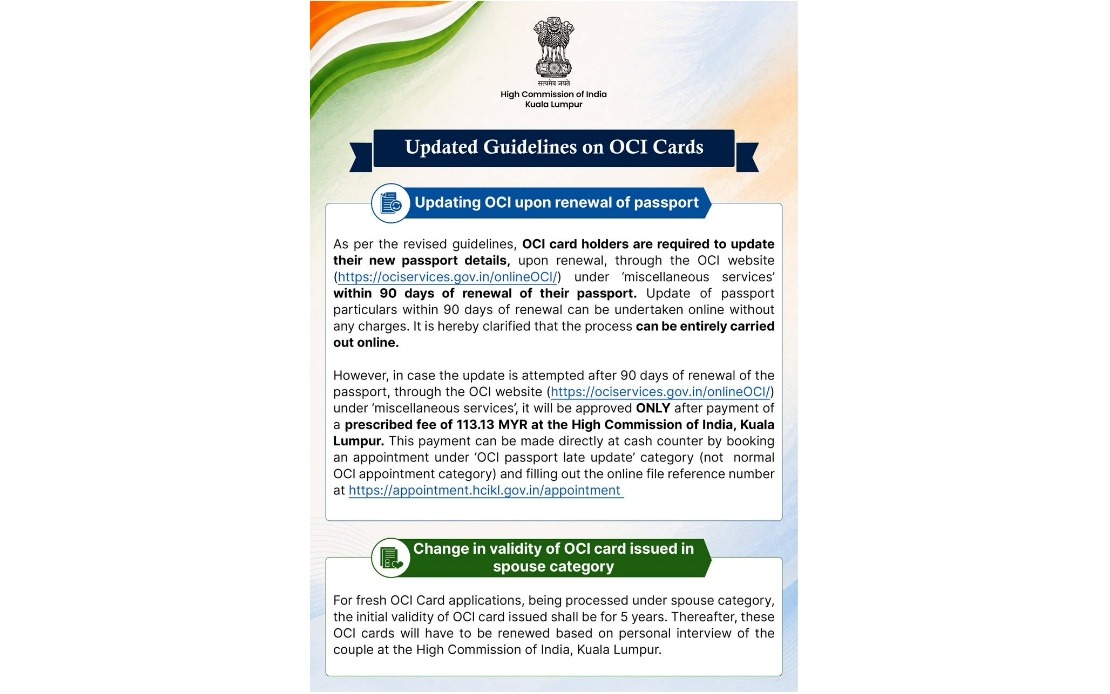
The High Commission of India in Kuala Lumpur has introduced streamlined yet more stringent procedures for managing Overseas Citizen of India (OCI) card documentation, bringing significant changes to administrative timelines that affect tens of thousands of OCI card holders in Malaysia. Under the newly issued guidelines, cardholders must report passport renewal details to Indian authorities within a tight 90-day window, a requirement that consolidates administrative efficiency with compliance enforcement across the growing diaspora community in Southeast Asia.
The revised framework allows OCI cardholders to fulfil this obligation entirely through digital channels at no cost during the initial 90-day window, streamlining what was previously a more cumbersome process requiring physical visits to the mission. The High Commission emphasised that the online update mechanism, accessible through the OCI website under the miscellaneous services section, eliminates bureaucratic friction for compliant applicants and represents a modernisation of document management systems that serves both the Indian government and the diaspora efficiently.
However, the guidelines introduce a financial penalty for those missing the deadline. Applicants who delay updates beyond the 90-day period must pay a prescribed fee of RM113.13 at the High Commission's cash counter in Kuala Lumpur. This structure incentivises timely compliance whilst generating administrative revenue and discouraging procrastination amongst cardholders who may otherwise postpone necessary documentation updates indefinitely.
The payment process requires advance appointment booking through a dedicated "OCI passport late update" category rather than the standard OCI appointment system. Applicants must present their online file reference number and proceed to the mission's counter during designated appointment slots, adding a layer of formal procedure that distinguishes late submissions from routine applications. This distinction reflects India's effort to manage administrative workload whilst maintaining orderly processing channels.
For Malaysian-based OCI cardholders, this development carries practical implications for travel and identity documentation, particularly given Malaysia's geographic position as a major hub for Indian professional migration and business activity. The 90-day window is sufficiently generous for most passport renewals, yet tight enough to require active engagement from cardholders rather than passive retention of outdated documents. The requirement reflects international best practices in maintaining accurate diaspora records, ensuring that Indian authorities possess current identification data for security and consular purposes.
Simultaneously, the High Commission announced a significant modification to OCI card validity under the spouse category, a development affecting married couples where one spouse is an Indian citizen or OCI cardholder. New applications processed under this category will now receive initial OCI cards valid for five years only, rather than the previous indefinite tenure that characterised most OCI issuances. This change introduces a deliberate verification mechanism into the spouse category specifically.
Following the initial five-year validity period, couples seeking to renew their OCI cards must attend a mandatory personal interview at the High Commission of India in Kuala Lumpur. This requirement ensures that both spouses appear in person, allowing Indian officials to verify the continuing validity of their relationship and assess whether circumstances that originally qualified them for OCI status remain unchanged. The interview requirement represents heightened scrutiny specifically targeting the spouse category, potentially addressing concerns about fraudulent applications or changed personal circumstances.
For the broader Malaysian context, this modification carries implications for mixed-nationality couples and families navigating Indian citizenship frameworks. The spouse category has traditionally offered streamlined pathways to OCI status for non-Indian nationals married to Indian citizens or existing OCI cardholders. The new interview requirement transforms what was previously a largely documentary process into a more interactive verification exercise, reflecting India's balancing act between facilitating diaspora engagement and maintaining immigration integrity.
The comprehensive nature of these revisions suggests that the Indian High Commission in Kuala Lumpur has undertaken a broader policy review of OCI administration in Malaysia, potentially prompted by processing backlogs, documentation discrepancies, or compliance failures identified in routine audits. By introducing stricter timelines and verification mechanisms, New Delhi demonstrates commitment to modernising diaspora management systems whilst asserting administrative control over card validity and accuracy. Such measures align with global trends towards more robust identity verification in immigration frameworks.
These guidelines carry downstream consequences for Malaysia's Indian diaspora community, which constitutes a significant demographic and economic force in the country. Many OCI cardholders are settled residents, business professionals, or retirees with deep Malaysian roots who nonetheless maintain Indian citizen connections. The procedural changes require enhanced engagement with Indian bureaucratic systems, even for those whose daily lives centre entirely on Malaysia. The online update mechanism mitigates this burden somewhat, yet the underlying message emphasises that OCI status entails ongoing administrative obligations rather than perpetual rights.
The High Commission has made detailed information regarding these revised guidelines available through multiple channels, including the official OCI portal and the mission's dedicated appointment booking website. This multi-platform communication approach acknowledges that OCI cardholders vary in their digital literacy and access patterns, ensuring that information reaches diverse audience segments within the Malaysian Indian community. Proactive dissemination represents an effort to minimise non-compliance driven by ignorance rather than deliberate avoidance.
For Malaysian authorities, these Indian policy shifts merit attention insofar as they affect foreign nationals resident in Malaysia or Malaysian citizens who hold dual OCI status. Any significant changes to Indian diaspora documentation requirements ripple through Malaysia's immigration and identity management frameworks. The 90-day passport update requirement and spouse interview mandate represent administrative intensification that may prompt queries to Malaysian immigration authorities from affected individuals seeking clarification on how these Indian procedures interact with Malaysian legal obligations.
The revised OCI guidelines underscore the dynamic nature of diaspora management in contemporary Asia, where millions of individuals maintain simultaneous engagement with multiple national frameworks and documentation systems. As India refines its overseas citizen administration, comparable changes across Southeast Asian host countries create cumulative complexity for individuals navigating multiple bureaucracies. Malaysia's significant OCI population should prepare for closer institutional engagement with Indian authorities whilst exploring whether equivalent administrative streamlining might occur within Malaysian frameworks themselves.

