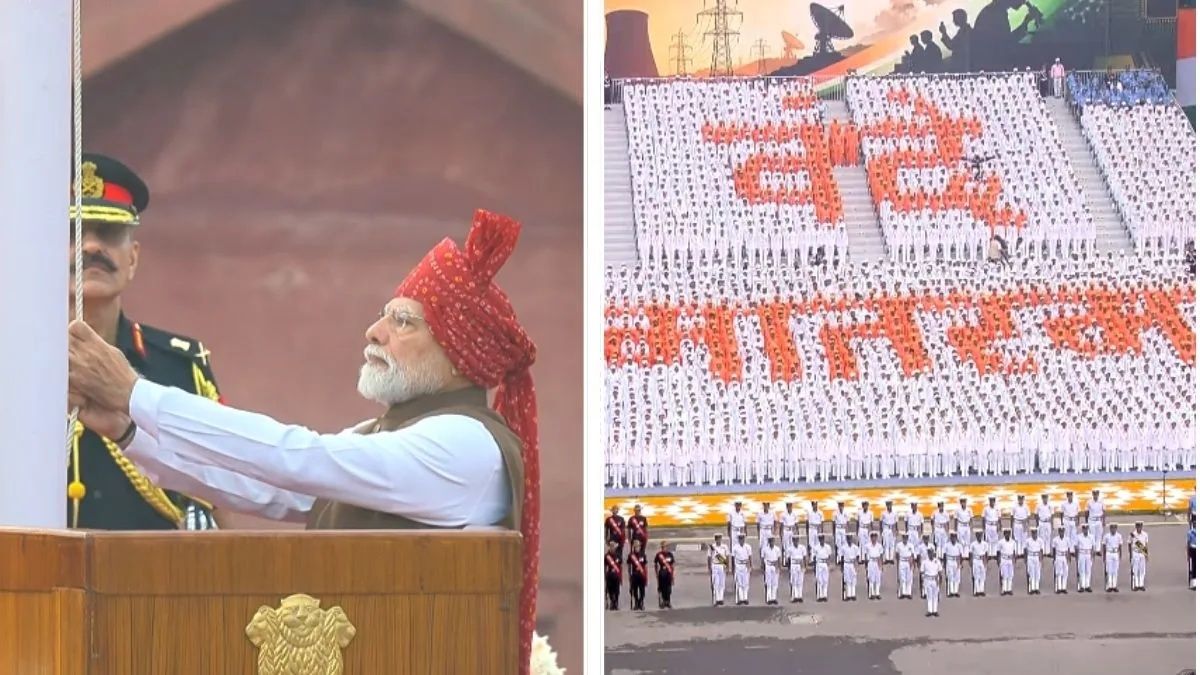
India has committed itself to a defining objective: achieving developed nation status within the next two decades. Prime Minister Narendra Modi articulated this vision during his Independence Day address at the Red Fort on Saturday, framing the goal of 'Viksit Bharat'—or Developed India—as a landmark aspiration that will shape the nation's trajectory through 2047. The announcement carries profound implications not only for India's domestic transformation but also for how the global community perceives the world's most populous nation and its economic potential.
Modi's pronouncement reflects a deliberate shift in India's national consciousness toward scaled-up ambitions. Rather than incremental progress, the Prime Minister explicitly cautioned against limiting aspirations, arguing that India must fundamentally reimagine what it can achieve. This messaging represents a philosophical departure from previous development paradigms, positioning the 2047 target as the driving force for citizen engagement and institutional reform across governance, industry, and society. The framing suggests that becoming a developed economy requires not merely policy adjustments but a collective mindset transformation among India's 1.4 billion people.
The economic foundation for this ambition rests on India's recent trajectory. Modi highlighted that the country has moved beyond the vulnerability that characterised its position as part of the 'Fragile Five'—a term applied to economies viewed as susceptible to capital flight and currency instability. This transition underscores genuine structural improvements in economic resilience and growth capacity. The Prime Minister's emphasis on escaping previous stagnation frames the 2047 goal as both ambitious and achievable, grounded in demonstrable recent performance rather than mere optimism.
Manufacturing strength figures prominently in Modi's development narrative. Defence production has expanded fourfold over the past twelve years, reflecting both security imperatives and industrial capability advancement. Khadi and Gramodyog production—sectors rooted in India's independence movement and rural livelihoods—has grown fivefold, suggesting that development targets encompass not merely large-scale industrial sectors but also traditional, community-based enterprises. Electronic manufacturing has surged sevenfold, positioning India as an increasingly significant player in global semiconductor and technology supply chains amid regional competition from Vietnam and Thailand.
The digital transformation metrics reveal perhaps the most striking modernisation. Mobile phone production increased by one-third during the twelve-year period, while digital transactions doubled, indicating deepening financial inclusion and technological adoption across income levels. These figures hold particular resonance for Southeast Asian observers, as they illustrate how large developing economies can achieve inclusive growth by harnessing technology to extend services to underbanked populations. Malaysia, having progressed further along the development path, may recognise both parallels and divergences in these growth patterns.
Modi's ceremonial emphasis during the address carried symbolic weight. The full rendition of 'Vande Mataram'—the national song—at the Red Fort on Independence Day for the first time since 1947 was characterised as historic. This symbolic act linked contemporary development aspirations to India's independence struggle, positioning the 2047 goal as a continuation of the anti-colonial project rather than merely an economic benchmark. The imagery of the Tricolour in homes and minds suggested that development ambitions must be anchored in renewed nationalist sentiment and collective identity.
The flag hoisting ceremony itself reflected indigenous military capability. The 1721 Field Battery deployed indigenous 105mm Light Field Guns rather than imported systems, symbolising India's defence self-reliance and industrial maturity. This emphasis on domestic production capacity across multiple sectors—from defence to electronics to traditional crafts—underscores that the development vision encompasses import substitution and sovereignty alongside growth metrics.
However, Modi's address also acknowledged immediate challenges tempering long-term ambition. Recent flooding across multiple Indian regions prompted the Prime Minister to express concern for affected families and pledge national solidarity. This balancing act between visionary goal-setting and pragmatic crisis response illustrates the governance challenge inherent in pursuing transformational development. Nations pursuing aggressive growth targets must simultaneously manage humanitarian crises, environmental vulnerabilities, and immediate citizen welfare—a tension that developing economies across Southeast Asia understand intimately.
The 2047 target carries geopolitical dimensions relevant to India's regional context. A developed India would fundamentally alter Asian economic architecture, potentially rivalling or exceeding existing major economies in aggregate capacity. For neighbouring nations and regional partners, India's development trajectory directly affects trade relationships, investment flows, technology competition, and security dynamics. The explicit articulation of this goal signals India's intention to reshape its regional role and global positioning over the coming decades.
The vision also implicitly challenges India's current institutional and infrastructural capacities. Transitioning from an emerging economy to a developed nation requires not merely increased production volumes but enhanced quality of life metrics, institutional effectiveness, education outcomes, healthcare delivery, and environmental sustainability. Modi's exhortation for bigger thinking may reflect recognition that incremental improvements in existing systems will prove insufficient for developmental leap-frogging required to achieve developed nation status within twenty years.
For Malaysian policymakers and observers, India's explicit 2047 commitment offers lessons about long-term vision articulation and citizen mobilisation around shared development goals. Malaysia itself has pursued ambitious development targets through successive plans, though perhaps with less explicit emphasis on a singular transformational date. The Indian approach of anchoring development aspirations in historical milestones—the centenary of independence—creates psychological and symbolic resonance that may enhance public commitment and institutional focus.
The success of India's Viksit Bharat vision ultimately depends on translating Prime Minister Modi's rhetorical ambition into sustained policy implementation, institutional reform, and inclusive economic participation. The manufacturing growth figures and digital transaction expansion suggest genuine progress, yet the gap between emerging and developed economy status remains substantial in per capita income, human development indicators, and institutional maturity. Whether India can maintain the political consensus, policy consistency, and investment discipline required across multiple electoral cycles and changing circumstances remains the critical question underlying this 2047 commitment.

