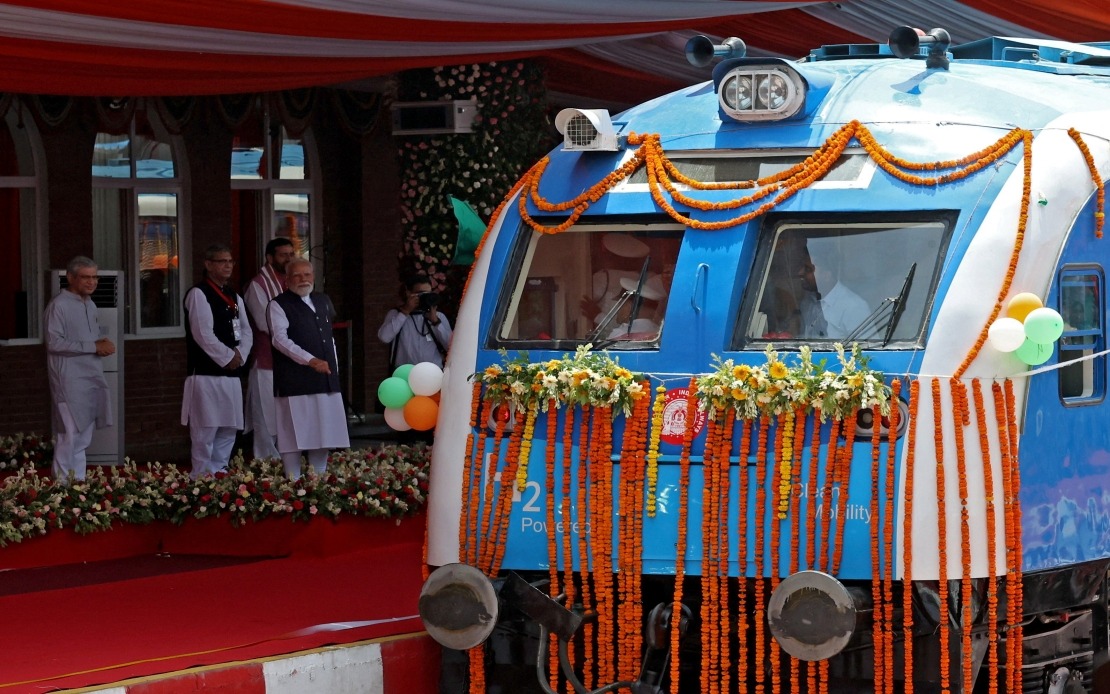
India has entered the hydrogen railway era with the inauguration of its first domestically developed hydrogen-powered train, a milestone that Prime Minister Narendra Modi formally launched on Friday. The vessel, poised to revolutionise mobility in the northern state of Haryana, will traverse the 89-kilometre corridor connecting Jind to Sonipat, transforming a crucial commuter link into a living demonstration of renewable energy innovation in mass transit.
The achievement represents a watershed moment for Indian technological self-reliance in the rail sector. Rather than importing turnkey solutions, Indian engineers and manufacturers have developed the hydrogen fuel cell technology from the ground up, reducing dependence on foreign expertise and positioning domestic industry as a competitive player in the global clean-energy railway market. This indigenous capability underscores New Delhi's broader ambition to position itself as a manufacturing powerhouse, particularly in sectors aligned with climate objectives.
At the operational heart of this train lies a 1,200-kilowatt Proton Exchange Membrane Fuel Cell system, a sophisticated component that orchestrates an electrochemical reaction between hydrogen and oxygen to generate electricity. Unlike conventional diesel locomotives, which emit carbon dioxide and particulate matter harmful to urban air quality, this hydrogen system produces only water vapour and heat as byproducts. The distinction carries profound implications for air quality in regions where railways serve dense populations, potentially alleviating respiratory health burdens that plague major Indian cities.
The ten-coach configuration has been certified to operate at speeds up to 75 kilometres per hour under current operating parameters, though its design architecture accommodates acceleration to 110 km/h, suggesting scope for enhanced service frequency once operational data validates safety margins. This staged approach to deployment reflects prudent engineering practice when introducing novel propulsion systems on revenue-generating routes where reliability and passenger safety are paramount.
India's entry into hydrogen railway operations positions it within an exclusive global cohort. China, Germany, Japan, and the United States have already deployed hydrogen trains on select routes, but their predominance stems partly from decades of fuel cell development funding and existing hydrogen supply infrastructure. India's rapid advancement in this field, achieved through concentrated effort and government backing, demonstrates the nation's capacity to leapfrog incremental improvements and adopt cutting-edge technologies swiftly when strategic priorities align.
The Jind-Sonipat route serves as a strategic testbed for several reasons. The corridor carries substantial passenger traffic, providing operational data under realistic conditions; the route's moderate distance aligns with hydrogen fuel cell endurance profiles; and Haryana's industrial base offers potential for hydrogen production facilities, enabling a closed-loop supply chain. Should performance metrics prove favourable, the technology could be replicated across India's vast 43,000-kilometre rail network, a transformation that would position Indian Railways among the world's cleanest mass transit operators.
From a climate perspective, this initiative advances India's commitments under the Paris Agreement and its Net Zero 2070 target. Railways already represent one of India's lower-emission transport modes, but hydrogen propulsion accelerates decarbonisation beyond what electrification alone can achieve, particularly for freight corridors and remote lines where electrification infrastructure remains economically challenging. The technology thus offers a pathway to green India's entire railway system, not merely high-density urban networks.
The hydrogen supply chain, however, remains nascent in India. Most hydrogen is currently generated through steam reforming of natural gas, a process that yields carbon emissions unless coupled with carbon capture technology. Long-term sustainability demands development of green hydrogen production via electrolysis powered by renewable energy. Government ministries and private investors are beginning to mobilise resources toward these upstream infrastructure investments, recognising that successful deployment of hydrogen trains hinges on expanding production capacity and distribution networks.
For neighbouring Southeast Asian nations including Malaysia, India's hydrogen train represents a technological benchmark and potential collaboration opportunity. Regional governments increasingly explore hydrogen as a long-term energy solution, and India's practical experience navigating engineering, regulatory, and supply-chain challenges offers valuable lessons. Potential partnerships in hydrogen technology development, joint manufacturing initiatives, or knowledge-sharing frameworks could accelerate the region's transition to clean transportation.
The Jind-Sonipat operation will generate crucial performance data regarding hydrogen system durability, efficiency, and maintenance requirements under Indian climatic conditions—monsoon humidity, temperature extremes, and dust exposure that differ markedly from operating environments in Europe or East Asia. This localised knowledge will inform subsequent generations of hydrogen trains and potentially attract international manufacturers seeking to adapt designs for Asian markets.
Looking forward, the success of this pilot will significantly influence Indian Railways' capital investment priorities. If operational outcomes validate hydrogen technology's reliability and economics, procurement budgets may shift toward hydrogen fleets, potentially disrupting the supplier ecosystem and creating opportunities for domestic manufacturing expansion. Private rail operators, particularly those developing freight corridors, may also evaluate hydrogen propulsion as a competitive advantage against trucking alternatives.
Ultimately, India's hydrogen train initiative symbolises a broader transformation in how nations approach infrastructure modernisation. Rather than perpetuating dependence on fossil fuels, governments increasingly leverage technological innovation to decouple economic growth from environmental degradation. India's success in this domain enhances its standing as a Global South technology leader and demonstrates that clean transportation solutions need not remain the exclusive preserve of wealthy industrialised nations.

