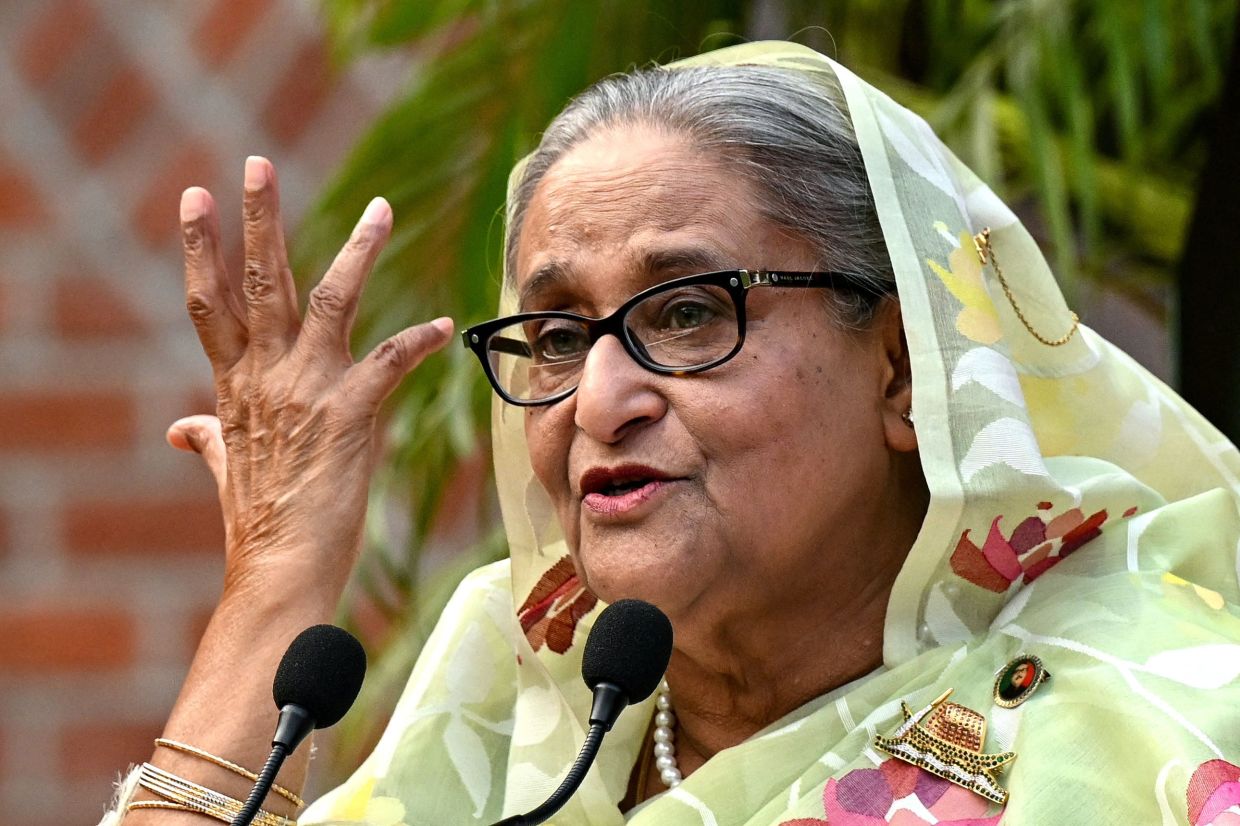
India's foreign ministry has moved to distance the New Delhi government from an upcoming virtual address by Bangladesh's exiled former Prime Minister Sheikh Hasina, declaring that the event falls entirely under private auspices. The clarification came after Bangladesh formally requested that India explain its position on Hasina's planned appearance, signalling mounting tension between the two South Asian neighbours over how they manage the controversial political figure who has been living in India since fleeing Dhaka following the student-led uprising that toppled her administration in 2024.
Indian Foreign Ministry Spokesperson Randhir Jaiswal confirmed on Wednesday that the August 5 event, being held under the auspices of the Foreign Correspondents' Club of South Asia, represents a private media initiative with which the government has no connection. Jaiswal explicitly stated that New Delhi "neither does it endorse any views that may be expressed at the forum," a carefully worded statement designed to insulate the Indian state from any association with Hasina's remarks. This public distancing underscores the delicate diplomatic position India finds itself in as it seeks to maintain improving relations with Bangladesh's post-2024 government while providing asylum to one of the country's most controversial political figures.
Meanwhile, Bangladesh has taken aggressive steps to prevent domestic dissemination of Hasina's words, with Information Adviser Zahed Ur Rahman warning local media outlets that broadcasting or publishing her speech would contravene a December 2024 order issued by Bangladesh's International Crimes Tribunal. The tribunal's directive explicitly bans the publication and transmission of Hasina's statements, interviews, and audiovisual material across both traditional and social media platforms. This represents a comprehensive attempt to control the narrative surrounding the 78-year-old former premier, whose absence from Bangladeshi public discourse is clearly a matter of concern for the ruling government.
The August 5 event marks the second anniversary of the uprising that forced Hasina from power, making the timing symbolically significant for both supporters and opponents of her rule. The address will represent Hasina's first public appearance since her flight from Dhaka, though it will occur via video link from India rather than in person. She is expected to be joined by her son, Sajeeb Wazed Joy, and other speakers who share her political perspectives, suggesting the event will serve as a platform for both personal and party messaging to international audiences and Bangladesh's diaspora.
Hasina's legal situation in Bangladesh remains precarious. In 2025, she was sentenced to death in absentia for crimes against humanity stemming from her administration's suppression of the 2024 student demonstrations. She has publicly dismissed this verdict as legally void, positioning herself as a victim of political persecution rather than accepting the tribunal's judgment. Her legal team and political allies have framed the conviction as part of a broader campaign to silence dissent and eliminate the Bangladesh Awami League as a political force, a narrative that will likely feature prominently in her virtual address.
Rumours about Hasina's future intentions have circulated through political circles, with her own statements to Reuters last month suggesting that she and senior Awami League colleagues plan to return from exile around December to face the courts. Should this materialise, it would create an immediate constitutional and legal crisis for Bangladesh's new government, forcing officials to choose between arresting their most prominent political rival or allowing her to remain free and continue mobilising opposition. The prospect of her return has clearly influenced Bangladesh's current efforts to suppress her public voice and prevent her statements from reaching the country's population.
Hasina's supporters argue that efforts to silence her cross-border activism demonstrate the authoritarian trajectory of Bangladesh's current administration. Abu Obaidha Arin, an aide to the former premier, declared that Dhaka's "efforts to silence dissent cannot extinguish voices" beyond Bangladesh's borders, framing the virtual address as an act of resistance against what he characterises as political suppression. This rhetorical positioning appeals to international audiences and human rights advocates who question the legitimacy of Bangladesh's post-uprising government and its handling of its political opponents.
Bangladesh's State Minister for Foreign Affairs Shama Obaed Islam has conveyed Dhaka's displeasure to Indian authorities on multiple occasions, emphasising that Bangladesh views political activities by Hasina and other Awami League leaders operating from Indian territory as problematic for bilateral relations. This messaging carries implicit pressure on India, suggesting that continued accommodation of Hasina's exile and political organising could undermine the improving ties both governments have signalled interest in pursuing. The framing positions this issue as central to whether India and Bangladesh can develop a more cooperative partnership under Prime Minister Tarique Rahman's administration, which took office following February's election.
Dhaka continues to pursue formal extradition proceedings against Hasina, though India has not indicated willingness to surrender her. The extradition question sits at the intersection of competing interests: Bangladesh's desire to prosecute its former leader, India's humanitarian considerations regarding asylum and protection of political figures, and broader diplomatic considerations affecting the relationship. India's arms-length approach to the August 5 event suggests New Delhi wishes neither to facilitate nor to openly obstruct Hasina's political activities, a pragmatic middle ground that satisfies neither Bangladesh nor Hasina's supporters.
The bilateral relationship between India and Bangladesh has undeniably strained since Hasina's July 2024 departure, though recent signals from both governments suggest a willingness to compartmentalise the Hasina issue and develop improved cooperation in other spheres. The new Bangladesh government has indicated openness to working with India on trade, security, and regional matters, positioning the relationship as moving toward normalcy. However, unresolved tensions over Hasina's presence in India and her political activities suggest that this chapter of India-Bangladesh relations will likely remain contested for the foreseeable future, with periodic flare-ups whenever the exiled former premier makes public statements or takes political action.
The August 5 virtual address represents a test of whether Bangladesh's media blackout can successfully prevent Hasina's message from reaching domestic audiences, and whether the international community views Bangladesh's suppression of her speech as legitimate governance or as an overreach. How this episode unfolds will influence perceptions of Bangladesh's commitment to pluralism and freedom of expression among Western democracies and multilateral institutions, factors that matter considerably for a nation seeking international investment and development assistance. For Malaysia and other ASEAN nations, the India-Bangladesh tensions serve as a reminder of how internal political crises can destabilise bilateral relationships and complicate regional diplomacy for years after the initial crisis passes.

