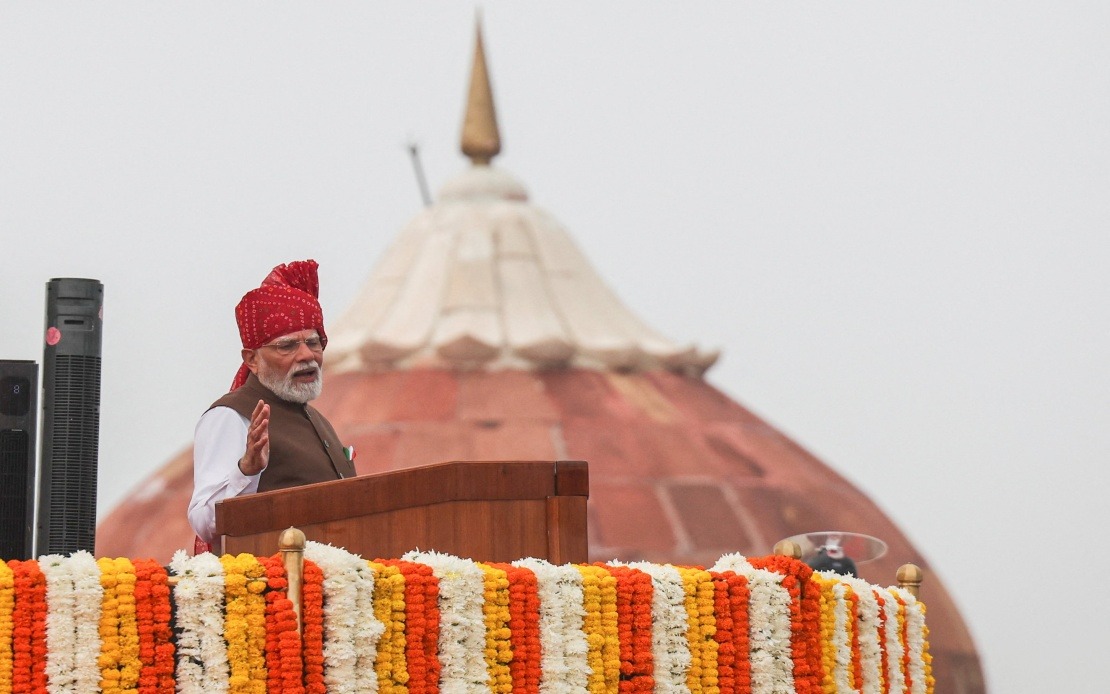
Indian Prime Minister Narendra Modi has articulated a comprehensive vision for transforming India into a self-reliant developed economy by 2047, anchoring his Independence Day address on Saturday around strategic investments in semiconductors, defence manufacturing, and energy security. Speaking from the Red Fort in New Delhi, Modi framed self-sufficiency across these vital sectors as essential to India's trajectory toward prosperity, a message designed to galvanise both policymakers and citizens around the government's long-term developmental aspirations.
The semiconductor sector occupies a central position in Modi's economic strategy, reflecting India's determination to reduce dependence on global chip supplies and establish itself as a manufacturing hub. Three semiconductor fabrication plants have already begun operations, Modi announced, with expectations for five to eight additional plants to become functional within the next seven to eight years. This expansion carries significance for Southeast Asia's technology landscape, as India's growing chip manufacturing capacity could reshape regional supply chains and potentially reduce the entire region's reliance on concentration in Taiwan and South Korea. For Malaysia, which hosts substantial semiconductor operations and serves as a global microchip hub, India's advancement represents both competitive pressure and potential partnership opportunities in an increasingly diversified Asian manufacturing ecosystem.
Nuclear energy features prominently in Modi's energy security calculations, with India targeting 100 gigawatts of nuclear capacity by 2047, a substantial increase from current levels. The Prime Minister highlighted India's recent breakthrough in mastering fast-breeder nuclear technology, characterising this achievement as a watershed moment for the country's journey toward self-sufficiency in nuclear fuel production. India's nuclear ambitions carry regional implications, as the country's energy security decisions influence broader Asian geopolitical dynamics and competition for energy resources. The fast-breeder reactor programme particularly demonstrates India's capacity for technological innovation in complex energy infrastructure, positioning the nation as an increasingly sophisticated player in global nuclear technology markets.
Renewable energy achievements underscore India's multifaceted approach to energy independence. Solar capacity has expanded dramatically from 2 gigawatts to 160 gigawatts over the past 12 years, a nearly 80-fold increase that reflects both technological advancement and massive capital deployment. This trajectory places India among the world's leading solar energy markets and illustrates how quickly renewable infrastructure can scale when backed by sustained government commitment and capital investment. The renewable energy emphasis also aligns with global climate commitments and demonstrates that economic self-reliance need not conflict with environmental objectives—a balance that Southeast Asian nations increasingly seek to achieve in their own energy transitions.
Exploration activities for offshore oil and gas reserves underscore India's comprehensive energy strategy beyond nuclear and renewable sources. Modi announced 850 billion rupees, equivalent to approximately US$8.9 billion, allocated for exploration in offshore areas previously considered economically unviable. This exploration drive reflects India's recognition that energy security requires diversified sources rather than overdependence on any single technology. The investment in previously marginal reserves highlights the economic calculations underlying India's self-reliance doctrine: mobilising capital at scale to develop resources that other nations might consider uneconomic, thereby reducing exposure to international energy markets and price volatility.
Military and defence manufacturing constitutes another pillar of India's self-reliance architecture. Modi emphasised the government's commitment to developing domestic capabilities in advanced defence technologies, particularly unmanned aerial systems, counter-drone systems, and hypersonic defence platforms. India's push for indigenous defence production reflects a strategic calculation about national sovereignty and military independence, reducing vulnerability to international arms embargoes or supply disruptions. For the region, India's strengthening defence-industrial base carries significance for the balance of power in the Indian Ocean and beyond, potentially enabling India to respond more autonomously to security challenges without external dependency.
The Prime Minister's exhortation to Indians to favour domestically produced goods extends beyond mere economic nationalism into a behavioural campaign aimed at shifting consumption patterns. Modi's argument—that purchasing foreign goods may offer short-term convenience and cost savings but fails to build indigenous capabilities or test domestic innovation—reflects a philosophical position about how economies develop. This messaging targets domestic consumption habits as a policy lever, encouraging citizens to view purchasing decisions as participating in national development. For a nation of India's scale and population, shifting consumer preferences can generate enormous domestic demand, enabling Indian manufacturers to achieve economies of scale and technological maturity that global competitiveness requires.
The 2047 timeframe carries symbolic weight beyond mere numerical planning. India's Independence in 1947 and the aspiration to attain developed-nation status exactly a century later creates a compelling national narrative, linking historical struggle to contemporary ambition. This framing helps mobilise political consensus across India's diverse population around long-term structural investments that might otherwise face short-term criticism over costs or implementation challenges. For international observers and policymakers, Modi's articulation of a 25-year development timeline provides clarity about India's strategic direction and likely policy priorities across successive administrations.
Southeast Asian nations, including Malaysia, should observe India's self-reliance strategy with nuanced attention. The approach offers potential benefits through closer technological cooperation and manufacturing partnerships, particularly in semiconductors, renewable energy, and defence sectors where complementary capabilities exist. Simultaneously, India's inward-focused development strategy and emphasis on domestic procurement could reshape regional trade patterns and supply chains. Nations across Southeast Asia increasingly recognise that managing relationships with a rising India requires understanding both the opportunities and competitive dynamics embedded in India's development model, particularly as India's growing economic and military capabilities reshape the Asian geopolitical landscape.

