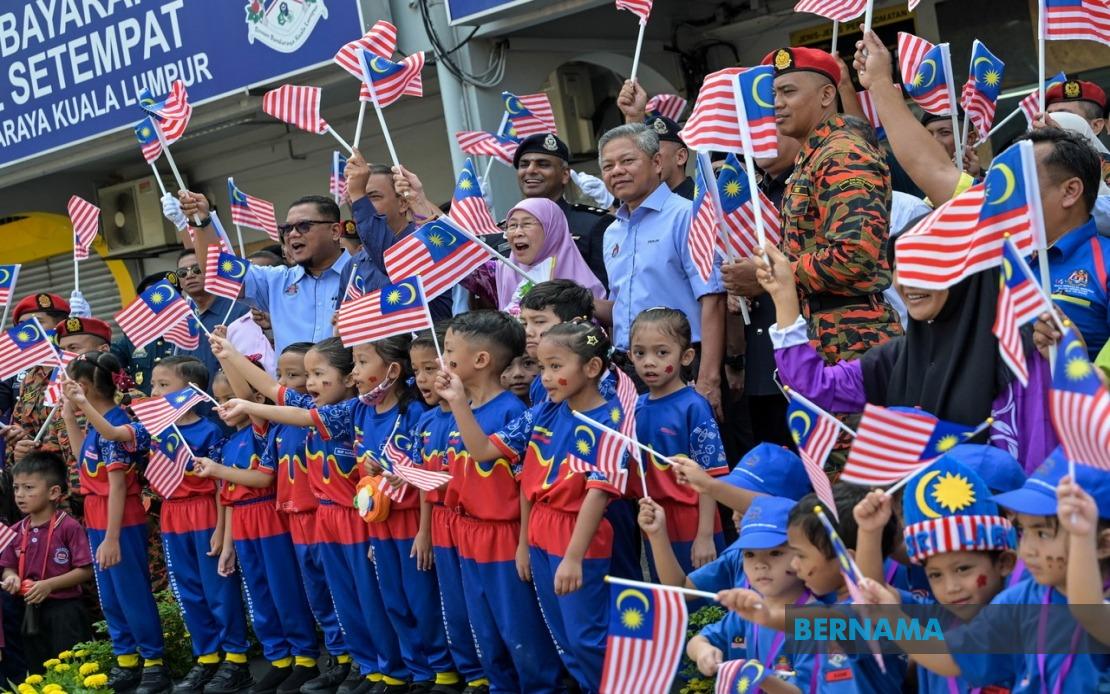
The commemoration of Malaysia's independence should transcend the ceremonial hoisting of flags and patriotic slogans, according to Datuk Seri Dr Wan Azizah Wan Ismail, who used the occasion of this year's National Day celebrations to reflect on the deeper significance of the nation's sovereignty. Speaking at the Semarak Merdeka Programme in Kuala Lumpur, the Prime Minister's wife and Bandar Tun Razak Member of Parliament articulated a vision of independence rooted in collective responsibility, positioning the annual observance as an opportunity for citizens to reconnect with the values that underpin the nation's founding.
Dr Wan Azizah's remarks align closely with this year's National Day theme, "Malaysia Madani: Jiwa Merdeka," which government officials have positioned as a framework for elevating living standards, ensuring fair access to opportunities, and fortifying social cohesion across diverse communities. Her intervention comes at a time when policymakers are increasingly emphasising the link between national celebration and tangible improvements in citizens' lives, particularly those in lower-income brackets. The theme, which translates roughly to "Malaysian Civilisation: Spirit of Freedom," carries implicit messaging about the government's development agenda and its commitment to inclusive growth.
The substance of independence, according to Dr Wan Azizah, lies in honouring the sacrifices made by preceding generations who fought for sovereignty and nation-building. This framing positions contemporary Malaysians as custodians of a legacy rather than merely inheritors of a national date. By emphasising the struggles of the independence movement, she drew a through-line connecting historical sacrifice to present-day obligations, suggesting that truly valuing freedom means understanding and perpetuating the principles for which earlier Malaysians fought. This interpretation adds moral weight to patriotic observances, transforming them from symbolic acts into reflections on civic duty.
The programme itself took place in Bandar Tun Razak, a parliamentary constituency that Dr Wan Azizah represents and which she characterised as emblematic of Malaysia's multicultural identity. The area's demographic composition—approximately 60 percent Malay, 24 percent Chinese, and 8 percent Indian residents across some 191,000 inhabitants, according to Malaysian Population and Housing Census data—serves as a microcosm of the nation's religious and ethnic plurality. Dr Wan Azizah's choice to highlight these figures underscores an argument that harmonious coexistence among different communities remains integral to preserving the conditions under which independence can be meaningfully exercised and enjoyed.
Beyond the ceremonial aspects of the event, Dr Wan Azizah's visit to families in the Seri Pulau Pinang and Desa Tun Razak People's Housing Projects revealed the practical dimensions of governance that she believes complement Independence Day observance. The distribution of social security benefits and humanitarian assistance formed the ceremonial core of her engagement, signalling that independence celebrations can be augmented by direct support to vulnerable populations. This approach reflects a broader policy inclination to interweave national commemoration with welfare provision, suggesting that the state's protection of freedom extends into economic and social security domains.
One beneficiary, K. Moganavalli, 39, received assistance following the sudden death of her husband Edwin Anthony Dass, who had worked as a lorry driver and ride-hailing operator. The package included a one-off Funeral Management Benefit of RM3,000 from the Social Security Organisation (PERKESO) and a monthly Survivor's Pension of RM3,118.33, supplemented by additional aid from the Federal Territories Islamic Religious Council (MAIWP). Moganavalli's situation—that of a full-time housewife left to provide for three young children after her breadwinner's unexpected passing—illustrates the precarious economic circumstances that persist within urban communities, even as the nation marks its independence.
Another recipient, Khalijah Binti Nazir, 64, represents a different vulnerability profile, having withdrawn from employment to care for two children, one of whom has a hearing impairment. Her monthly assistance package comprises RM800 in Baitulmal aid, RM300 via Boost eWallet, and RM150 under the Sumbangan Asas Rahmah (SARA) scheme, with an additional RM100 monthly directed to her son. These varied assistance streams, each originating from different government bodies and charitable frameworks, highlight the complex patchwork of social safety nets upon which lower-income families depend. The adequacy and sustainability of such fragmented support systems remain implicit concerns within the broader narrative of national independence and citizen welfare.
The emphasis on distributing these benefits during an Independence Day programme carries symbolic weight that extends beyond administrative convenience. By linking poverty alleviation and social security to the celebration of freedom, Dr Wan Azizah positioned economic dignity and material security as dimensions of the independence that the nation has secured. This framing acknowledges that for many Malaysians, independence has meaning only insofar as it produces conditions permitting economic survival and family stability. The visible contrast between national celebration and the lived reality of families requiring emergency assistance serves as a reminder that patriotic rhetoric must be grounded in substantive policy outcomes.
The participation of Datuk Azman Abidin, the Prime Minister's political secretary, in the Semarak Merdeka Programme suggests that the event carried significance within the broader political apparatus, extending beyond Dr Wan Azizah's constituency engagement. The presence of senior political staff signals institutional attention to how Independence Day commemoration is framed and executed, particularly in demographically diverse areas. For Malaysian readers, this coordination indicates that messaging around independence, unity, and development is carefully orchestrated at multiple levels of government, with events in local constituencies reflecting broader national narratives and policy priorities.
For Southeast Asian observers, Malaysia's approach to independence celebration offers insight into how middle-income nations manage the intersection of historical commemoration and contemporary development challenges. The emphasis on unity and harmony, particularly within multicultural contexts, remains central to how Malaysia's political leadership articulates the value of independence. Unlike some regional counterparts where independence commemorations focus primarily on anti-colonial narratives or military achievement, Malaysia's framing emphasises internal cohesion and shared responsibility. This approach reflects the nation's particular post-independence trajectory, marked by multiple instances of communal tension that have required active management and mutual accommodation.
The thematic emphasis on "Jiwa Merdeka"—the spirit of freedom—rather than the mechanics of independence or historical grievance against colonisers, suggests a deliberate pivot toward forward-looking governance discourse. By anchoring independence in notions of spiritual and social consciousness rather than political structures, Dr Wan Azizah and other government leaders invite citizens to view the nation's achievements as ongoing projects requiring continuous cultivation. This framing can be understood as an attempt to sustain patriotic sentiment while simultaneously acknowledging that independence, as a state of being, demands constant renewal through collective effort and mutual support.
The distribution of assistance to families in public housing projects during the programme also carries implications for how the state positions itself in relation to citizen welfare. These are constituencies that, while within the Federal Territories, experience material hardship that sits in tension with the prosperity that Malaysia has achieved as an upper-middle-income nation. The presence of government representatives delivering assistance in person creates a direct link between state benevolence and national celebration, potentially reinforcing citizen identification with state institutions. For Malaysian policymakers, such events serve dual functions: they provide tangible relief to vulnerable populations while simultaneously performing legitimacy and responsiveness.
Moving forward, Dr Wan Azizah's articulation of independence as a "shared responsibility" establishes a normative framework that encompasses both state obligation and citizen participation in sustaining national peace and prosperity. This framing sidesteps potential political contestation by positioning independence not as a completed historical fact but as an ongoing project requiring broad-based engagement. For a nation navigating questions of social cohesion, economic inequality, and political representation, this approach offers a unifying narrative that connects commemorative ritual to substantive policy outcomes, even as significant challenges in welfare provision, employment opportunity, and community development remain.

