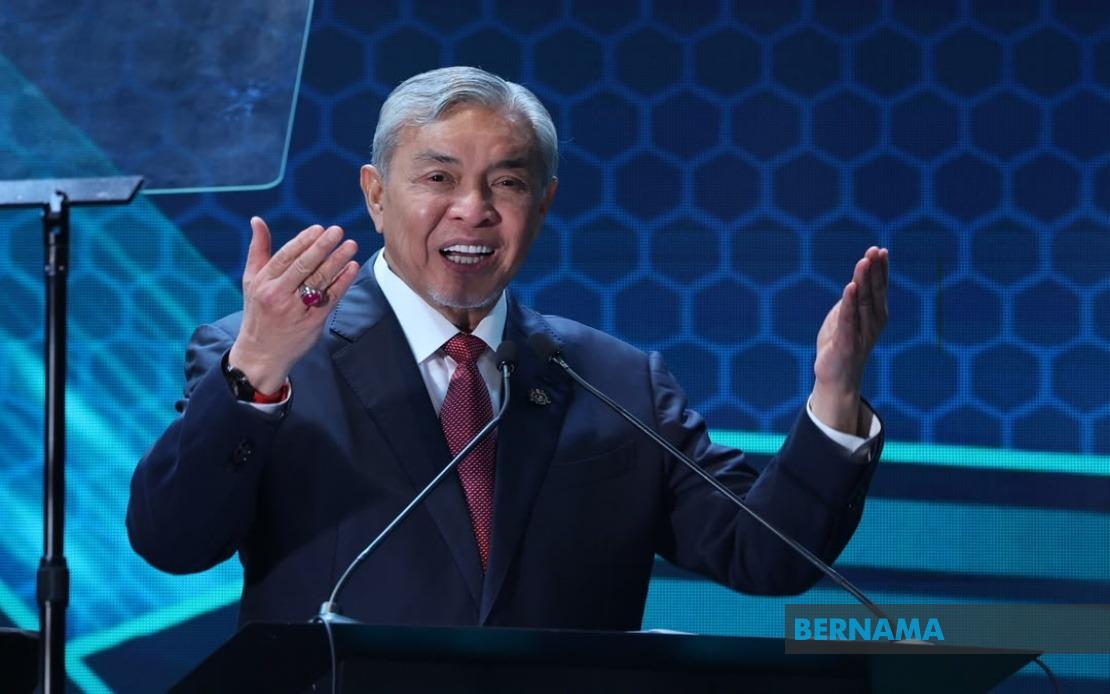
Deputy Prime Minister Datuk Seri Dr Ahmad Zahid Hamidi has called for a fundamental reimagining of Malaysia's Immigration Department, moving it beyond conventional border control operations to become a strategic engine driving national economic competitiveness whilst simultaneously fortifying the country's security infrastructure. Speaking at the 2026 Immigration Day celebration in Cyberjaya, Ahmad Zahid articulated a comprehensive four-point mandate intended to guide the department's evolution, emphasising that lasting institutional change demands unified direction and sustained commitment rather than piecemeal reforms or ad-hoc initiatives.
The Deputy Prime Minister's strategic framework centres on four interconnected pillars designed to reshape the Immigration Department's institutional identity and operational focus. These priorities encompass facilitating Malaysia's economic expansion, buttressing national security and sovereignty, accelerating technological modernisation and service delivery innovation, and cultivating organisational integrity alongside professional excellence and humanitarian principles. Ahmad Zahid stressed that effective transformation cannot emerge from fragmented efforts or isolated policy changes, but instead requires a coherent philosophical foundation that permeates every operational decision and institutional practice across the department.
The economic dimension of this transformation reflects a growing recognition that immigration administration directly influences Malaysia's attractiveness to international investors and high-skilled talent. Ahmad Zahid highlighted how excessive procedural complexity and unnecessary administrative delays diminish national competitiveness, drawing a comparative lens toward the United Arab Emirates. The UAE's integration of immigration policies with foreign investment strategies, including its Golden Visa programme extending up to ten years of residency, has positioned the country as a magnet for global capital. This approach yielded foreign direct investment totalling RM196.6 billion in 2025, securing the UAE's position as the ninth-largest foreign investment destination globally for the fourth consecutive year.
For Malaysian policymakers and business leaders, this international benchmark carries considerable weight. The nation competes within a region increasingly attracting multinational corporations and high-net-worth individuals seeking expansion opportunities. Singapore, Vietnam, and Thailand have all implemented streamlined immigration processes designed to facilitate business mobility and talent attraction. Malaysia's ability to reduce administrative friction whilst maintaining security standards could significantly enhance its competitive positioning within Southeast Asia's increasingly crowded investment marketplace. The Immigration Department's transformation therefore extends beyond bureaucratic efficiency to encompass national economic strategy.
The security dimension addresses evolving transnational threats that bear little resemblance to the challenges confronting immigration authorities a decade ago. Ahmad Zahid identified the increasing sophistication of migrant smuggling networks and the growing complexity of human trafficking operations as central security concerns requiring intelligence-driven rather than purely reactive enforcement approaches. Cross-border criminal activities now operate with temporal and spatial fluidity that traditional border-control methodologies struggle to address. This necessitates repositioning the Immigration Department as an institution leveraging advanced technological capabilities alongside enhanced inter-agency coordination to anticipate and neutralise threats before they materialise.
The technological transformation component reflects contemporary global security architecture developments. Ahmad Zahid advocated for the Immigration Department to harness big data analytics, artificial intelligence, predictive analytics capabilities, digital identity systems, biometric technologies, and smart border infrastructure. These tools enable faster decision-making processes whilst enhancing accuracy and security outcomes. The aspiration extends beyond mere operational acceleration to encompassing enhanced institutional thinking and precision-focused action delivery. This technological integration resonates with Malaysia's broader digital economy ambitions and aligns departmental modernisation with national infrastructure development trajectories.
The integrity and professionalism pillar addresses institutional legitimacy and public confidence, dimensions increasingly critical in polarised political environments. Ahmad Zahid emphasised that the Immigration Department's reputation depends not solely on rigorous law enforcement but equally on professional conduct, ethical decision-making, and demonstrated humanitarian sensitivity. Personnel must exercise sound discretionary judgment whilst maintaining procedural compliance and possessing the institutional courage to pursue ethically defensible courses of action even when circumstances prove pressurised. This framing acknowledges that citizen and investor confidence in government institutions depends substantially on perceived fairness and transparency in administrative conduct.
The timing of this transformation initiative reflects broader governance discussions within Malaysia's federal administration. As the country pursues higher-income economy status and regional leadership positioning, institutional effectiveness becomes increasingly consequential. The Immigration Department's operational performance directly affects Malaysia's image internationally and influences business confidence in the nation's institutional competence. Ahmad Zahid's emphasis on integrity and humanitarian values alongside enforcement capacity suggests recognition that institutional legitimacy in democratic societies requires demonstrable commitment to procedural fairness and ethical governance standards.
From a Southeast Asian perspective, Malaysia's immigration transformation aligns with regional trends toward technology-enabled governance and competitive talent attraction. The region's rapid economic integration and labour mobility patterns have intensified immigration administration challenges. Countries deploying effective technological solutions and customer-responsive service models gain competitive advantages in attracting skilled migrants and facilitating legitimate cross-border commercial activity. Malaysia's capacity to implement this transformation successfully could establish benchmarks for other regional economies whilst enhancing the nation's attractiveness as an investment and talent destination.
The implementation architecture envisioned by Ahmad Zahid demands sustained leadership commitment and resource allocation beyond typical departmental budgeting cycles. Technological modernisation, biometric system deployment, inter-agency coordination infrastructure, and personnel capability development represent substantial investments requiring multi-year commitment. Success depends on translating policy pronouncements into operational reality through consistent budget prioritisation, institutional accountability mechanisms, and performance measurement systems. The Deputy Prime Minister's emphasis on directional clarity and shared institutional philosophy suggests recognition that transformational change requires cultural shifts within bureaucratic organisations often resistant to established operational patterns.
The involvement of senior government officials at the 2026 Immigration Day celebration, including Chief Secretary Tan Sri Shamsul Azri Abu Bakar and Immigration Director-General Datuk Zakaria Shaaban, underscores the cross-institutional significance attributed to this transformation initiative. This administrative positioning indicates that immigration modernisation constitutes a government-wide priority rather than an isolated departmental concern. Such high-level engagement typically precedes substantial resource commitments and institutional restructuring, suggesting that Malaysia's policymakers view immigration administration as strategically consequential for broader national objectives.
For Malaysian businesses engaged in international operations or foreign investment attraction, this transformation initiative carries tangible implications. Streamlined immigration processes affecting visa applications, permit approvals, and skilled worker recruitment could reduce transaction costs and accelerate market entry timelines. The emphasis on technology-driven service delivery suggests gradual movement toward online processing systems reducing physical office visits and administrative delays. Such developments would align Malaysia with international best practices whilst enhancing competitiveness for companies competing against regional alternatives offering more efficient immigration administration frameworks.
The success of this transformation agenda will ultimately be measured through observable changes in immigration administration speed, accuracy, and customer experience quality across diverse stakeholder categories. The four-point mandate establishes ambitious institutional objectives, yet realising these aspirations requires sustained commitment to implementation, adequate resource provision, and institutional willingness to modify established procedures. Ahmad Zahid's vision of the Immigration Department as simultaneously an economic catalyst and security safeguard reflects contemporary governance imperatives in rapidly evolving regional and global contexts.

