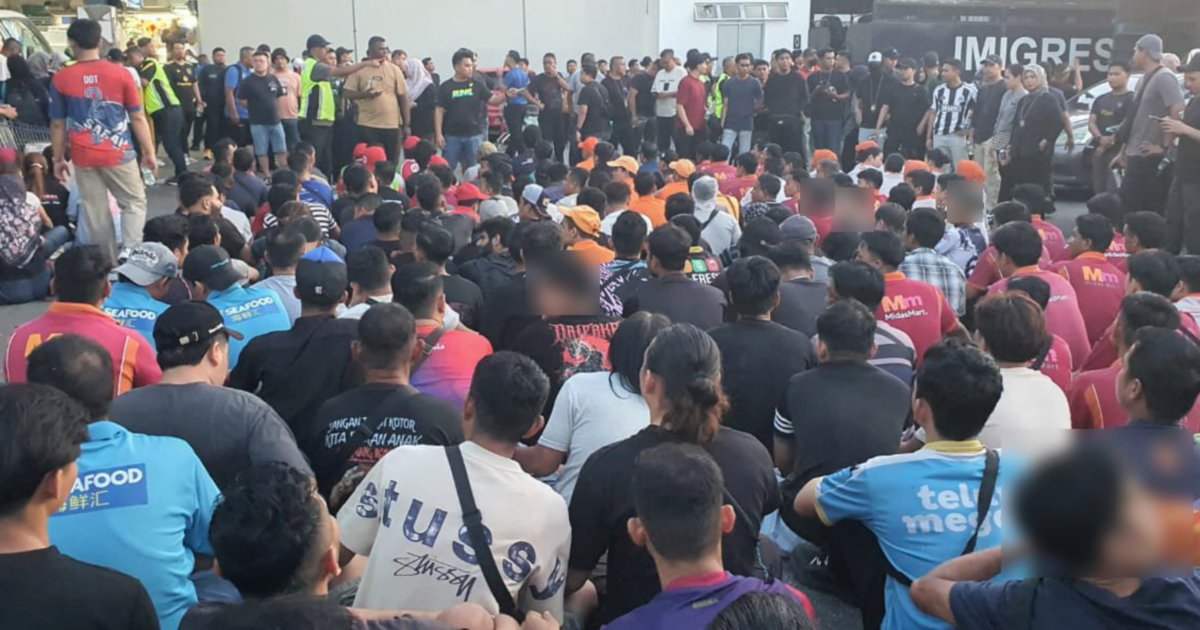
Immigration enforcement personnel have detained 226 undocumented migrants during a coordinated operation in Johor, breaking up a sophisticated scheme that enabled foreign workers to obtain fraudulent passport stamps while remaining in the country illegally. The operation revealed the extent of document manipulation and systematic border violations that had persisted for approximately four years across the southern state.
At the centre of the discovery was an Indonesian fishmonger whose routine exposed the network's methods. For roughly four years, this individual made regular monthly excursions across the border into Singapore, where he obtained legitimate passport stamps that provided the veneer of legal border crossings. Upon returning to Malaysia, he resumed illegal employment despite his documents suggesting he had properly departed and re-entered the country. This pattern of cyclical border crossings combined with continuous undeclared work highlighted how organised fraud operations exploit standard immigration procedures and create legal ambiguity around worker status.
The sophisticated nature of this scheme demonstrates how transnational labour networks blur the lines between legitimate commerce and illegal employment. By maintaining a pattern of border movements backed by official-looking documentation, perpetrators created records suggesting compliance with immigration law while facilitating prolonged illegal residence and work. The Indonesian fishmonger's occupation as a trader involved in cross-border commerce likely provided natural justification for frequent travel, making the fraudulent arrangement appear routine to casual observation.
This revelation carries significant implications for Malaysia's labour enforcement strategy and regional migration management. Southeast Asia's porous borders and high demand for undeclared migrant workers create persistent vulnerabilities that fraudulent networks continuously exploit. The operation underscores how document manipulation represents one of the most effective tools for circumventing immigration controls, particularly when legitimate border crossing points are used as part of the deception.
The scale of the operation—involving 226 detained individuals—suggests this was not merely a single case of document fraud but rather a systematic network facilitating illegal employment across multiple sectors. The interconnected nature of Southeast Asian economies and labour markets means such schemes often operate across jurisdictions, involving recruitment networks, employers, transportation facilitators, and document handlers spanning multiple nations. Breaking apart one node in this larger structure may help authorities identify broader patterns of illegal labour trafficking and exploitation.
Malaysia has long grappled with managing one of the region's largest migrant workforces, with officially registered migrant workers numbering in the millions. Alongside this legitimate migration, significant undeclared populations work in construction, agriculture, domestic service, manufacturing, and informal sectors. Each sector presents distinct opportunities for labour trafficking and document fraud, requiring tailored enforcement approaches and regulatory oversight.
The discovery in Johor comes amid broader regional challenges in labour enforcement. The International Labour Organization and various humanitarian organisations have documented how undocumented status renders migrant workers vulnerable to exploitation, wage theft, unsafe conditions, and abuse. Simultaneously, undeclared employment depresses wages for citizen workers and distorts labour market competition. These economic and social harms motivate immigration enforcement, yet the ongoing emergence of sophisticated fraud schemes demonstrates the cat-and-mouse dynamic between authorities and organised networks.
Documentary fraud specifically presents enforcement challenges because it exploits the inherent trust placed in official travel documents and border authorities. When individuals possess what appear to be legitimate passport entries, immigration officials at checkpoints may not suspect fraud without conducting time-consuming background investigations. The monthly crossing pattern in this case created a veneer of legitimacy precisely because it mimicked normal travel behaviour, allowing the underlying illegal employment to remain concealed.
The operation's success in disrupting this network required coordination between multiple agencies and likely involved intelligence gathering over an extended period. Immigration authorities, police, and labour enforcement bodies typically must collaborate to identify such schemes, as they involve both immigration violations and employment law breaches. Intelligence sharing across border regions and between nations remains a developing capability in Southeast Asia, though operations like this one demonstrate growing institutional capacity.
For Malaysia's labour market, the implications extend beyond enforcement statistics. The large detained population suggests that illegal employment networks continue to thrive despite existing regulations and enforcement efforts. This reflects both the persistent economic advantages that undeclared work offers employers and the desperation of migrants seeking any employment regardless of legal status. Addressing the root causes requires not only stronger enforcement but also labour market policies that reduce incentives for illegal hiring and improve conditions for documented migrant workers.
The discovery also highlights information gaps within Malaysia's immigration system. The fact that a pattern persisting for four years went undetected suggests that border databases, employer monitoring, and inter-agency intelligence sharing could be strengthened. Modern technology including facial recognition at borders, improved document authentication systems, and centralised worker registries could enhance detection capabilities, though such investments require significant resources and coordination.
Regionally, this operation demonstrates that Malaysia remains committed to enforcing immigration law, despite the practical challenges posed by geography, economic incentives, and limited resources. The detention of 226 individuals will likely lead to processing, legal proceedings, and deportations, with attendant costs and administrative burden. Yet without addressing systemic vulnerabilities that enabled this network to operate undetected for years, similar schemes will likely emerge elsewhere.
Moving forward, the case underscores the necessity for comprehensive approaches combining stronger border management, improved document authentication, enhanced employer accountability, and international cooperation. Only through such multi-layered strategies can Malaysia effectively manage migration flows while protecting both its citizens and migrant workers from exploitation.

