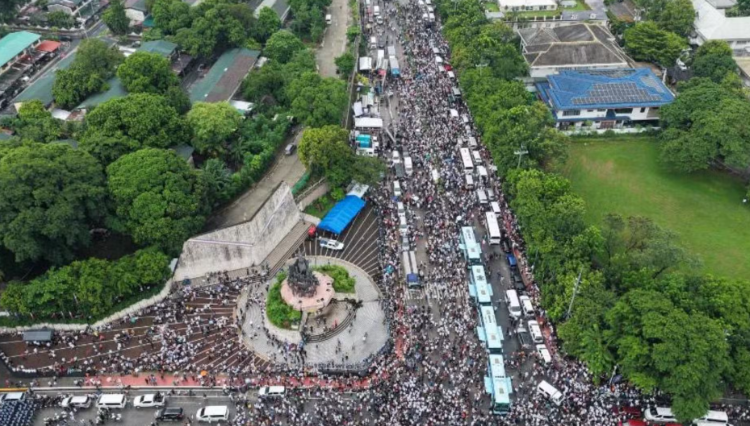
Thousands of members of the Iglesia Ni Cristo, one of the Philippines' most influential religious organisations, converged on Manila's main highway on Tuesday to demonstrate against criminal charges facing a senator and prominent church member. The gathering created significant congestion along EDSA, one of the capital's busiest thoroughfares, disrupting the morning commute for workers and students across multiple districts. The timing and scale of the mobilisation underscored the sect's capacity to influence public discourse and demonstrate political clout at critical junctures in the nation's governance.
The rally emerged in response to prosecutors' decision to file graft charges against Senator Rodante Marcoleta, accusing him of failing to declare approximately 75 million pesos in unspent election campaign funds. Government ombudsman Jesus Remulla announced the charges just a day earlier, setting off rapid coordination by the religious organisation to assemble its supporters. Marcoleta's membership in the Iglesia Ni Cristo and his longstanding association with the Duterte political family positioned the charges within a broader contest over accountability and political allegiances that has fractured the archipelago's power structures in recent months.
The immediate political context surrounding the charges involves Vice President Sara Duterte's impeachment trial, scheduled to begin on July 6, which requires a two-thirds majority of the 24-seat Senate for conviction and removal from office. Marcoleta is widely regarded as a reliable vote against conviction, given his deep ties to the Duterte faction and his church's historical alignment with the political dynasty. With only 16 affirmative votes needed for conviction, the loss of even a single sympathetic senator could prove decisive, making the senator's legal troubles and his church's response matters of genuine constitutional consequence.
Religious authorities and church spokespersons framed the demonstration as a defence of judicial fairness rather than explicit partisanship. Edwil Zabala, the sect's official spokesman, released a video message emphasising that the organisation sought transparency and equal treatment before the law. His remarks condemned what the church characterised as "selective justice," suggesting that charges against Marcoleta reflected political vendetta rather than principled prosecution. The framing allowed the organisation to mobilise its extensive membership base while maintaining a veneer of institutional neutrality and concern for democratic principles.
Police officials monitoring the gathering reported approximately 8,000 participants in the morning hours, with expectations that attendance would swell as the day progressed. The demonstration severely constrained vehicular movement across the capital's arterial routes, with only bus lanes remaining operational at certain points. The disruption highlighted both the organisational capacity of the religious institution and the vulnerability of Manila's infrastructure to large-scale public assemblies, a recurring challenge as political tensions intensify across the country.
The charges against Marcoleta form part of a broader pattern of legal actions targeting Duterte loyalists as the political landscape shifts dramatically. Senator Jose "Jinggoy" Estrada faced corruption allegations connected to a massive flood control scandal involving fraudulent infrastructure projects that sparked public outrage across the nation. Meanwhile, Senator Ronald "Bato" Dela Rosa, another prominent Duterte associate, fled to avoid arrest on an International Criminal Court warrant stemming from his involvement in the former president's lethal drug enforcement operations that claimed thousands of lives.
The Iglesia Ni Cristo's sustained engagement in electoral politics and high-stakes governance moments reflects its evolution beyond a purely religious institution into a significant political force. In November, the church mobilised hundreds of thousands of members to protest the flood control corruption scandal, with speakers directing blame toward President Ferdinand Marcos. In January, another massive rally opposed Duterte's impeachment, demonstrating the organisation's ability to activate its base rapidly around issues affecting its preferred political figures. These mobilisations reveal deep institutional connections between the sect and various factions within the Philippine elite.
The fractious relationship between Duterte and Marcos, once close political allies who have now turned into bitter adversaries, has created opportunities for organised groups to amplify their influence by backing particular figures. The Iglesia Ni Cristo's consistent support for Duterte positions it as a counterweight to the incumbent president's power. This dynamic complicates straightforward narratives about the charges against Marcoleta, rendering them simultaneously genuine prosecutorial decisions and moves within an intense factional struggle for control of state institutions and resources.
President Marcos's decision to cancel a scheduled luncheon with foreign media representatives to monitor the rallies demonstrated the gravity with which the administration viewed the gathering. The cancellation signalled official awareness that the convergence of organised religious mobilisation and questions about judicial independence could undermine confidence in the government's commitment to impartial law enforcement. The episode highlights how accusations of selective prosecution, even when charges possess legitimate evidentiary foundations, can be weaponised by well-organised constituencies to challenge governmental legitimacy.
For Malaysian observers and policymakers, the Philippine situation illustrates vulnerabilities in institutional design when powerful religious organisations maintain tight integration with particular political factions. The capacity of the Iglesia Ni Cristo to mobilise tens of thousands within hours demonstrates the risks of allowing religious institutions to accumulate unchecked political influence. Southeast Asian democracies must grapple with balancing religious communities' legitimate participation in civic life against the dangers of sectarian organisations becoming vectors for factional political struggle that undermines institutional independence and equal application of laws.
The unfolding impeachment trial and associated prosecutions will test whether the Philippine judiciary and legislature can maintain procedural credibility amid accusations of political weaponisation. Marcoleta's trial verdict, combined with Vice President Duterte's impeachment outcome, will significantly influence both the operational independence of Philippine institutions and the regional perception of whether the island nation can enforce accountability through impartial legal processes. The Iglesia Ni Cristo's continued mobilisation suggests that organised constituencies will persist in attempting to influence outcomes through demonstrations of organised political force.

