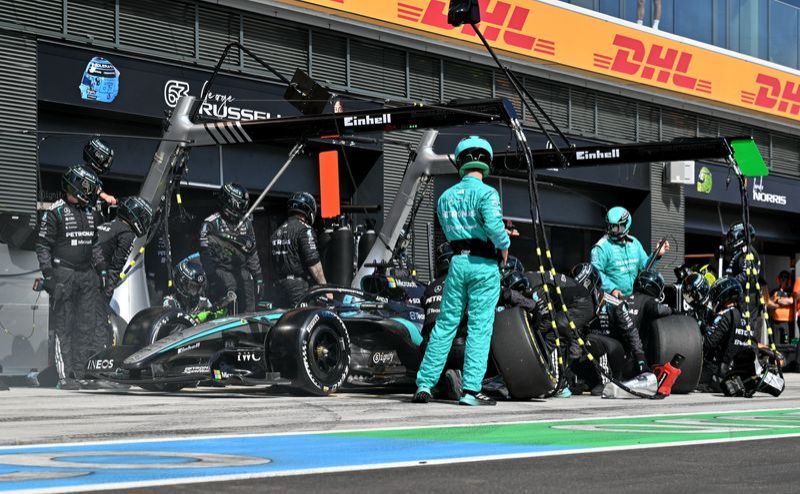
George Russell's patience with the relentless string of technical failures afflicting his Mercedes has finally worn thin. The British driver, once regarded as a serious championship contender before the season began, admitted after Sunday's Hungarian Grand Prix that he has transcended mere disappointment into a state of numb resignation. With Formula One breaking for its traditional August recess, Russell faces an enforced holiday that comes as much-needed psychological relief as it does a calendar necessity.
The Budapest weekend encapsulated everything that has gone wrong for Russell since the campaign's start. Qualifying sixth on the grid and positioned ahead of his teenage teammate Kimi Antonelli, Russell should have been targeting points and momentum. Instead, his Mercedes triggered an anti-stall activation at the moment the lights went out, a catastrophic glitch that pitched him from contention into the depths of the field within seconds. Though he recovered to seventh place by the chequered flag, the damage proved decisive—Antonelli stormed to the podium in third, extending his championship advantage over his struggling teammate.
The irony cuts deepest because Russell's raw pace remained competitive throughout the race. He demonstrated the speed to run with the grid's front-runners, yet circumstances entirely beyond his control conspired to render that talent irrelevant. This represents the bitter pattern that has haunted him across the opening eleven rounds: strong qualifying performances undone by mechanical sabotage, races where his driving talent cannot compensate for equipment failures.
Russell's explanation of the malfunction revealed the randomness of his misfortune. The engine began exhibiting wild revving behaviour a full four seconds before the start sequence, with the power unit refusing to respond to his throttle inputs despite being brand new. Mercedes engineering offered no immediate answers, suggesting the problem arose from somewhere within the increasingly complex propulsion system where diagnosis remains challenging. For a driver already stretched thin emotionally, facing such unpredictability carries psychological weight beyond the obvious performance consequences.
The statistical gulf between Russell and Antonelli now yawns wide enough to be virtually insurmountable with twelve races remaining. Trailing by fifty-nine championship points, Russell has managed only two victories compared to his teammate's six, while also recording three races without scoring any points. The pre-season assessment that positioned Russell as a title favourite appears almost laughable now, a reminder of how comprehensively fortune has abandoned him. Antonelli, by contrast, has seized the opportunity presented by his veteran teammate's misfortune and built a commanding lead.
What troubles Mercedes team principal Toto Wolff most is the pattern's consistency and intensity. The team accepts responsibility for Russell's predicament without reservation, acknowledging that he has endured a disproportionate number of technical setbacks relative to other drivers on the grid. Wolff conceded that the frequency and severity of problems affecting Russell specifically represent a failure on the team's part to maintain competitive equipment. This admission carries weight in Mercedes' famously results-driven culture, where accountability at the top remains non-negotiable.
Russell's mental fortitude has been tested severely throughout this ordeal. He emphasized his refusal to surrender to disappointment as a protective mechanism, recognizing that dwelling on circumstances beyond his control would prove counterproductive and psychologically damaging. Yet his comment about rarely feeling the need for a break before this season underscores the genuine toll this campaign has exacted. For a perfectionist competitor like Russell, season-long equipment failures represent a form of torture that no amount of positive thinking can fully mitigate.
The previous weekend in Belgium added another layer of frustration when Russell spun at the first corner following contact with Lewis Hamilton's Ferrari. Though stewards penalized Hamilton, the collision itself highlighted how Russell's championship hopes have been buffeted by external factors both mechanical and circumstantial. His inability to accumulate consistent results has nothing to do with his capabilities as a driver and everything to do with circumstances almost entirely outside his influence.
For Malaysian and Southeast Asian Formula One followers, Russell's predicament illustrates a broader reality in modern motorsport: that technical reliability remains as vital as driver ability in determining competitive outcomes. Mercedes' struggles with consistency raise questions about whether the reigning champions have lost their engineering edge, particularly in solving the specific problems that plague Russell's car. As the sport's summer shutdown begins, Mercedes engineers will face intense pressure to identify and rectify the gremlins that have haunted their driver, knowing that the championship window may slam shut if they fail.
Russell heads into the August break with mixed emotions. While the enforced rest offers psychological respite from the constant mechanical disappointments, he returns in September knowing that his championship defence has effectively ended. The focus inevitably shifts from title contention toward salvaging what remains of his season and, more importantly, establishing a baseline of reliability upon which future campaigns can be built. For now, Russell must find solace in the knowledge that his driving pace remained competitive at Budapest, even as fortune's cruel indifference once again robbed him of the results his talent deserved.

