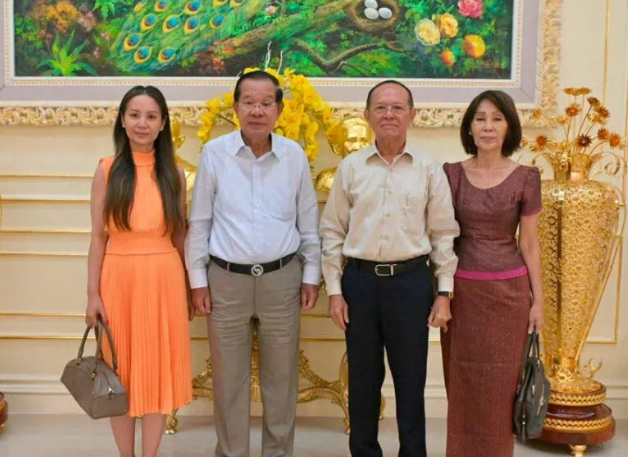
Cambodia's political landscape shifted noticeably when Senate president Hun Sen welcomed his former rival Kem Sokha into his residence on Sunday morning, marking another step in what appears to be a gradual normalisation of relations between two figures who once stood at the opposite ends of the country's sharply divided political spectrum. The three-hour engagement, which lasted from 9am until noon and included Sokha's wife and daughter, represented a continuation of their renewed contact following Sokha's pardon and return to public life after years of legal troubles that had confined him to house arrest.
Hun Sen's public commentary on the meeting, shared via social media, contained particularly striking language when he singled out Sokha's daughter Kem Monovithya for special commendation. Describing her as "an excellent human resource for the nation," Hun Sen spent a considerable portion of their conversation engaged with the younger Monovithya, a detail that Hun Sen himself chose to emphasise in his account of the gathering. Such specific praise carries considerable weight given Monovithya's prominent historical ties to the Cambodia National Rescue Party, the opposition force that her father led and that once represented the most significant challenge to Hun Sen's Cambodian People's Party's dominance.
The context of these meetings cannot be fully understood without examining the turbulent history that preceded them. Kem Sokha, who co-founded the CNRP and served as its president, emerged as Hun Sen's most formidable political opponent during a period when Cambodia's opposition movement had gained genuine traction among voters. The party achieved striking results in the 2013 national election and made further significant gains in the 2017 commune elections, suggesting that Hun Sen's monopoly on power faced a genuine challenge. Yet in November 2017, just months after Sokha's arrest in July of that year, the Supreme Court dissolved the CNRP entirely, effectively decapitating the opposition movement.
Sokha's subsequent legal ordeal unfolded over years, culminating in his 2023 conviction on a treason-related charge centring on alleged conspiracy with a foreign power, for which he received a 27-year prison sentence. The Phnom Penh Appeal Court upheld this conviction on April 30, 2026, maintaining both the lengthy sentence and imposing additional restrictions including a five-year ban on international travel. These legal measures, combined with his house arrest and prohibition from political activity, effectively removed him from Cambodia's public sphere during this extended period.
However, the trajectory shifted dramatically beginning in May, when King Norodom Sihamoni issued a royal pardon that terminated Sokha's remaining prison sentence and house arrest. This clemency, while significant, left in place the restrictions preventing him from engaging in political activities. A subsequent royal decree issued on July 24 lifted the five-year overseas travel restriction that had further constrained his movements, suggesting an increasingly deliberate easing of the conditions that had bound him. Within days of this decree, Sokha made a high-profile public appearance by travelling to Banteay Meanchey province to visit displaced families affected by ongoing tensions along the Cambodia-Thailand border, explicitly characterising himself as acting in a private capacity rather than as a political representative.
The significance of these recent developments lies partly in what they suggest about Cambodia's political direction. Sokha's re-emergence into public life, facilitated by the royal pardons and the lifting of his overseas travel ban, represents a marked shift from the years when his name was essentially absent from mainstream discourse. His statement during the border visit, wherein he claimed to have raised the plight of displaced Cambodians with international contacts, signals his desire to rebuild a public profile independent of formal political party structures. Whether this trajectory leads toward a genuine political reconciliation or represents merely a symbolic rehabilitation of his public standing remains uncertain.
Hun Sen's characterisation of Sokha's daughter as an excellent human resource for Cambodia is perhaps the most intriguing element of the recent meeting. This remark must be assessed against the backdrop of Monovithya's history as a prominent figure associated with her father's opposition movement. By publicly commending her capabilities and desirability as a national asset, Hun Sen appeared to open a door, albeit cautiously, toward the possibility of her playing some role in Cambodia's future. Notably, he provided no specifics regarding what form such involvement might take, leaving analysts and observers to speculate about whether this represented merely polite acknowledgment or a genuine signal of potential political engagement.
The broader implications of this warming relationship between Hun Sen and Sokha extend beyond the personal dimensions of their meetings. For Malaysian and Southeast Asian observers, these developments offer insights into how authoritarian or semi-authoritarian regimes manage political opposition and whether mechanisms exist for bringing former adversaries back into the fold. The pattern of royal pardons followed by the gradual lifting of restrictions, combined with renewed personal contact between the rival leaders, suggests a choreographed approach to political reconciliation that preserves the ruling party's dominance while offering the opposition figure a dignified return to public life.
It bears noting that neither Hun Sen nor Sokha has publicly characterised their meetings as part of a broader political agreement or formal reconciliation process. The absence of such announcements may reflect genuine uncertainty about what these encounters ultimately portend, or it may indicate a preference for allowing perceptions to develop organically without formal declarations that might constrain future options. Hun Sen's decades of political survival have been characterised by tactical flexibility and an ability to neutralise opposition through incorporation rather than permanent exclusion, and the Sokha engagement may represent another chapter in this approach.
The evolution of relations between these two figures holds particular interest for Southeast Asia more broadly, where questions about democratic governance, opposition tolerance, and the management of political transitions remain live issues across multiple countries. Cambodia's path, in which a dominant ruling party maintains its grip on power while selectively reintegrating former opponents, offers a model distinct from both more openly competitive democracies and more thoroughly authoritarian states. As Sokha gradually rebuilds his public presence and Hun Sen signals openness to engaging with the Sokha family, observers will be watching closely to see whether this trajectory leads toward meaningful political inclusion or represents merely a recalibration of Cambodia's existing power structures.

