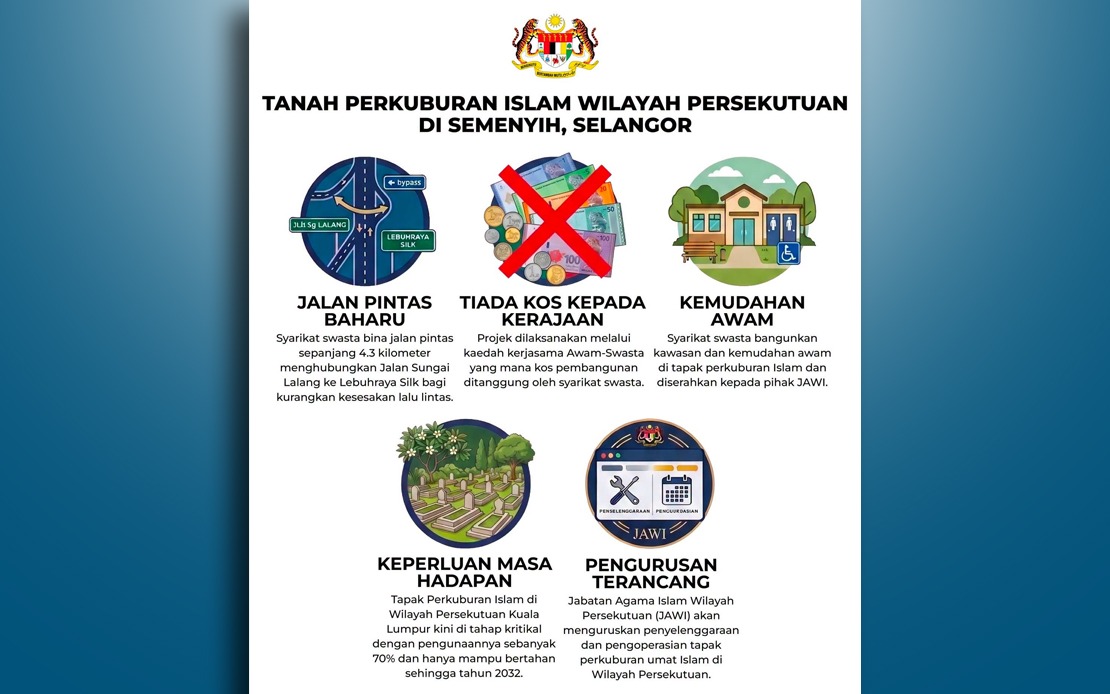
The Federal Territory Muslim Cemetery Development Project in Hulu Semenyih represents a long-gestated solution to one of Kuala Lumpur's most pressing demographic challenges. Minister in the Prime Minister's Department (Federal Territories) Hannah Yeoh has emphasised that this 332.6-acre initiative traces its origins to 2005, countering recent social media speculation about the scheme's origins and intentions. The clarification came after confusion rippled across online platforms, prompting the government to provide a comprehensive account of the project's trajectory, scope and intended benefits for both the capital's Muslim residents and surrounding Selangor communities.
The urgency underpinning this development cannot be overstated. Current Islamic burial grounds serving the Federal Territory of Kuala Lumpur have already surpassed 70 per cent occupancy, a metric that underscores the deepening crisis facing funeral administrators and bereaved families. As of June 2023, only approximately 29 per cent of available plots—numbering 34,496 in total—remained unsold or unallocated. At the prevailing rate of cemetery usage, these remaining spaces are projected to serve the community's needs until roughly 2032, leaving a significant gap in provision thereafter. This trajectory makes the provision of expanded burial capacity not merely desirable but essential to ensure continued dignified Islamic burial practices across generations.
Beyond addressing Kuala Lumpur's internal demand, the project incorporates a regional dimension that reflects broader cooperative frameworks between the federal capital and its surrounding state. Under the development blueprint, 10 per cent of the cemetery's total capacity has been earmarked exclusively for residents from neighbouring areas within Selangor. This allocation acknowledges the interconnected nature of the Klang Valley metropolitan region and recognises that burial practices frequently transcend administrative boundaries. Families residing in peripheral Selangor towns often maintain ties to Kuala Lumpur through employment, kinship networks and historical residential patterns, making access to a centrally located burial site of considerable practical importance.
The project's financial architecture has been deliberately structured to minimise the burden on public finances. Rather than shouldering the full infrastructure development cost, the government has contracted with a private developer through a public-private partnership arrangement. The developer will bear the complete expense of constructing essential facilities—including staff accommodation, prayer rooms, administrative offices, catering amenities, sanitation facilities, security infrastructure and earthworks preparation—sufficient to accommodate 104,470 Muslim burial plots designated for Federal Territory residents. This arrangement shifts capital outlay responsibilities to the private sector while maintaining government oversight of outcomes and standards.
Critically, the land itself remains under Federal Lands Commissioner ownership, ensuring public control over this essential communal asset. More significantly, operational management remains firmly lodged with the Federal Territories Islamic Religious Department (JAWI), precluding privatisation of funeral and cemetery management functions. This hybrid model—private capital provision coupled with public sector stewardship—attempts to balance fiscal prudence with the principle that burial services should remain insulated from profit-driven commercial pressures. By reserving regulatory authority to JAWI, the framework preserves Islamic religious standards and ensures equitable access regardless of economic status.
The proposed link road from Jalan Sungai Lalang to the SILK Highway constitutes a significant ancillary benefit emerging from this development. Spanning 4.3 kilometres, this arterial route will provide Hulu Semenyih residents with an alternative transportation corridor that bypasses existing congestion points. The RM93.89 million construction cost will be financed entirely by the developer as a condition imposed by Selangor state authorities. For local communities experiencing chronic traffic delays, this infrastructure improvement offers tangible daily relief independent of the cemetery's direct functionality. The road addresses a long-standing grievance among Semenyih commuters while simultaneously facilitating cemetery access during peak usage periods.
The project has traversed multiple layers of governmental scrutiny before reaching its current stage. Technical assessments evaluating site suitability, environmental impact, and engineering feasibility have been completed. A Value Management Lab evaluation—a structured process designed to optimise project delivery and cost-effectiveness—was undertaken to ensure responsible public resource allocation. Approval has been secured sequentially from both the Selangor state government and federal authorities, indicating alignment between different tiers of governance. This multi-stage vetting process reflects the complexity of land-use decisions affecting major metropolitan areas where competing interests require careful reconciliation.
The timing of this project carries particular resonance for Malaysia's Muslim-majority society. Population projections indicate that burial space demands will intensify across major urban centres over coming decades. Kuala Lumpur's experience—where existing facilities face depletion within a decade—provides a cautionary template for other states. By implementing this expansion now, based on planning frameworks established nearly two decades prior, the Federal Territory avoids the crisis management scenarios that plague less proactive jurisdictions. The 2005 origins of this project underscore patient, systematic governance rather than reactive emergency response.
For Malaysian policymakers and urban planners observing this development, the Hulu Semenyih initiative offers instructive lessons about long-term infrastructure planning. The interval between initial conception in 2005 and implementation in 2024 reflects the bureaucratic pathways necessary to navigate competing stakeholder interests, environmental considerations and financial arrangements. While some may view this timeline as sluggish, it equally demonstrates the deliberate consensus-building required for projects affecting religious practices and community welfare. The project's eventual execution, despite substantial intervals and iterative modifications, validates patient planning methodologies over hasty decision-making in matters touching public sentiment and cultural significance.

