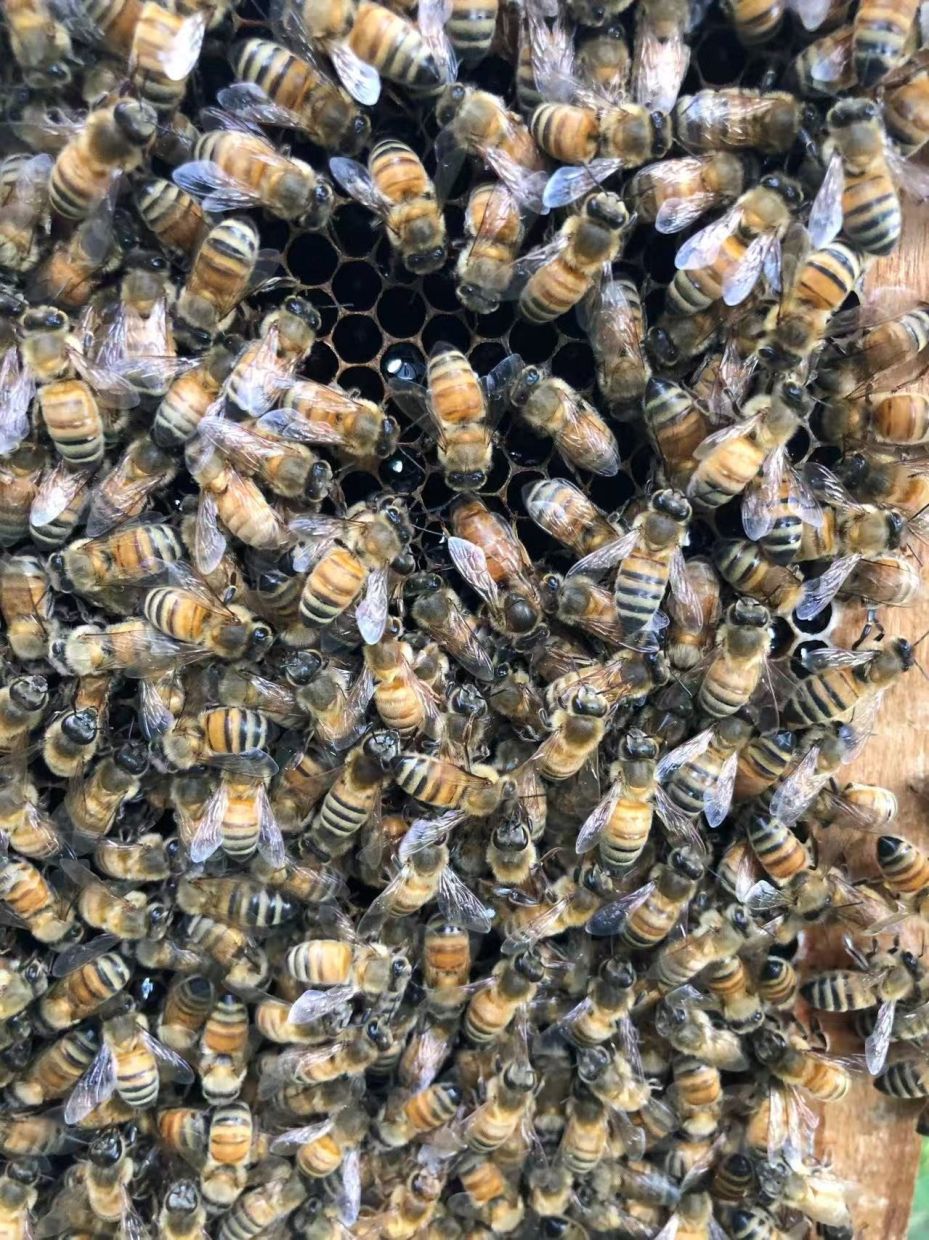
Researchers have upended a long-standing assumption about how honeybee colonies select and develop their queens. For decades, the scientific consensus held that a nutrient-rich substance called royal jelly—secreted by worker bees and fed exclusively to one larva—was the sole determining factor in transforming an ordinary fertilised egg into the colony's sole reproductive female. New research published in the journal Nature suggests this explanation is incomplete, revealing that the physical and chemical properties of the wax chamber itself play a critical role in royal development. The discovery, led by Kai Wang from the Institute of Apicultural Research at the Chinese Academy of Agricultural Sciences, fundamentally challenges the doctrine of nutritional determinism that has dominated honeybee biology for generations.
All honeybee larvae begin their lives identically, emerging from the same type of fertilised egg as their countless sisters who will become workers. The destiny that separates a queen from a common worker has long puzzled scientists, particularly given that colonies produce their reproductive females not through genetic difference but through deliberate developmental choices made collectively by the hive. The mechanism driving this differentiation has been assumed straightforward: worker bees identified a single larva, fed it an exclusive diet of royal jelly—a protein-rich secretion they produce from glands in their heads—and this diet alone triggered the physiological cascade that creates a queen. The new research indicates this understanding overlooks a critical architectural dimension that has been present in honeybee nests throughout their evolutionary history.
Honeybee colonies construct their homes from wax secreted through the abdomens of female workers, shaped into the familiar hexagonal cells that form the colony's structural and functional framework. Most cells serve either as food storage or as nurseries for developing larvae destined for worker roles. Yet colonies also construct a third, distinctly different structure: a chamber resembling a peanut shell hanging downward from the main comb, built specifically to house developing queens. Beekeepers have observed these distinctive structures for centuries as indicators of swarming or succession planning, but treated them largely as passive containers serving no particular function beyond sheltering the developing royal larva. Wang's research reframes these queen chambers as precisely engineered biological systems, what he describes as "an active, highly engineered 'smart incubator'" operating according to principles researchers are only now beginning to understand.
The wax from which queen chambers are constructed differs markedly from worker-cell wax in several significant ways. The royal chamber walls are noticeably softer and possess a higher melting point than ordinary comb wax, and they release distinct chemical compounds—what researchers characterise as a unique chemical "perfume." These physical properties may combine to create developmental conditions uniquely suited to royal transformation. The softer walls potentially allow the growing larva greater room to expand as it develops, while the chemical composition may trigger hormonal changes in the developing larva itself. When researchers exposed larvae destined for queenhood to standard worker-cell wax while maintaining their royal jelly diet, the results were striking: queen development proceeded poorly and larval mortality rates soared dramatically, indicating that the sensory experience of the wax chamber—what Wang terms the "smell and feel" of royal wax—is essential to survival and transformation into a functional queen.
The biological cost of producing queen chambers falls on a select group of young worker bees tasked with their construction. These workers employ remarkable physiological strategies to shape the special royal wax, elevating their thoracic temperatures to over 39 degrees Celsius (102 degrees Fahrenheit)—essentially running a controlled fever—to process the high-melting-point wax into the precise form required. Gene expression patterns in these workers shift dramatically during queen-cell construction, reflecting the metabolic intensity of the task. Remarkably, these specialised workers are not members of a permanent caste system; rather, they are ordinary, flexible young workers temporarily assuming extraordinary responsibilities through temporary shifts in gene activation. Wang describes them as "the ultimate multitaskers," as they simultaneously construct queen chambers while continuing routine hive duties such as food sharing and cell inspection—a demonstration of the colony's remarkable capacity to allocate labour flexibly according to collective need.
The implications of this research extend beyond pure scientific curiosity into practical applications for agriculture and food security. Managed honeybee colonies provide critical pollination services for more than 80 major agricultural crops globally, yet beekeepers in North America and elsewhere report mounting colony losses that threaten agricultural productivity. Boris Baer, professor of pollinator health at the University of California, Riverside, and co-leader of the study, emphasises that queen quality stands central to colony health and resilience. Understanding the natural mechanisms through which colonies produce robust, viable queens offers beekeepers evidence-based approaches to improving queen breeding programmes and potentially developing more resilient managed populations capable of withstanding the various stressors—disease, pesticide exposure, habitat loss—that currently drive colony collapse.
The research also suggests that similar mechanisms may operate throughout the insect world's social species. Termite mounds, wasp paper nests, and the elaborate wax structures built by stingless bee species may similarly function as more than mere shelter, potentially encoding developmental instructions through their physical and chemical properties. This perspective repositions architectural design within social insect colonies as a form of collective information transfer, where structures communicate biological directives to developing individuals. The complexity of social insect organisation, viewed through this lens, reflects sophisticated multi-layered systems of control in which nutrition, pheromonal signalling, temperature regulation, and structural engineering combine to coordinate individual development with collective reproductive strategy.
Wang's most surprising finding was the realisation that the "deeply rooted dogma" of nutritional determinism—the conviction that royal jelly represents the singular secret to queen production—was fundamentally incomplete. This discovery required overturning assumptions that had become so embedded in the field that their validity went largely unquestioned. The study does not yet identify the precise chemical or physical aspect of the royal wax that triggers queenly development, leaving what Wang describes as the crucial next frontier: identifying the molecular switch that communicates to developing larval DNA the message "You are the queen." Future research must isolate which specific chemical compounds, which particular physical characteristics, or which combination of sensory inputs delivers this transformative biological signal.
The broader significance of Wang's work lies in its redefinition of the honeybee colony as an integrated "superorganism" rather than a collection of individually motivated insects. In this framework, worker bees collectively orchestrate the transformation of an ordinary larva into a future mother, with each worker contribution—whether secreting royal jelly, elevating thoracic temperature to process wax, or constructing the architectural envelope—representing a coordinated element within a unified biological system. The metaphor Wang employs—"Eating well is important, but living in the perfect home is what truly changes your destiny"—captures a fundamental truth about development applicable far beyond honeybees: that nurture encompasses not merely nutrition but the entire environmental context in which growth occurs. As climate change and intensified agricultural practices continue to stress wild and managed bee populations across Southeast Asia and globally, insights into natural queen production mechanisms become increasingly vital to preserving the ecological and economic services these insects provide to human agriculture and natural ecosystems.