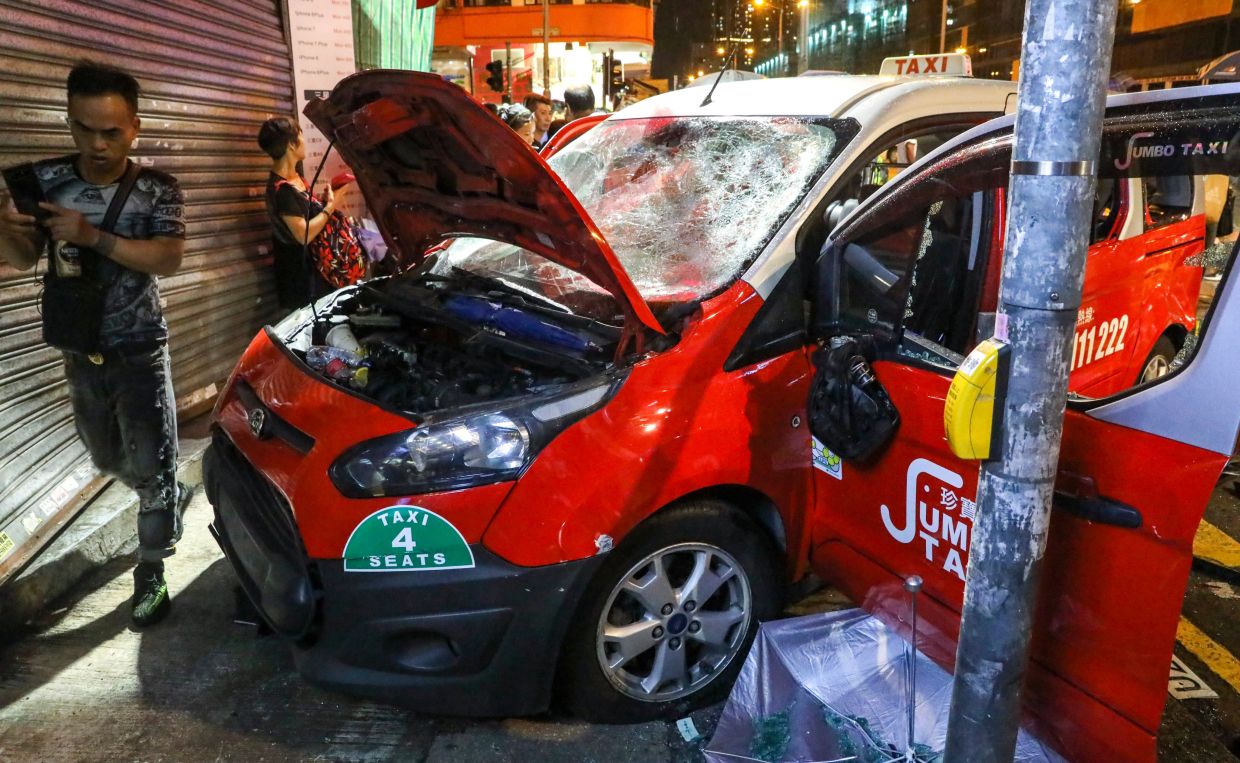
A Hong Kong woman who suffered life-altering injuries when a taxi mounted a pavement and struck her during the tumultuous 2019 pro-democracy demonstrations is now seeking HK$8.4 million in compensation. The case highlights the complex legal questions that emerge when ordinary citizens become casualties in the crossfire of civil unrest, and raises uncomfortable issues about who bears responsibility when violence cascades unpredictably through public spaces.
Park Hoi-lam, who was working as a pharmaceutical packer at the time, was walking through Sham Shui Po on October 6, 2019, after transport disruptions forced her group to abandon their original journey to Tsim Sha Tsui. The day's demonstrations had paralysed the territory's transport network, trapping commuters and forcing them to navigate blocked streets. Her lawyers presented evidence to Justice Simon Leung Chun-man that taxi driver Henry Cheng Kwok-chuen bore full responsibility for the collision, arguing that he failed to exercise basic care by neither sounding his horn nor attempting to brake before his vehicle struck Park and another woman on Yen Chow Street.
The physical toll on Park's body has been staggering. She endured seven surgical operations within three months of the incident, and although she was discharged from hospital on January 18, 2020, her recovery remains incomplete years later. Medical experts have informed her that her condition has plateaued and will not improve further despite additional surgeries. She now faces the prospect of knee replacement surgery in the future, a procedure that looms over her working life as a kindergarten clerk in Tuen Mun. The scars on her legs, which she cannot afford to have surgically corrected, serve as permanent reminders of that October afternoon.
The functional limitations Park faces in her daily work reveal how profoundly the accident has diminished her capacity to perform even routine childcare tasks. As a clerk in a kindergarten, she is unable to lift heavy objects or comfort distressed toddlers by carrying them, capabilities that form the backbone of early childhood education work. Walking remains painful and restricted—she cannot traverse more than an hour without requiring rest, a significant constraint for someone whose employment demands mobility and presence throughout a working day. These restrictions have forced Park to radically restructure her professional and personal life around her injuries.
Cheng's defence team mounted a starkly different narrative, contending that their client was himself a victim of protest violence and should not be held liable to someone else injured during the same chaotic period. They argued that Cheng was subjected to a vicious assault by protesters who attacked him with metal rods and hard objects, positioning him as another innocent casualty of the day's unrest rather than a negligent driver. Their legal strategy pivots on the argument that seeking compensation from one violence victim through the courts does not constitute true justice, particularly when that victim was doing nothing more than performing his job as a taxi driver.
Counsel for Park, Susanna Leong, systematically dismantled the defence's framing by emphasizing that whatever violence occurred afterward was irrelevant to the mechanics and culpability of the collision itself. The fact that a taxi mounted a pavement at high speed and struck pedestrians speaks directly to how and why the accident happened, she argued, and those circumstances can be evaluated independently of subsequent events. Leong pressed the point that neither sounding a horn nor attempting to brake represented optional courtesies—they were fundamental obligations of care that any reasonable driver should have fulfilled when confronted with a crowd of pedestrians.
The defence strategy extended to questioning Park's credibility and the extent of her disability. Ashok Sakhrani, counsel for Cheng, attempted to introduce covert surveillance footage obtained by a private detective that purported to show Park engaging in normal activities like shopping and dining after work. The implicit suggestion was that anyone capable of these routine functions cannot claim to have lost their capacity for normal living. Park's response exposed the limitations of such visual evidence: she pointed out that occasional shopping and dining trips do not equate to leading a meaningful or fully functional life, particularly for someone whose profession and physical independence have been fundamentally compromised.
The 2019 Sham Shui Po protests represented some of the most intense civil unrest Hong Kong had experienced in decades, and the incident exemplifies how widespread disorder creates hazardous conditions that injure bystanders with no involvement in the underlying political disputes. Park herself had not been participating in the demonstration—she was simply attempting to navigate disrupted transport routes. The blocking of roads and suspension of railway services forced her into streets that had become congested with protesters, creating precisely the kind of chaotic public space where accidents become more likely. This collision occurred at the intersection of structural disruption and individual negligence, raising questions about how liability should be apportioned in such circumstances.
The case also reveals the financial vulnerability of workers in lower-income positions when catastrophic injury occurs. Although Park's injuries qualify as serious by any objective measure, she lacks the financial resources to pursue recommended reconstructive surgery for her leg scars, a procedure that would likely improve both her physical function and psychological well-being. The gap between medical recommendation and her capacity to pay highlights how injury settlements carry implications beyond compensation—they determine whether victims can access the full range of treatments their conditions warrant.
The trial is expected to conclude within six days, but the broader implications extend well beyond this individual dispute. The case will establish precedent regarding driver liability when injuries occur during mass protest events, and whether courts will accept the argument that drivers bear no responsibility for accidents that occur in protest-affected areas simply because they themselves subsequently became victims of violence. For Hong Kong's legal system, the decision will clarify how civil liability operates in the contested spaces created by large-scale social upheaval.
Park's testimony painted a picture of diminished capacity masked by surface normalcy. She performs her kindergarten duties, she shops, she dines—the ordinary activities of urban life—but each is circumscribed by pain, limitation, and the knowledge that medical experts have determined her condition will never substantially improve. This gap between appearing functional and actually being severely disabled represents perhaps the most insidious consequence of serious injury: the way that life can continue while never truly returning to what it was before.

