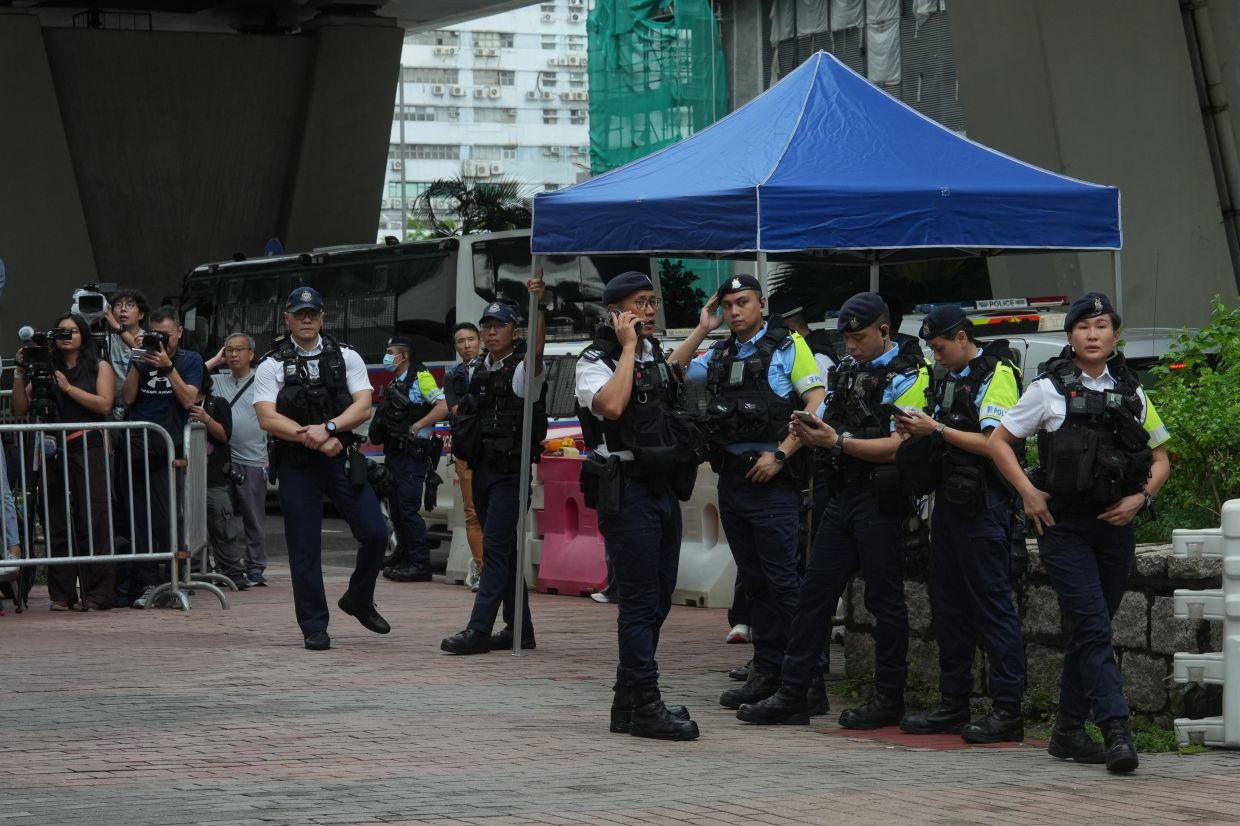
Hong Kong's police force has detained a woman suspected of wearing apparel bearing a seditious message outside West Kowloon Court, marking the latest enforcement action in the territory's increasingly stringent approach to public expression. The arrest occurred on a Friday morning when the woman was singled out by an undercover officer and removed from the vicinity hours before a landmark judicial verdict was delivered in a closely watched national security case.
Police confirmed the detention on Monday evening, citing suspicion of disorderly conduct in a public space, obstruction of law enforcement, and acting with seditious intent. In a terse statement, a force spokesman characterised the operation as a public safety and order measure, though authorities declined to divulge operational specifics. The incident unfolded during what had become a tense scene at the courthouse, where more than 50 people had assembled from the early morning to observe or report on judicial proceedings expected to conclude a significant prosecution.
The timing of the arrest proved particularly conspicuous, occurring mere hours before judges rendered their verdict against Lee Cheuk-yan and Chow Hang-tung, former leadership figures of the Hong Kong Alliance in Support of Patriotic Democratic Movements of China, a now-dissolved advocacy organisation best known for organising the territory's annual Tiananmen Square remembrance vigil. Media cameras captured the moment when the woman, reportedly wearing a black T-shirt bearing Japanese characters, was escorted into a police vehicle by officers who simultaneously directed journalists to leave the vicinity. The nature of the characters and their alleged seditious content was not explicitly detailed in official statements, though observers noted the symbolic significance of the arrest's proximity to the unfolding court verdict.
The prosecution of Lee and Chow represents one of Hong Kong's most significant national security cases since the 2020 national security law's enactment. The three High Court judges who deliberated the case produced a 216-page judgment establishing a sweeping interpretation of what constitutes subversion under the security legislation. Their ruling held that any effort to undermine or displace the Communist Party of China's authoritarian control could constitute subversion, regardless of whether such efforts employ violent or peaceful methods. Notably, the judges determined that the territory's constitution fundamentally precludes the adoption of Western-style democratic governance, effectively constraining the bounds of permissible political discourse.
Both defendants stood accused of inciting subversion by publicly advocating for the termination of what they characterised as "one-party dictatorship" across mainland China. Lee, who previously served in Hong Kong's legislative apparatus, and Chow, a practising barrister, have each endured nearly five years in custody awaiting trial completion. Their conviction carries substantial implications for the space available for political activism and speech in Hong Kong, where civil liberties have contracted markedly since the national security law's implementation.
A fourth defendant in the case, Albert Ho Chun-yan, who held the position of vice-chairman within the alliance, has remained in detention for more than four years. Ho entered a guilty plea in January and presently awaits sentencing, a proceeding that will occur following the judges' determination of appropriate penalties for Lee and Chow. The cascade of guilty findings against the alliance's leadership effectively concludes the legal persecution of an organisation that once represented a visible outlet for commemorating the 1989 Tiananmen Square incident—an event the mainland government has systematically expunged from public memory and education.
The arrest occurring outside the courthouse exemplifies the intensified policing of political expression in Hong Kong's public spaces. By detaining someone merely for the apparel they wore in a public location, authorities have signalled an expansive interpretation of sedition that extends beyond speech and advocacy into personal presentation itself. This development signals a marked escalation from previous enforcement patterns, where prosecutions typically centred on explicit statements or organised activities rather than sartorial choices.
From a regional perspective, Hong Kong's trajectory demonstrates how national security legislation can function as an instrument for constraining political pluralism and democratic expression. Neighbouring democracies and semi-democracies across Southeast Asia, including Malaysia, observe these developments with varying degrees of concern. While Malaysia maintains its own sedition laws and internal security apparatus, Hong Kong's recent trajectory illustrates the velocity with which broad security legislation can be deployed to suppress conventional political activity and peaceful advocacy.
The verdict's underlying legal reasoning also reshapes the boundaries of acceptable political thought in Hong Kong. By codifying the notion that challenging one-party communist rule constitutes subversion, judges have effectively criminalised a philosophical position rather than exclusively targeting violent conspiracy or espionage. This represents a qualitative shift from conventional national security jurisprudence in common law jurisdictions, where sedition traditionally required either incitement to violence or imminent threats to state stability.
The intersection of these developments—the T-shirt arrest, the verdict, and the judges' expansive reasoning—collectively illustrates the mechanism by which national security frameworks can progressively narrow the space for political expression and dissent. For observers throughout Asia, the Hong Kong case demonstrates both the speed and breadth with which such transformation can occur once legislative foundations are established. The conviction of Lee, Chow, and their organisation effectively marks the terminal point of an era in which Hong Kong maintained distinct civil liberties protections from mainland China, a divergence that had persisted since 1997's handover.

