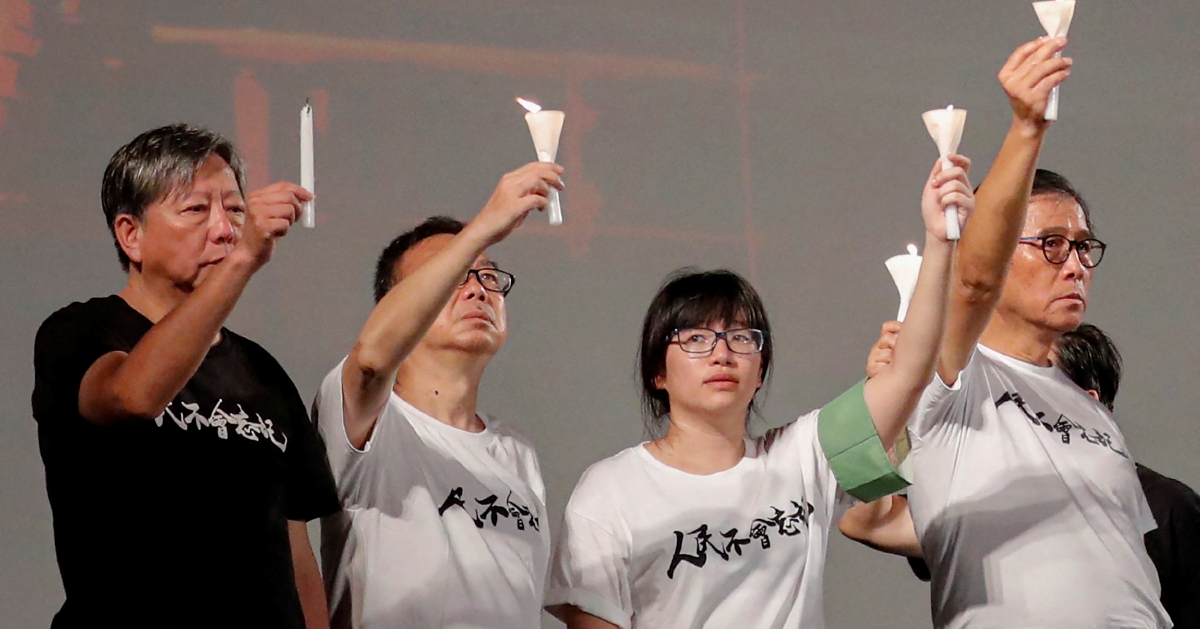
A Hong Kong court on Friday delivered guilty verdicts against two prominent activists who orchestrated yearly memorial gatherings to commemorate the 1989 Tiananmen Square crackdown, with the charges centring on allegations of incitement to subversion. The convictions represent a watershed moment in Hong Kong's evolving legal landscape, where commemorative activities once considered central to the territory's distinctive identity are now subject to criminal prosecution under escalating national security frameworks.
The two individuals stood trial for their roles in coordinating candlelit vigils held annually on June 4th, honouring the victims of China's military intervention on Tiananmen Square three decades ago. These gatherings, traditionally drawing tens of thousands of Hong Kong residents, symbolised the territory's unique position as the only place in China where public commemoration of the event was openly permitted. The conviction signals a fundamental shift in how authorities approach historical remembrance and political expression in the semi-autonomous region.
The application of subversion charges against individuals engaged in organising peaceful commemorative events underscores the broadening scope of Hong Kong's national security legislation. Originally introduced in 2020 following months of pro-democracy protests, these laws have progressively been deployed against an expanding spectrum of activities, from direct political advocacy to more indirect forms of expression and assembly. The court's ruling suggests that public remembrance of sensitive historical events now carries significant legal jeopardy.
For Malaysian observers, the Hong Kong situation carries particular relevance as it demonstrates how national security frameworks, once introduced with stated intentions of maintaining public order, can expand into domains affecting fundamental freedoms. Malaysia itself maintains comprehensive legislation addressing sedition and national security concerns, making the trajectory of Hong Kong's legal evolution instructive for understanding how such powers might be applied domestically. The principle that commemoration itself constitutes incitement rather than protected expression challenges conventional understandings of permissible public discourse.
The vigils that these activists organised had become iconic fixtures of Hong Kong's civil society landscape, attracting university students, elderly citizens, religious groups, and ordinary residents united by a commitment to remembering historical events their government increasingly prefers to obscure. The annual gathering represented one of the last remaining visible expressions of political dissent permitted in the territory, with participants carrying candles while singing and speaking about broader questions of freedom and governance.
This conviction follows a pattern of legal actions against individuals associated with Hong Kong's democracy movement. Multiple pro-democracy politicians, journalists, academics, and activists have faced prosecution under national security legislation over recent years, with charges ranging from sedition to collusion with foreign forces. The consistency of this enforcement pattern suggests systematic use of criminal law to constrain political opponents and reshape the boundaries of acceptable public conduct.
The Tiananmen commemoration holds deep symbolic weight across Greater China and the Chinese diaspora worldwide. In mainland China, any public reference to the 1989 events remains tightly controlled, with the government maintaining strict censorship over historical records and public discussion. Hong Kong's annual vigils thus represented a notable exception to this near-universal information control, embodying the territory's relative openness compared to the mainland. The conviction effectively eliminates this distinctive space for remembrance.
International rights organisations have expressed concern about the deteriorating human rights situation in Hong Kong, warning that the application of subversion charges to commemorative activities reflects a troubling expansion of state power over civil society. The convictions may face appeals, but their immediate effect is to create substantial legal risk for anyone considering organising similar remembrance events in coming years. This chilling effect extends beyond the defendants themselves to broader questions about what forms of historical memory remain permissible in Hong Kong.
For Southeast Asia more broadly, Hong Kong's experience serves as a cautionary illustration of how political and legal frameworks can rapidly transform public space. Nations in the region with their own national security legislation face ongoing questions about how such measures might be interpreted and applied beyond their original stated purposes. The progression from legislation to criminalisation of peaceful gathering represents a trajectory worth monitoring for implications across the region.
The verdict also carries implications for diaspora communities and international relations. Chinese communities throughout Southeast Asia, including Malaysia, have historically used June 4th commemorations as occasions for public remembrance and political expression. These convictions may influence how authorities across the region approach similar activities, potentially creating precedent for restricting Tiananmen-related commemoration on grounds of respecting Chinese sovereignty or preventing subversive activity.
The broader question emerging from these convictions concerns how societies balance security imperatives against space for historical reflection and political dissent. The Hong Kong court's decision suggests that in the current environment, historical memory itself may be constructed as a security threat when that memory contradicts official state narratives. This conceptualisation represents a significant departure from conventional democratic practice, where commemoration and critical historical engagement are typically understood as fundamental freedoms.
As Hong Kong enters this new phase of its constitutional and political life, the fate of these two activists and the category of charges applied against them will likely shape how civil society organisations operate across the territory. The conviction effectively places historical memory within the scope of criminal liability, establishing legal precedent for future prosecutions.

