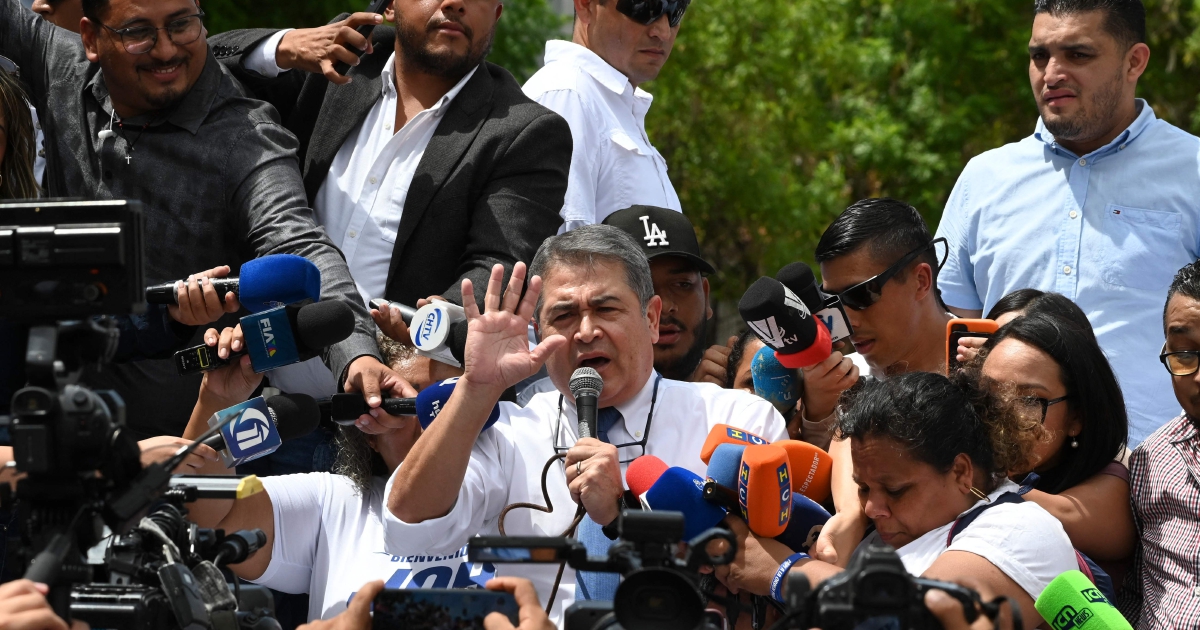
Former Honduran president Juan Orlando Hernandez secured a significant courtroom victory on Monday when a judge in Tegucigalpa granted him the right to remain free while he confronts serious corruption allegations in his home country. The decision marks another chapter in the tumultuous legal saga of the Central American leader, who previously benefited from a presidential pardon that shielded him from conviction in the United States for narcotics-related offences. Trump's intervention on Hernandez's behalf last year stunned observers across Latin America and raised eyebrows among anti-corruption advocates who viewed the pardon as a setback for accountability efforts in the region.
The timing of the Honduran court's ruling underscores the complex interplay between international and domestic judicial systems that has come to define Hernandez's legal predicament. While American courts no longer pose an immediate threat to his liberty following Trump's pardon, domestic prosecutors have moved aggressively to pursue charges related to alleged misappropriation of public funds and abuse of office during his administration from 2014 to 2022. The decision to permit him to avoid preventive detention signals a degree of judicial flexibility in Honduras, despite the gravity of the accusations levelled against him by his own government.
Hernandez's presidency was marked by persistent allegations of organised crime connections and drug trafficking facilitation, claims he consistently denied throughout his tenure. These accusations ultimately triggered investigations that extended across borders, with American authorities building a case that implicated him in conspiracy to traffic cocaine and money laundering. The narrative that emerged from court filings painted a picture of a leader allegedly compromised by criminal networks, a characterisation that deeply damaged Honduras's international reputation at a time when the country grappled with gang violence and institutional weakness.
The pardon granted by Trump represents a dramatic reversal of the trajectory that appeared inevitable when Hernandez left office. American prosecutors had constructed what they considered a compelling case, but Trump's final-hour clemency decision rendered their efforts moot. The move proved particularly controversial given the Biden administration's emphasis on anti-corruption initiatives throughout Latin America and the Caribbean, where institutional capture by organised crime remains a persistent threat to democratic stability.
Back in Honduras, however, the legal machinery continues to grind forward. Domestic corruption charges carry their own weight and significance, touching on allegations that strike at the heart of institutional integrity. Hernandez faces accusations that he exploited his presidential powers to enrich himself and cronies through fraudulent dealings. These charges reflect broader concerns about the capture of state institutions by elites who weaponised public office for personal gain—a pattern that has complicated development efforts and eroded public confidence in governance throughout Central America.
The ruling permitting Hernandez to remain at liberty rather than endure pre-trial detention reflects judicial reasoning that presumably weighed factors including his ties to Honduras, the stability he might pose as a defendant with established residence, and possibly considerations about the availability of supporting evidence during the trial process. Honduras has faced significant international pressure to demonstrate credible anti-corruption prosecution, and the handling of such high-profile cases carries broader implications for the country's institutional credibility on the global stage.
For Malaysia and other Southeast Asian nations observing judicial developments in Latin America, the Hernandez case offers instructive lessons about the persistence of corruption within state structures and the challenges that prosecutorial systems face when confronting former leaders. The region has witnessed comparable struggles to hold powerful figures accountable for abuse of office and financial misconduct, where political connections and international assistance sometimes prove decisive in determining outcomes.
The distinction between American and Honduran legal processes in this case illuminates how corruption's transnational dimensions complicate accountability. While Trump's pardon reflected American political calculations and presidential prerogatives, it did not extend to crimes prosecuted under Honduran law. This jurisdictional reality creates a scenario where international clemency offers limited sanctuary against determined domestic prosecution—though defence strategies and resource disparities can influence case trajectories substantially.
Hernandez's ability to remain free during his corruption trial positions him to mount an active legal defence while maintaining some semblance of normal life, though his political future and personal liberty remain fundamentally uncertain. The case continues to reverberate through Honduran politics and society, serving as a focal point for discussions about institutional reform and the need for strengthened checks on executive power. As the trial proceeds, both Honduras and the international community will watch closely to assess whether domestic judicial systems can deliver accountability independently, without reliance on external pressure or foreign interventions that might complicate the pursuit of justice.

