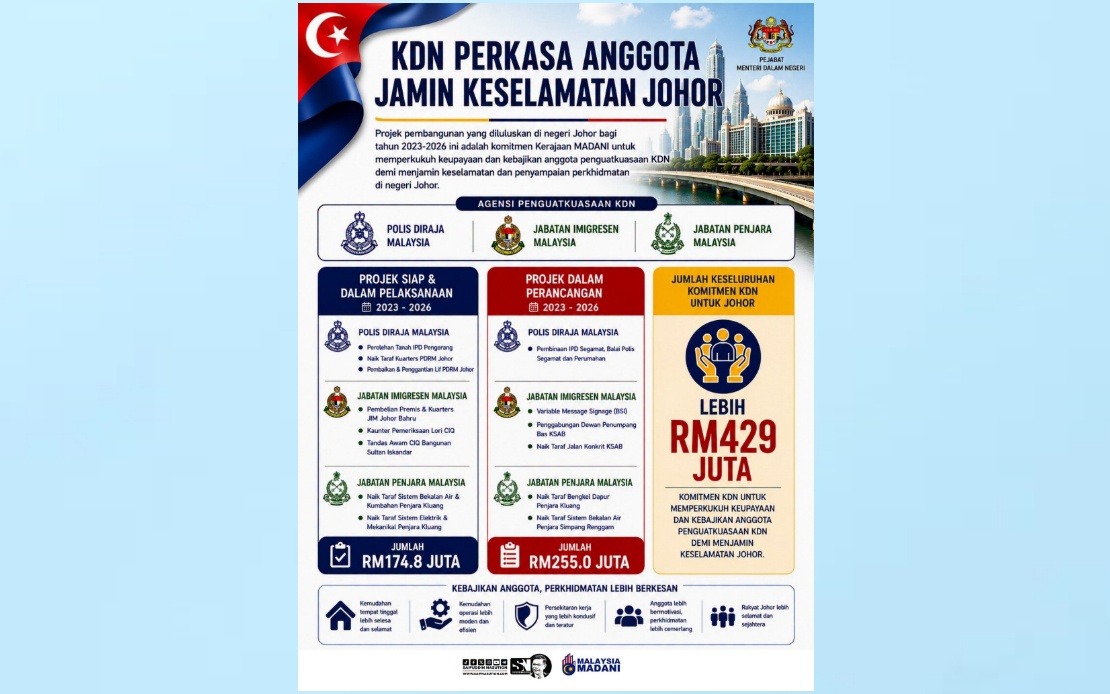
The Home Ministry has committed more than RM429 million since 2023 toward strengthening enforcement operations and staff wellbeing across Johor, reflecting the government's strategy to build a more capable and motivated security apparatus at the state level. The substantial investment encompasses three cornerstone agencies—the Royal Malaysia Police, the Malaysian Immigration Department, and the Malaysian Prisons Department—underscoring the interconnected nature of Malaysia's law enforcement infrastructure and the need for coordinated resource allocation across multiple fronts.
Home Minister Datuk Seri Saifuddin Nasution Ismail framed the initiative not merely as facility upgrades but as a strategic investment in human capital and operational resilience. By improving work environments, providing modern quarters, and equipping enforcement personnel with contemporary tools and infrastructure, the ministry argues that the broader public derives tangible security benefits. This philosophy reflects a maturing understanding within government that officer morale, workplace conditions, and access to proper equipment directly translate into faster response times, more professional conduct, and higher-quality law enforcement outcomes that ultimately serve Malaysian citizens more effectively.
Of the RM429 million total, RM174.8 million has been allocated to projects either completed or actively under way, while RM255 million has been earmarked for developments currently in planning phases. This division signals the ministry's pragmatic approach: consolidating and accelerating near-term improvements while laying groundwork for longer-term capacity expansion. The split also suggests that planning and design work for more ambitious infrastructure projects is substantially advanced, positioning the ministry to move swiftly into construction and implementation once budgetary or administrative hurdles are cleared.
Among projects already progressing on the ground, the acquisition of land for the Pengerang District Police Headquarters represents a critical capacity-building exercise in a district that has experienced significant economic and population growth. The purchase of office space and staff accommodation for the Johor Bahru Immigration Department addresses longstanding capacity constraints at one of Malaysia's busiest entry points, where immigration processing delays have periodically created friction at the border. Simultaneously, facility upgrades at Kluang Prison reflect acknowledgment that prison infrastructure, often neglected in public discourse, directly impacts both staff safety and prisoner welfare, factors that influence rehabilitation outcomes and recidivism rates.
In the pipeline phase, the construction of Segamat District Police Headquarters—designed to incorporate both a police station and residential quarters—demonstrates the government's commitment to establishing comprehensive security infrastructure in smaller urban centres. Segamat's growing commercial and agricultural importance has historically outpaced the development of police infrastructure, making this project a logical response to demographic and economic trends. The consolidation of bus passenger terminals at the Sultan Abu Bakar Complex represents a cross-cutting infrastructure improvement that, while not exclusively a security initiative, will enhance the ministry's ability to conduct passenger screening and threat assessment at a critical transport interchange.
Projects in the advanced planning stage also include upgrades to kitchen and water supply systems at Kluang and Simpang Renggam prisons respectively. Such investments, though unglamorous compared to police headquarters construction, are essential for maintaining dignified conditions of detention and reducing operational inefficiencies that drain staff time and resources. These improvements align with international standards and Malaysia's obligations under prison management best practices, positioning the country favourably in regional comparisons and reducing the likelihood of adverse human rights assessments.
Minister Saifuddin Nasution positioned this allocation within the broader framework of the MADANI Government's federalism strategy, emphasising that Johor receives support proportionate to its development needs and population. This framing is particularly significant given Johor's historical role as Malaysia's second-largest state and its strategic importance as a gateway to Singapore and a major economic hub. By highlighting the ministry's responsiveness to Johor's requirements, the government aims to demonstrate even-handed resource distribution and counters any perception that resource allocation follows political factionalisation.
Prime Minister Datuk Seri Anwar Ibrahim's recent parliamentary clarification that Johor's development and management allocation has risen to approximately RM14.6 billion from the previous RM10.2 billion provides macroeconomic context for the Home Ministry's RM429 million commitment. This forty-percent increase in state-level allocation suggests a deliberate effort to accelerate development across all portfolios, including security infrastructure. For Malaysian readers accustomed to infrastructure delays and chronic underfunding of enforcement agencies, such figures offer tangible reassurance that budgetary pressure is easing and investment trajectories are shifting upward.
The implications for Southeast Asia are noteworthy. Regional security challenges—from transnational crime networks to maritime piracy to organised human trafficking—increasingly require enforcement agencies with robust infrastructure, well-trained and motivated personnel, and modern technological capabilities. Malaysia's investment in Johor enforcement capacity contributes to regional stability by enhancing the country's ability to police its border regions, control contraband flows, and coordinate with neighbouring jurisdictions. A better-resourced Johor enforcement sector translates into more effective intelligence-sharing, faster cross-border responses, and reduced operational friction with Thai and Singaporean counterparts.
Staff welfare investments carry particular significance in this regional context. Across Southeast Asia, enforcement agencies struggle with low morale, inadequate compensation, and poor working conditions—factors that undermine integrity and make personnel vulnerable to corruption. Malaysia's deliberate effort to improve quarters, facilities, and operational support addresses these vulnerabilities proactively, potentially establishing a competitive standard within the region and signalling to its own personnel that government values their wellbeing and professionalism.
The ministry's comprehensive approach—spanning physical infrastructure, staff accommodation, and operational equipment—reflects sophisticated understanding that effective law enforcement requires integrated solutions. Police officers without adequate facilities become demoralised; immigration officers without modern processing systems create bottlenecks that invite corruption; prison staff without proper infrastructure cannot maintain humane conditions or prevent escapes. By addressing these interconnected challenges simultaneously across three major agencies, the Home Ministry pursues a systems-level improvement that yields multiplicative gains rather than isolated, disconnected upgrades.
Looking forward, the success of this RM429 million programme will largely determine whether similar future investments are approved. If projects are completed on time and within budget, and if enforcement performance metrics improve measurably, the ministry will establish credibility for requesting expanded allocations. Conversely, project delays or cost overruns would undermine confidence and potentially constrain funding for subsequent phases. Malaysian readers monitoring government spending will rightly track the implementation trajectory of these initiatives as a barometer of fiscal discipline and project management capability across the public sector more broadly.

