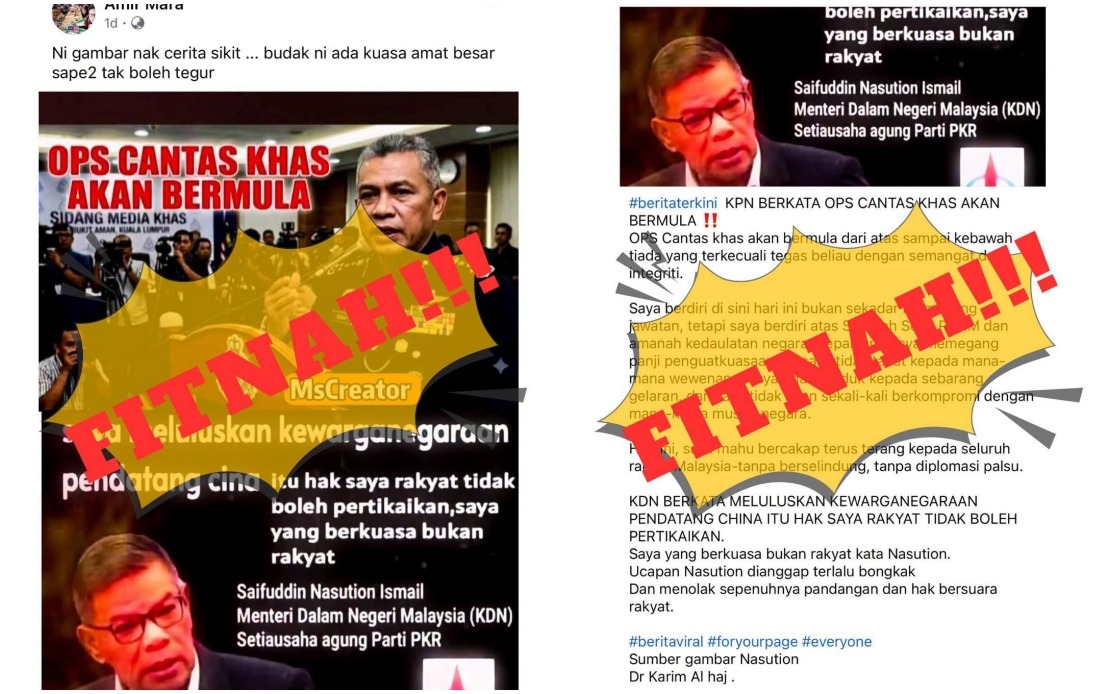
Home Minister Datuk Seri Saifuddin Nasution Ismail has firmly refuted allegations circulating on social media that the Home Ministry granted citizenship en masse to foreign nationals, alongside claims that 1.2 million Chinese nationals remain in Malaysia. Speaking from Putrajaya, Saifuddin Nasution emphasised that he has already addressed these accusations on multiple occasions, backed by verified official data and documented evidence, yet misleading narratives continue to resurface across digital platforms.
The persistence of these claims represents a deliberate strategy to mislead the public, according to the Home Minister. Various posters and recycled video content alleging improper citizenship grants have gained traction on social media, despite official clarifications issued previously. Saifuddin Nasution expressed frustration at what he characterised as a coordinated effort to revive discredited allegations, suggesting that certain actors intentionally exploit these sensitive topics to sow discord.
The Home Minister's statement underscores growing concerns about misinformation affecting governance in Malaysia. The circulation of unverified claims about citizenship grants strikes at fundamental anxieties about immigration policy and national composition, issues that carry particular weight in the Malaysian political landscape where demographic concerns frequently intersect with communal tensions. By recycling unsubstantiated narratives, actors amplify existing societal divisions and erode institutional credibility.
Saifuddin Nasution highlighted the broader dangers posed by such misinformation campaigns. Beyond merely damaging the reputation of individuals or institutions involved, unchecked spread of false claims threatens Malaysia's social fabric by stoking racial animosity and potentially inciting public disorder. The Home Minister linked the propagation of such narratives directly to national security concerns, suggesting that deliberate falsehoods designed to provoke communal conflict warrant serious attention from authorities.
The Home Ministry has previously released detailed statements documenting the accuracy of its citizenship procedures, with comprehensive data refuting the allegations. These clarifications have been widely reported and remain available through official channels. Yet despite this transparency, some parties continue leveraging social media platforms to resurrect debunked claims, often with minimal contextual accuracy. This pattern reflects a troubling disconnect between official communications and public discourse, particularly regarding immigration and citizenship matters.
The minister's call for responsible information consumption addresses a challenge facing all Southeast Asian democracies in the digital age. With viral content spreading faster than corrections can reach audiences, false narratives frequently establish themselves in public consciousness before fact-checks gain traction. Saifuddin Nasution urged citizens to verify information through official sources before accepting or sharing claims, essentially appealing to digital literacy as a bulwark against coordinated disinformation.
Political exploitation of immigration anxieties represents a recurring phenomenon across the region, with citizenship and demographic composition serving as potent mobilising issues. The deliberate recycling of refuted claims about mass citizenship grants fits a recognisable pattern wherein actors resurrect discredited allegations periodically to maintain public concern and extract political advantage. For Malaysia specifically, where questions of citizenship have historically intersected with broader discussions about national identity and social contract, such claims carry outsized resonance.
The Home Minister's emphasis on distinguishing fact from fiction reflects the increasing necessity for institutional actors to combat misinformation actively. In an environment where social media algorithms often prioritise engagement over accuracy, official denials frequently struggle to reach audiences exposed primarily to sensational claims. Saifuddin Nasution's direct intervention across multiple platforms suggests recognition that traditional media channels alone prove insufficient for countering viral falsehoods in contemporary Malaysia.
The timing and mechanics of these misinformation campaigns warrant examination. The coordinated nature of the circulation, involving multiple content formats across different platforms, suggests organised rather than organic spread. For Malaysian observers, understanding the mechanics of such campaigns becomes essential for evaluating claims about state capacity and immigration administration. The persistence of these allegations despite repeated official rebuttals raises questions about the effectiveness of current strategies for combating deliberate disinformation on matters of national sensitivity.
Moving forward, Saifuddin Nasution's statement represents both a direct rebuttal and a broader call for institutional trust. The Home Minister's repeated emphasis on documented evidence and official data underscores the importance of transparency in addressing public concerns about immigration policy. Whether this approach ultimately succeeds in stemming the circulation of false claims remains to be seen, though the challenge reflects systemic tensions between institutional credibility and digital-era misinformation that extend well beyond Malaysia's borders.

