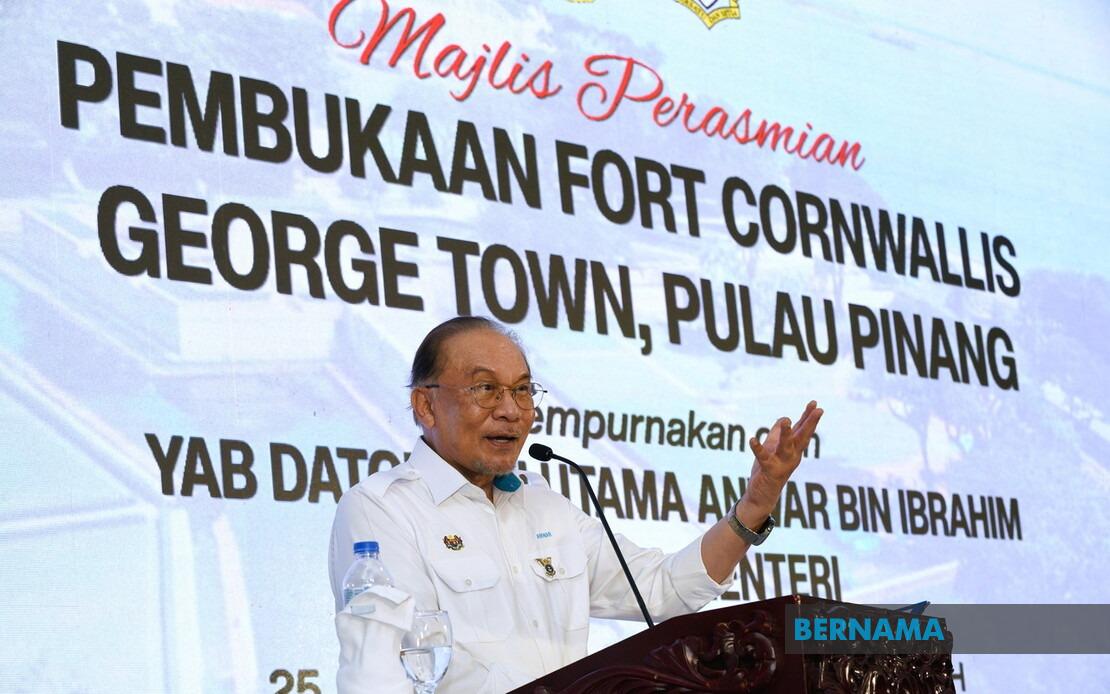
Prime Minister Datuk Seri Anwar Ibrahim has called for a fundamental shift in how Malaysia approaches its historical heritage, arguing that significant sites must prioritize their role as classrooms for national consciousness over their appeal as visitor attractions. Speaking at the opening ceremony of Fort Cornwallis in George Town on July 25, Anwar outlined a vision where young Malaysians connect with their past through meaningful narratives that illuminate the nation's journey toward independence and the value of internal cohesion.
The Prime Minister's remarks represent a deliberate effort to reframe heritage conservation as an instrument for nation-building rather than commercial enterprise. He emphasized that visits to historically significant locations should transcend superficial appreciation of architecture and aesthetic appeal, instead encompassing structured educational content that contextualizes each site within the broader struggle for self-determination and national identity. This approach reflects growing concern among policymakers about generational disconnection from the sacrifices that preceded Malaysia's independence.
Anwar identified a critical gap in how historical narratives have traditionally been transmitted, suggesting that accounts inherited from colonial administrations have shaped understanding in ways that obscure indigenous perspectives and experiences. He advocated for reclaiming the historical record, reconstructing narratives around the lived experiences of ordinary Malaysians who endured colonial rule rather than perpetuating interpretations filtered through foreign administrative lenses. This reframing carries implications for how educational institutions, tourism operators, and heritage management agencies structure visitor experiences and curriculum content.
The Fort Cornwallis conservation project itself becomes emblematic of this broader philosophy. Rather than preserving the structure as a monument to colonial achievement, Anwar positioned it as a facility for examining the mechanics of foreign domination and understanding how external powers historically leveraged strategic interests against local populations. This distinction matters profoundly for Southeast Asian nations grappling with how to honor heritage sites without endorsing the systems they once represented.
Anwar's emphasis on teaching the interconnection between national unity and resistance to external domination carries particular resonance in Malaysia's multiethnic context. He suggested that colonial history itself demonstrates the vulnerability of divided societies to external manipulation, implying that contemporary racial and communal harmony constitute essential safeguards against future subjugation. This linkage transforms historical education into a practical argument for maintaining intercommunal cooperation and strengthens the historical case for the social contract underlying Malaysia's constitutional framework.
The Prime Minister placed direct responsibility on the current generation to preserve hard-won independence and the gains achieved through previous struggles. By framing heritage education as preparation for custodianship rather than mere remembrance, Anwar shifted the conversation from passive consumption of historical content toward active engagement with the obligation to defend existing settlements. This approach potentially influences how government agencies, schools, and private operators design educational programming around historical sites throughout the country.
For Malaysia's tourism industry and heritage sector, Anwar's remarks suggest a pivot toward what might be termed "educational tourism" or "values-based heritage interpretation." Rather than competing primarily on visitor numbers or commercial revenue, historical sites would develop competitive advantages through the quality and authenticity of their educational offerings. This model could differentiate Malaysian heritage experiences in an increasingly saturated regional tourism market while simultaneously serving domestic civic education objectives.
The practical implementation of this vision faces considerable challenges. Developing coherent, pedagogically sound educational content for heritage sites requires collaboration among historians, educators, and site managers operating within budget constraints. Training personnel to deliver consistent, evidence-based historical narratives while accommodating diverse visitor backgrounds demands investment in professional development. Additionally, balancing commercial sustainability with educational mission requires careful design of business models that do not subordinate learning outcomes to revenue generation.
Anwar's framework also invites scrutiny regarding whose narratives ultimately define historical interpretation. While rejecting colonial perspectives, determining which voices and experiences receive primacy in reconstructing history remains contested terrain, particularly in multiethnic societies where communities experienced colonialism differently. The challenge lies in developing inclusive historical narratives that acknowledge plural experiences without fragmenting national identity or diluting broader messages about independence and unity.
For Southeast Asian nations navigating similar questions about heritage conservation and historical memory, Malaysia's approach offers a model for connecting cultural preservation to civic education and national purpose. Other countries managing colonial-era sites face parallel questions about how to contextualize these spaces meaningfully without either glorifying imperial systems or treating history as merely entertainment. Anwar's articulation of these concerns positions Malaysia within broader regional conversations about post-colonial nation-building and the role of shared historical understanding in maintaining social cohesion.
The initiative also reflects Malaysia's investment in soft power and regional leadership through cultural and educational diplomacy. By demonstrating how heritage conservation serves developmental goals and national resilience, Malaysia potentially influences peer nations' approaches while enhancing its international standing as a thoughtful steward of Southeast Asian historical memory. This positioning extends beyond tourism into education partnerships and cultural exchange arrangements that could yield diplomatic benefits.

