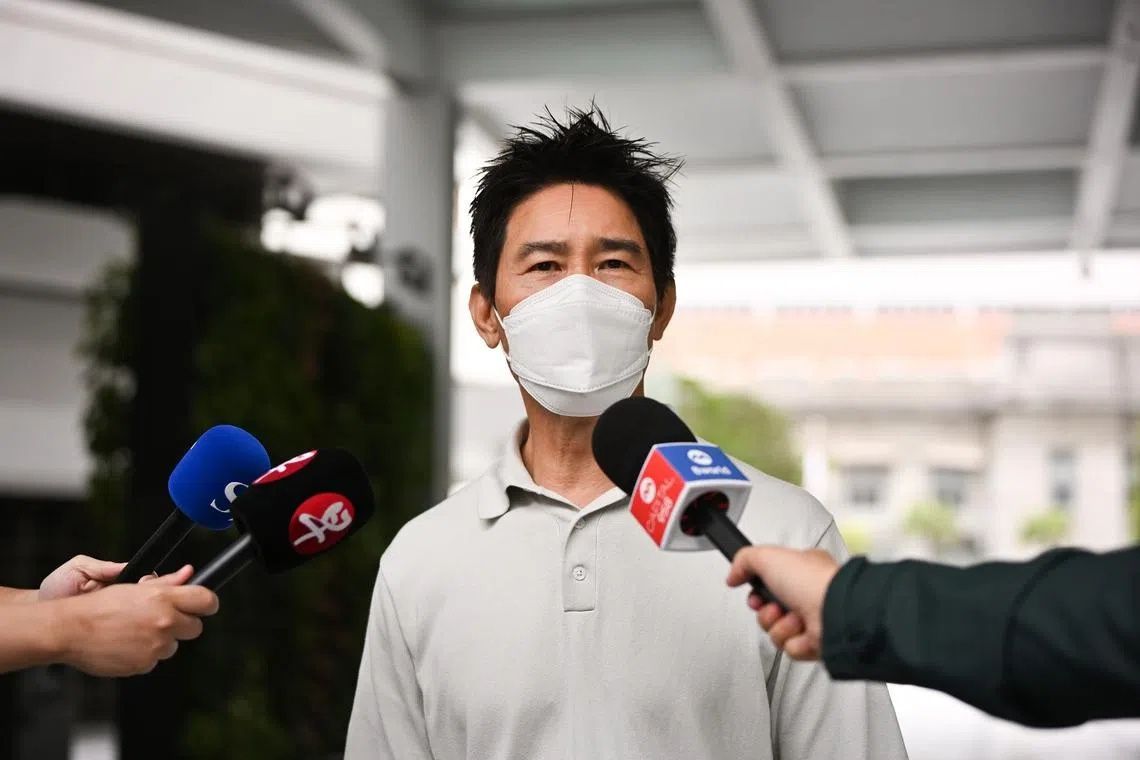
Former Singaporean actor Edmund Chen, 64, has won a substantial reduction in his custodial sentence after the High Court intervened in what it deemed an excessive punishment. On Monday, July 20, Justice Hri Kumar Nair cut the actor's five-day jail term imposed by a district judge in January down to just one day, while upholding his five-year driving disqualification. The case centres on a March 2025 traffic incident along the expressway that resulted in a 21-year-old motorcyclist sustaining multiple wrist fractures requiring surgical intervention.
The original sentence handed down by the district judge came despite prosecutors recommending a financial penalty ranging from S$3,000 to S$5,000, a significant detail that highlighted the tension between the bench and the prosecution over whether the offence warranted imprisonment at all. Chen, whose legal name is Tan Kai Yuan, had pleaded guilty to a single charge of causing grievous hurt while operating a vehicle without due regard for other road users. The distinction proved crucial in the appellate process, as Justice Nair acknowledged that while the district judge may not have erred in determining that custodial time was warranted, the quantum imposed was disproportionate to the circumstances.
The accident occurred near midday on March 4, 2025, on the AYE heading toward the CTE, an area typically characterised by significant traffic volume. Chen's vehicle was positioned in the fourth lane when he attempted to decelerate substantially before filtering across the third lane to position himself for the CTE/SLE junction. The critical factor was that Chen had not positioned his vehicle in the appropriate lane earlier, forcing him to make a sudden manoeuvre near the road split. The motorcyclist, approaching from behind, struck Chen's vehicle despite attempting to swerve away, suggesting that visibility or reaction time may have been compromised by the vehicle's unexpected slowdown and lane change.
Chen's defence team, led by Senior Counsel Abraham Vergis of Providence Law Asia, built their mitigation case around several technical and contextual elements revealed in dashcam footage from Chen's vehicle. The footage demonstrated that Chen had activated his indicator lights before executing the lane change, a factor supporting the argument that he attempted to signal his intentions. Vergis further contended that the motorcyclist's presence was obscured by a passing vehicle due to the curvature of the road, thereby reducing Chen's practical opportunity to detect the hazard. Despite these mitigating points, the footage also showed that Chen crossed white chevron markings on the road surface following the collision, a detail the district judge had weighted significantly in imposing the harsher sentence.
The nature and extent of the victim's injuries formed a central plank of the appeal strategy. Vergis characterised the injuries as falling within the less severe category of grievous hurt, noting that both fractures were localised to the extremities rather than affecting vital areas. The fact that surgical repair was conducted under local rather than general anaesthesia was presented as evidence that the injuries, while serious, did not constitute life-threatening harm. The victim spent two days in Singapore General Hospital and received 99 days of hospitalisation leave, but made a complete recovery without any permanent disability or functional impairment. These factors, Vergis argued, were inconsistent with the imposition of custodial time, particularly when a maximum financial penalty of S$5,000 combined with a lengthy driving ban would serve as adequate deterrence.
Deputy Public Prosecutor Ben Tan resisted the appeal, maintaining that the district judge's sentencing approach, while occupying the upper end of the penalties range, did not constitute an error of principle or application that justified appellate intervention. The prosecutor highlighted an aggravating factor that had influenced the lower court's decision: as Chen executed his manoeuvre, drivers in two other vehicles sounded their horns in warning, yet Chen persisted with the lane change regardless. This detail suggested a degree of inattentiveness or disregard for the warnings of other road users, elevating the recklessness element of the offence. The prosecutor argued that maintaining the five-day sentence would appropriately reflect the seriousness of driving conduct that endangered other road users, even if the resulting harm was ultimately contained to one victim.
Justice Nair's judgment acknowledged the prosecution's concerns but ultimately found that the quantum of imprisonment was disproportionate. While the judge could not conclude that the district judge was substantively wrong in determining that the custodial threshold had been crossed, he found the five-day term to be manifestly excessive given the totality of the circumstances. This approach represents a nuanced position that recognises both the validity of some custodial response to the careless driving and the inappropriateness of the lengthy detention that had been imposed. The reduction to one day effectively transforms the sentence from meaningful imprisonment to a largely symbolic custodial reminder.
Chen's legal representation underwent significant changes throughout the proceedings, reflecting the evolving nature of the case. He was initially represented by Josephus Tan and Cory Wong from Invictus Law following his conviction, but subsequently engaged Kelvin Ong and Dickson Chew from Contigo Law and formally discharged his previous team before engaging Senior Counsel Vergis for the appeal. This succession of counsel changes is not uncommon in high-profile cases where initial conviction requires a strategic reassessment. The shift to Senior Counsel representation for the appellate stage signalled the seriousness with which Chen approached the prospect of five days' incarceration, with his team marshalling stronger argumentative resources for the appeal.
Chen's status as a television personality from Singapore's entertainment industry lent public prominence to what might otherwise have been a routine traffic prosecution. Known by his stage name Edmund Chen, he built a household reputation through appearances in popular television dramas including Star Maiden and Patrol during his active career in entertainment. In 2000, he stepped away from full-time acting following the birth of his daughter Chen Yixin, though he maintained selective involvement in the industry, including a role in the 2017 drama Life Less Ordinary. His spouse, actress Xiang Yun, maintains a stronger profile in local television, having featured in classic dramas such as The Awakening, Double Happiness and The Little Nyonya, which ensures continued public awareness of the family name.
The emotional toll of the legal proceedings on Chen and his family was evident in remarks he made to reporters before the High Court hearing. He indicated that he had prepared for a five-day incarceration by bringing a week's supply of medications, and that both he and his family had been unable to sleep the night before the appeal hearing, suggesting significant anxiety about the outcome. These comments highlight the personal stress that criminal proceedings impose on defendants and their families, even in cases where the physical harm to the victim was relatively contained. The reduction in sentence, while welcome to Chen, came only after months of legal proceedings and the substantial costs associated with engaging Senior Counsel for appellate representation.
The driving disqualification imposed alongside the reduced custodial sentence remains significant for Chen's personal circumstances. The five-year ban from operating motor vehicles represents a substantial practical restriction on his mobility and independence, particularly given his age and potential future employment prospects should he return to the entertainment industry. This penalty appears to have been accepted as proportionate by both the appellate judge and the defence, suggesting broad agreement that disqualification from driving was an appropriate response to the dangerous driving behaviour. The combination of one day's imprisonment, the five-year driving ban, and the psychological impact of criminal proceedings may yet prove sufficient to achieve the rehabilitative and deterrent objectives of the criminal justice system without resort to extended incarceration.

