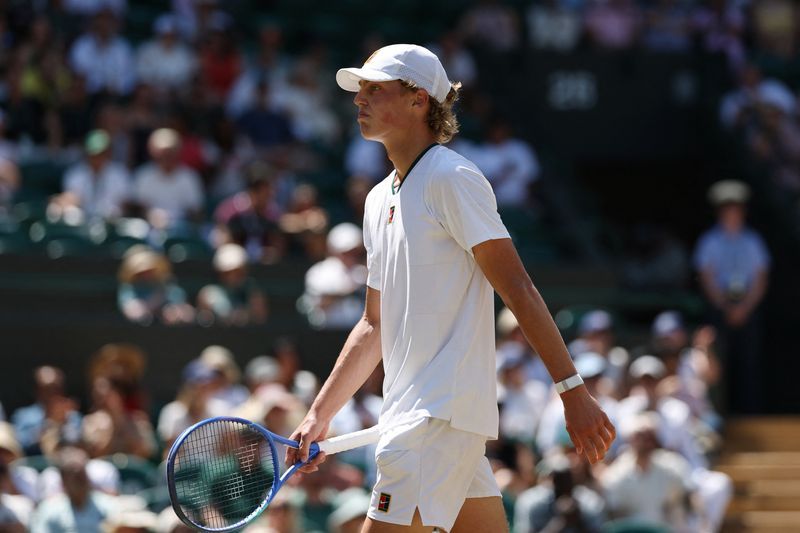
At just 17 years old, Cruz Hewitt has announced his arrival on the professional tennis circuit with a commanding first ATP Tour-level victory at the Washington Open, dispatching American Marcos Giron 6-3 6-4 in the opening round on Tuesday. The achievement represents a significant milestone for the young Australian, who entered the prestigious ATP 500 event as a qualifier ranked outside the world's top 600 competitors. For a teenager still establishing his place in professional tennis, capturing a main draw match against a seasoned opponent demonstrates the genuine promise that has been building around Hewitt's game throughout this transformative summer.
Cruz's breakthrough comes just weeks after he reached the Wimbledon boys' final, where he finished runner-up to American Jordan Lee. The sequence of accomplishments—reaching a Grand Slam junior final and immediately transitioning to ATP-level success—highlights the uncommon trajectory of a young player who appears ready to compete meaningfully against established professionals. This rapid progression echoes the path taken by other generational talents, though the pressure to sustain momentum at such a young age remains formidable in a sport where consistency across multiple seasons separates genuine prospects from brief sensations.
The Washington venue carries particular significance for the Hewitt family legacy. Lleyton Hewitt claimed the tournament title in 2004, during an era when he competed among the game's elite. For Cruz to earn his breakthrough win at the same venue where his father achieved success adds a layer of poignancy to the moment, bridging generations within the sport. When reflecting on his victory, Cruz acknowledged the emotional weight of this connection, noting that he remembers attending his father's final match at the tournament and that returning to Washington as a competitor felt surreal. Such family resonance in professional sport can either inspire athletes or burden them with unrealistic expectations—Cruz's perspective suggests he is channelling the former rather than struggling with the latter.
With his victory, Cruz became the youngest player to win a match at the Washington Open since Japan's Kei Nishikori accomplished the feat in 2007, a distinction that underscores just how rare it remains for teenage qualifiers to advance past established professionals at ATP level. The statistical company also notes that Cruz joins an exclusive cohort of players born in 2008 or later who have claimed tour-level victories, a group that includes Diego Dedura, Thijs Boogaard, and Moise Kouame. This narrowing of the field demonstrates both the difficulty of breaking through at professional level and the particular talent required of players attempting to do so while still in their teenage years.
Cruz credited his father's counsel with helping him navigate the mental and tactical demands of competing at this elevated level. Rather than offering complex technical instruction, Lleyton Hewitt advised his son to enjoy the experience, to approach each point individually, and to absorb the atmosphere that professional tennis creates. This wisdom reflects the perspective of a former world number one who learned that managing pressure and maintaining perspective often matters more than raw technique when competing in high-stakes environments. Cruz appears to have internalised this guidance, describing his approach as balancing the nerves natural to any inexperienced competitor with a determination to extract positives from the challenge.
The teenager's second-round draw presents a formidable test. He will face either Greek star Stefanos Tsitsipas, who remains a consistent presence in ATP rankings and Grand Slam draws, or fellow Australian Alex de Minaur, a player whom Cruz has known since childhood. The possibility of confronting de Minaur carries particular emotional significance for Cruz, who described their relationship as resembling that of brothers. De Minaur has spent time with the Hewitt family, including celebrating Christmas together, and has served as an informal mentor to the younger player. Should they meet, Cruz views the matchup not as an intimidating obstacle but as an opportunity to create lasting shared memory—a perspective that reveals considerable maturity and emotional intelligence alongside his technical ability.
For Malaysian and Southeast Asian tennis observers, Cruz Hewitt's emergence carries broader significance for junior development pathways. The success of players from the region often depends on exposure to high-level competition at ages when improvement curves remain steep. Cruz's immediate transition from junior success to senior competitiveness provides a case study in how family support systems, access to elite coaching, and cultural expectations can facilitate rapid progression. The Australian tennis ecosystem that produced both Lleyton Hewitt and de Minaur continues to prioritise young talent and competitive opportunity, a model that regional federations continue to study and attempt to emulate through development programmes and tournament structures.
Cruz's journey also reflects broader generational patterns in tennis, where players born in the late 2000s increasingly breach ATP level at younger ages than previous cohorts. Improved training methods, earlier specialisation, and changes to eligibility rules have compressed the timeline between junior excellence and professional competitiveness. Whether this acceleration benefits the long-term health and sustainability of players' careers remains an open question, but the immediate impact is clear: teenage victors at ATP events are no longer exceptional anomalies but rather the expected trajectory for the most gifted young talents in the sport.
As Cruz advances through the Washington draw, observers will monitor not merely his tournament results but his ability to sustain performance across multiple surfaces and opponents over an extended season. The capacity to convert occasional breakthrough wins into consistent competitiveness separates future stars from players whose early success proves ephemeral. At 17, with substantial room for physical and tactical maturation ahead, Cruz Hewitt possesses the advantage of time to develop his craft while building on genuine professional-level success.

