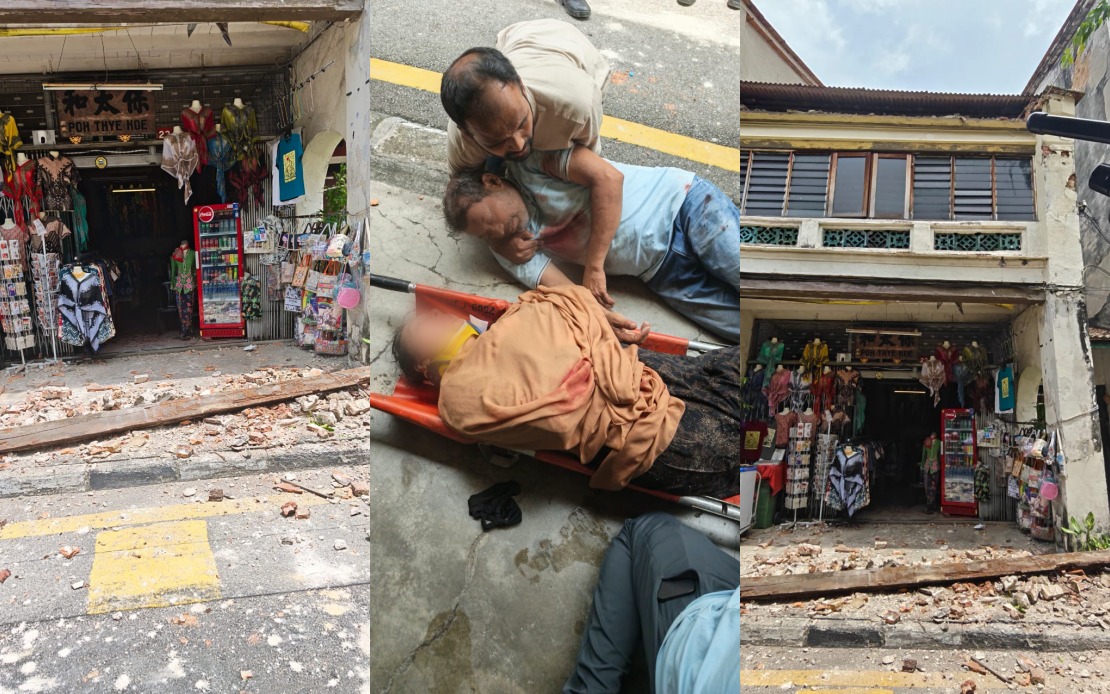
An incident in George Town on August 4 involving the sudden collapse of building materials has raised fresh concerns about the structural integrity of Penang's historic architecture. Two Sri Lankan nationals, Mohamad Ammtar, 66, and Fatimah, 55, sustained injuries when stones and timber from a deteriorating first-floor beam fell upon them as they walked along Armenian Street, one of the city's most visited tourist corridors. The emergency response was swift, with firefighters from the Lebuh Pantai Fire and Rescue Station arriving at the scene after receiving a distress call at 1.11 pm. Personnel from the Health Ministry provided immediate treatment before both tourists were transported to Penang Hospital for further medical evaluation.
According to Penang Fire and Rescue Department assistant director of operations John Sagun Francis, the affected structure operated as a mixed-use building with a grocery shop occupying the ground floor while the upper storeys appeared abandoned. The couple had been scheduled to return to Sri Lanka the following day, meaning the incident occurred near the end of what may now become a memorable though unfortunate visit to Malaysia. The precise circumstances that triggered the collapse remain under investigation, though initial observations point to structural deterioration consistent with an aging building that may not have undergone recent maintenance or safety reviews.
The incident has prompted immediate action from the Penang state government, which recognizes the gravity of allowing heritage buildings to deteriorate to dangerous levels. Wong Hon Wai, chairman of the Penang State Tourism and Creative Economy Committee, visited the scene and subsequently announced that George Town World Heritage Incorporated and the Penang Municipal Council had been tasked with issuing urgent safety advisories to all heritage building owners throughout the state. This directive extends beyond the immediate site of the incident, reflecting official acknowledgment that structural problems may be endemic across Penang's older building stock.
Wong emphasized that the responsibility for maintaining safe heritage structures extends to all property holders, not merely those with buildings already showing obvious signs of distress. He articulated concerns that aging structures pose inherent risks to both residents and the substantial flow of international tourists who visit George Town annually, particularly along heritage walking routes and commercial streets. The incident strikes at a critical intersection of cultural preservation and public safety—values that sometimes create tension when aging buildings require costly repairs or structural interventions that may compromise architectural authenticity.
George Town's status as a UNESCO World Heritage Site has made the city a focal point for regional tourism, attracting visitors seeking to experience authentic colonial architecture and cultural heritage. The presence of international tourists like Mohamad Ammtar and Fatimah underscores the economic importance of maintaining both the physical integrity and the safety reputation of heritage precincts. When accidents occur in such high-profile locations, they generate international attention and can influence travel decisions, making incident management not merely a local safety issue but a matter affecting Penang's tourism competitiveness.
The state government's response has included coordination with the Sri Lankan High Commission in Kuala Lumpur to ensure appropriate diplomatic and humanitarian support reaches the injured tourists. This multilateral approach reflects an understanding that incidents involving foreign nationals require sensitivity and professionalism to preserve relationships and Penang's reputation as a welcoming destination. The provision of immediate assistance signals that authorities take visitor welfare seriously, though such gestures operate as supplements to rather than replacements for systemic improvements in building safety.
The underlying structural issues exposed by this incident likely extend to numerous other heritage buildings across George Town and surrounding areas. Many shophouses and commercial properties in historic districts were constructed a century or more ago according to building standards that would be considered inadequate by contemporary codes. Timber beams, brick structures, and other original materials degrade over decades, particularly in Penang's humid tropical climate where moisture infiltration and biological decomposition accelerate deterioration. Owners of heritage properties often face genuine financial obstacles in undertaking repairs while maintaining architectural compliance, creating situations where maintenance is deferred until emergencies force action.
The Penang government's call for comprehensive safety inspections represents a necessary but potentially resource-intensive undertaking. Assessing the structural condition of dozens or even hundreds of heritage buildings requires qualified engineers and building inspectors, coordination with multiple agencies, and decisions about enforcement timelines and remedial requirements. The process must balance legitimate safety imperatives against the practical and financial constraints facing small business owners who operate from heritage structures, many of whom depend on low rental arrangements that allow them to remain viable in competitive urban markets.
Looking forward, this incident may catalyze broader discussions about heritage preservation funding mechanisms in Malaysia. Several Southeast Asian jurisdictions have established heritage conservation programs that provide subsidized technical assistance and partial funding for repairs to buildings of historical or cultural significance. Such approaches recognize that heritage conservation yields public benefits—tourism revenue, cultural continuity, urban character—that justify public investment alongside private owner responsibility. Penang authorities may consider whether existing programs adequately address the scale of maintenance challenges evident in the aging building stock.
The incident also highlights training and awareness gaps among building occupants and managers regarding structural warning signs. Visible cracks, sagging beams, displaced materials, and other indicators of distress can prompt preventive action if recognized and reported. Public education campaigns targeting heritage building residents and workers, combined with simplified reporting mechanisms for suspected structural problems, could help prevent future accidents by enabling early intervention before critical failures occur.
For Malaysian policymakers and urban planners, the George Town incident offers a cautionary reminder that heritage conservation cannot be treated as purely aesthetic or cultural enterprise divorced from practical maintenance realities. Structures designated for historic preservation must simultaneously function as safe, usable buildings serving contemporary purposes. This requires ongoing inspection protocols, accessible funding mechanisms for repairs, and clear assignment of responsibility between government, owners, and occupants. Without systematic approaches to these challenges, spectacular structures risk becoming liability hazards rather than sources of community pride and economic benefit.

