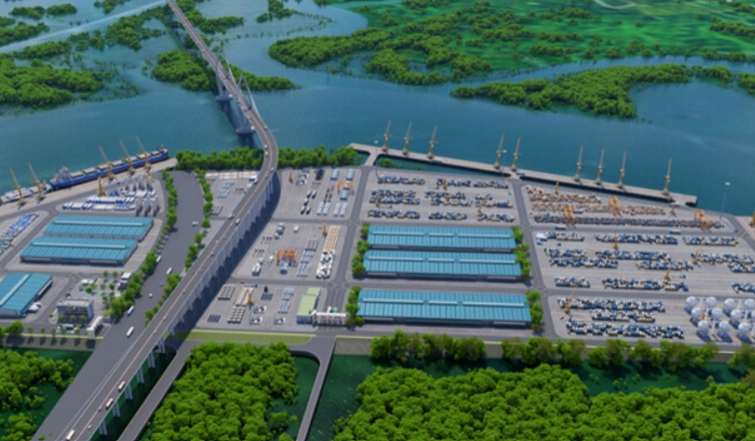
Ho Chi Minh City marked a significant milestone in its infrastructure ambitions on July 5 with the official groundbreaking of the QTM International Port, a US$261 million facility designed to reshape the country's southern maritime logistics landscape. The project represents a strategic response to mounting pressure on existing port infrastructure, particularly following recent municipal reorganisation that has intensified demand for cargo handling and warehousing services across the southern economic corridor.
Situated within the Phu My Ward component of the larger Cai Mep-Thi Vai deep-water port complex, the QTM facility will occupy more than 80 hectares and incorporate integrated warehousing and logistics operations across approximately 200,000 square metres of purpose-built infrastructure. When fully operational, the port will handle an estimated 16 million tonnes of cargo annually, positioning it as a major node in Vietnam's maritime network and supporting the country's growing integration into regional and global supply chains.
The development timeline stretches across two distinct phases, with construction commencing in 2026 and expected completion by 2034. This phased approach allows the port operator to capitalise on initial capacity gains while simultaneously positioning the facility for future expansion. The design specification calls for eight deep-water berths capable of initially accommodating vessels displacing 60,000 deadweight tonnes, with infrastructure engineered to eventually support mega-ships of up to 100,000 DWT—a critical capability given the trajectory of global container shipping toward larger, more efficient vessels.
For Malaysia and other Southeast Asian economies, the expansion holds particular significance as it addresses structural inefficiencies in Vietnam's logistics sector that have affected regional competitiveness. Deputy Prime Minister Pham Gia Tuc underscored this imperative by highlighting that logistics expenditure currently consumes 14 to 16 per cent of Vietnam's gross domestic product, substantially above benchmarks in more developed trading nations. By reducing per-unit transport costs through enhanced port efficiency and capacity, Vietnam aims to improve price competitiveness for exports while attracting additional manufacturing investment to the south.
The timing of this investment reflects tangible demand pressures. During the first half of 2024, HCM City recorded a 7.3 per cent increase in cargo volumes transported via maritime and inland waterway routes, demonstrating the urgency of infrastructure expansion. Hoang Nguyen Dinh, vice chairman of the HCM City People's Committee, characterised the project as essential to developing a modern, integrated network capable of managing regional and international traffic flows at volumes and efficiencies demanded by contemporary supply chains.
The municipal merger referenced by authorities consolidated three localities into a single administrative entity, effectively enlarging HCM City's economic footprint and consolidating demand for goods movement into a single port system. This consolidation creates both challenges and opportunities: while it intensifies immediate pressure on existing infrastructure, it also simplifies corridor planning and allows authorities to engineer solutions that serve a larger, unified market. The result is a port designed not merely for current requirements but calibrated for the region's projected growth trajectory.
For broader Southeast Asian supply chain dynamics, HCM City's expanded capacity carries implications that extend beyond Vietnam's borders. As one of the region's primary container hubs, the port complex provides direct connectivity to Trans-Pacific and European shipping routes, making it a critical transhipment point for goods moving between emerging Southeast Asian economies and developed markets. Enhanced capacity at Cai Mep-Thi Vai may redistribute traffic patterns across the region's port network, particularly benefiting manufacturers in Cambodia, Laos, and interior regions of Thailand seeking efficient maritime access.
The project's emphasis on integrated warehousing and logistics operations reflects contemporary supply chain philosophy that prioritises value-added services beyond simple cargo handling. By embedding distribution, consolidation, and light assembly capabilities within the port precinct, developers aim to create a competitive node that attracts regional businesses seeking efficient, cost-optimised operations for export manufacturing. This aligns with broader trends in Southeast Asia where ports increasingly function as logistics hubs rather than mere transfer points.
The aggressive construction timeline outlined by Deputy Prime Minister Pham carries ambitious expectations, with authorities targeting operation of the first phase within eleven months—a schedule that would require extraordinary coordination and substantial resource commitment. This accelerated approach reflects HCM City's objective of achieving double-digit economic growth and suggests that port capacity constraints are perceived as an immediate impediment to municipal expansion targets. However, such timelines in Vietnam's construction sector have historically proven challenging, suggesting the final operational date may require adjustment as engineering complexities emerge during execution.
HCM City's approximately 110 kilometres of coastline positions it as Vietnam's premier maritime gateway, yet existing port facilities have struggled to accommodate growth in containerised cargo and break-bulk operations. The QTM facility addresses this constraint by introducing purpose-built infrastructure engineered for contemporary vessel characteristics and cargo handling methodologies. When operational, it will function as a critical pressure relief valve for the broader Cai Mep-Thi Vai complex, potentially unlocking additional capacity across the entire port ecosystem.
Regional observers should monitor this project's development as an indicator of Vietnam's commitment to infrastructure modernisation and as a potential catalyst for rebalancing logistics costs across Southeast Asia. Should the facility achieve operational targets, it may establish a new competitive benchmark for port efficiency in the region, pressuring competing hubs in Malaysia, Thailand, and Singapore to accelerate their own capability enhancements. Conversely, construction delays or operational underperformance could signal constraints in Vietnam's project execution capacity that extend beyond maritime infrastructure into broader economic development initiatives.

