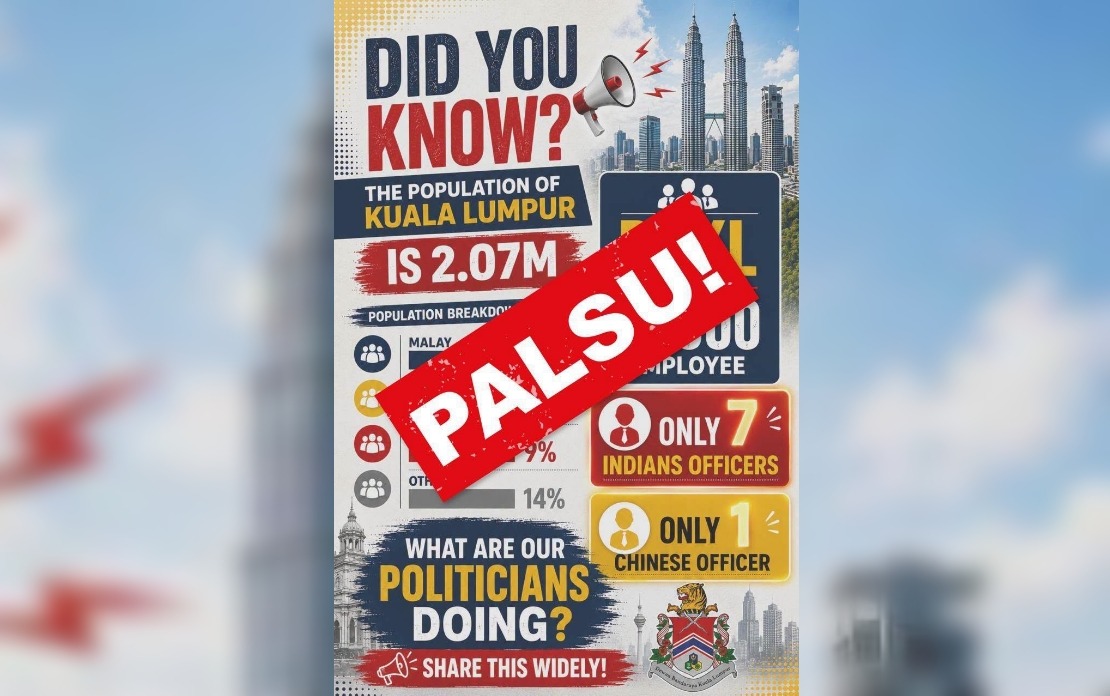
Minister in the Prime Minister's Department (Federal Territories) Hannah Yeoh has moved to counter what she describes as deliberate misinformation targeting Kuala Lumpur City Hall, warning the public against accepting unverified claims about the municipal authority's workforce that have surfaced amid the current election cycle. The minister's intervention comes after a WhatsApp poster began circulating widely, containing assertions that the authority, known locally as DBKL, employed minimal non-Bumiputera staff—specifically claiming only seven Indian and one Chinese employee on its rolls.
Yeoh rejected these figures as entirely inaccurate, publishing corrected data through a Facebook statement that reveals a substantially larger representation than the viral claims suggested. According to official records as of July 1, 2026, DBKL maintains a total workforce of 9,131 employees, among whom 490 identify as Indian and 22 as Chinese. Within the professional and managerial ranks specifically, the authority employs 10 Indian officers and two Chinese officers, further contradicting the narrative presented in the circulating poster. The discrepancy between the false claims and actual employment figures underscores how misinformation can gain traction during politically sensitive periods when divisive messaging holds particular resonance.
The minister's statement carries broader significance within Malaysia's ongoing debate around inclusive representation in the civil service and government-linked agencies. While Yeoh provided reassurance through the release of accurate numbers, she simultaneously acknowledged that room for improvement exists within DBKL's workforce composition. This measured approach—neither dismissing concerns about diversity outright nor accepting false premises—reflects the delicate balance required when addressing questions of racial representation in public institutions. Her willingness to concede that representation could be strengthened demonstrates recognition that underlying concerns about equitable opportunities merit serious consideration, even as the specific claims being circulated are demonstrably false.
Responding to the gap between perception and reality, Yeoh announced that DBKL has been directed to undertake a comprehensive internal audit of its employment practices. This review encompasses recruitment data analysis, examination of hiring methodologies, assessment of promotion pathways, and evaluation of where job opportunities are advertised. The goal, as articulated by the minister, is to identify structural barriers or blind spots that may inadvertently limit the applicant pool or create obstacles for certain candidates. By committing to transparency-based improvements rooted in merit-based selection, Yeoh positioned the authority's response as forward-looking rather than defensive, suggesting genuine commitment to addressing legitimate equity concerns.
The emergence of such misinformation during an election campaign reveals how easily false narratives can exploit genuine sensitivities around representation and opportunity. For Malaysian voters, particularly those in Kuala Lumpur, the circulation of unverified claims about government agencies carries particular weight given ongoing conversations about meritocracy, inclusivity, and fair access to public sector employment. The timing and nature of the false poster—distributed via WhatsApp, a platform where fact-checking rarely occurs before sharing—demonstrate how digital communication channels can amplify divisive content before authorities can respond effectively.
Yeoh's call for all stakeholders to refrain from exploiting workforce composition as a tool for sowing racial discord carries implicit recognition that such issues carry significant potential for polarization. Rather than weaponizing questions of representation, she urged parties to focus instead on correcting false information and addressing any genuine shortcomings through constructive engagement. This framing attempts to reclaim the conversation around diversity and equity from overtly political messaging back toward substantive policy discussion.
For civil society organizations and media observers tracking government accountability, the minister's commitment to reviewing DBKL's recruitment and promotion processes provides a concrete benchmark against which future progress can be measured. Should the authority genuinely implement transparent, merit-based hiring reforms, the case could serve as a model for other federal territory agencies or municipal bodies facing similar questions about workforce composition. Conversely, if implementation remains limited or changes prove superficial, critics will rightfully cite the gap between stated intentions and actual outcomes.
The incident also highlights how election periods intensify both the distribution of misinformation and the political stakes surrounding institutional accountability. Opposition groups and civil society monitors must balance vigilance against genuine inequities with responsibility to verify claims before amplifying them. Similarly, government officials must respond swiftly and comprehensively to false narratives while remaining open to legitimate criticism about representation and access.
Yeoh's emphasis on merit-based, fair, and transparent hiring practices reflects international and domestic standards for professional public service administration. By anchoring DBKL's accountability to these principles, the minister positioned the review not merely as a response to election-time controversy but as alignment with best practices in civil service management. For Malaysian readers accustomed to debates about bumiputera preferences and equal opportunity, the framing offers a potentially unifying framework around which broad consensus might coalesce.
Moving forward, the credibility of Yeoh's commitment will depend on the tangibility and timeliness of reforms implemented at DBKL. Should the authority publish updated hiring data, revised recruitment guidelines, and evidence of increased diversity in subsequent appointment cycles, the response can be assessed as substantive. Transparency in communicating these changes will be essential to rebuilding trust eroded by the initial circulation of misinformation and ensuring that public confidence in DBKL's personnel practices is restored.

