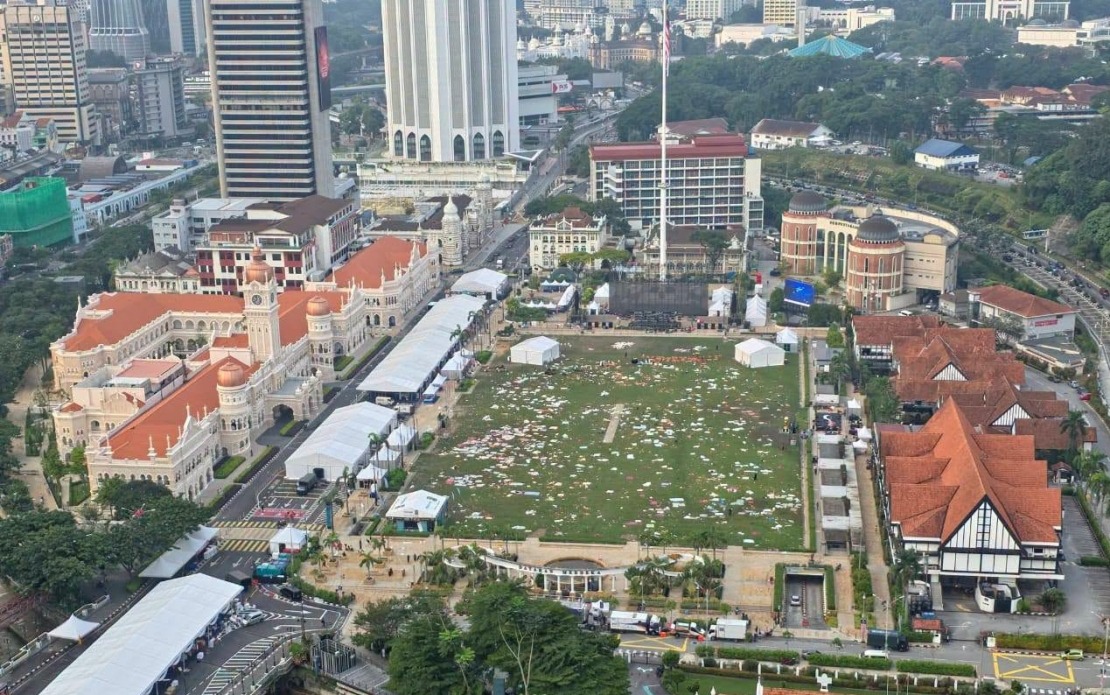
Federal Territories Minister Hannah Yeoh has seized on the littering problem at Dataran Merdeka following last month's public viewing of the 2026 FIFA World Cup final to deliver a broader message about civic responsibility and shared stewardship of national spaces. While publicly commending the dedicated efforts of Kuala Lumpur City Hall workers who cleaned up the venue, Yeoh has reminded Malaysians that maintaining public areas cannot remain the sole preserve of government servants and municipal staff.
The incident at the historic square, which turned into a refuse-strewn site after the screening event, prompted the minister to reflect on what she views as a fundamental disconnect between citizens' expectations of public services and their willingness to contribute personally to maintaining shared spaces. In a Facebook post, Yeoh articulated a philosophy that extends beyond the immediate cleanup operation, positioning proper waste disposal as a non-negotiable aspect of responsible citizenship rather than an optional courtesy.
Yeoh's intervention touches on a persistent challenge in urban Malaysia, where high-profile public gatherings frequently result in substantial cleaning operations that place considerable strain on municipal resources. The Dataran Merdeka incident is merely the latest in a series of similar occurrences at major venues across the Klang Valley, suggesting a pattern rather than an isolated lapse. Her remarks indicate growing frustration among government officials with the expectation that public servants should absorb the consequences of widespread public indifference to waste management.
The minister's framing of this issue within the Malaysia MADANI national aspiration framework represents an attempt to elevate the conversation beyond simple littering prevention. By connecting proper civic behaviour to the broader development philosophy articulated by Prime Minister Datuk Seri Anwar Ibrahim, Yeoh suggests that national progress cannot be measured purely through infrastructure development and economic metrics. Rather, she argues that a truly advanced society must be reflected in the everyday behaviour of its citizens toward shared resources and common spaces.
Yeoh's acknowledgement that DBKL has fulfilled its contractual obligations to maintain the venue is significant, as it preemptively addresses potential criticism that the ministry is deflecting responsibility. However, her central argument posits a distinction between what government must do and what citizens should do—a line she contends has become dangerously blurred in contemporary Malaysia. The implication is that municipal workers are being asked to perform tasks that rightfully belong to individual citizens, effectively subsidising thoughtlessness through their labour.
The invocation of Dataran Merdeka's historical significance as a national monument carrying symbolic weight beyond its function as an event venue adds another dimension to the minister's appeal. By characterising the square as embodying the capital's dignity and forming part of the nation's historical legacy, Yeoh frames littering not merely as a sanitation problem but as a form of disrespect toward national heritage. This rhetorical move attempts to appeal to patriotic sentiment and collective pride in shared monuments.
For Malaysia's municipal administrators and urban planners, Yeoh's public stance provides both validation and a challenge. The validation comes from high-level political acknowledgement that the burden placed on city authorities for cleaning public spaces extends beyond reasonable expectations. The challenge involves developing strategies to enforce individual responsibility without relying entirely on punitive measures that may prove difficult to implement at crowded public events. Several Southeast Asian cities have experimented with social shaming campaigns, deposit-return schemes for event venues, and pre-event education initiatives, though success rates vary considerably.
The minister's comparison between taxpayer rights and civic obligations reflects an evolving conversation about the social contract in Malaysia. While citizens do indeed deserve quality public services in exchange for taxes paid, Yeoh contends that this entitlement does not absolve individuals of basic responsibilities toward maintaining those very services. This tension between rights and duties remains largely unresolved in Malaysian public discourse, where citizens often expect premium services at minimal personal cost or inconvenience.
Implementing cultural change around public space maintenance presents substantial challenges in a multiethnic, multicultural society with varying norms regarding communal responsibility. What constitutes appropriate civic behaviour varies across different communities and generations, requiring nuanced approaches that respect cultural diversity while establishing baseline standards applicable to all. Educational initiatives targeting schools and community organisations could gradually shift attitudes, though visible results would likely require years of sustained effort.
Beyond the immediate context of Dataran Merdeka, Yeoh's remarks carry implications for how Malaysian cities might manage future large public gatherings. Event organisers and venue managers may increasingly be expected to implement waste management systems that make proper disposal convenient and culturally acceptable. Some international best practices involve pre-event briefings, clearly marked disposal stations, volunteer ambassadors, and post-event incentives that reward cleanliness.
The minister's intervention also reflects broader concerns within the Federal Territories administration about resource allocation and municipal efficiency. As Kuala Lumpur continues to host major cultural and sporting events, the cumulative cost of post-event cleanups represents a significant budgetary consideration that competes with other infrastructure priorities. Shifting behavioural norms could release resources currently consumed by remedial cleaning for investment in preventive measures or facility improvements.
Yeoh's appeal to personal responsibility ultimately rests on the assumption that public reminders from high-ranking officials can influence individual behaviour at scale. While such appeals have demonstrated modest effectiveness in some contexts, their impact often proves temporary without reinforcing mechanisms or sustained campaigns. The success of this particular intervention will depend partly on whether other government agencies and community leaders amplify the message consistently across various platforms and settings.
Moving forward, the challenge for Malaysian policymakers involves translating Yeoh's aspirational rhetoric into concrete behavioural change through a combination of education, social reinforcement, practical design improvements, and where necessary, graduated enforcement. The Dataran Merdeka incident offers a teachable moment about collective responsibility that extends far beyond one public square, touching fundamental questions about what Malaysians owe to their shared national spaces and to one another.

